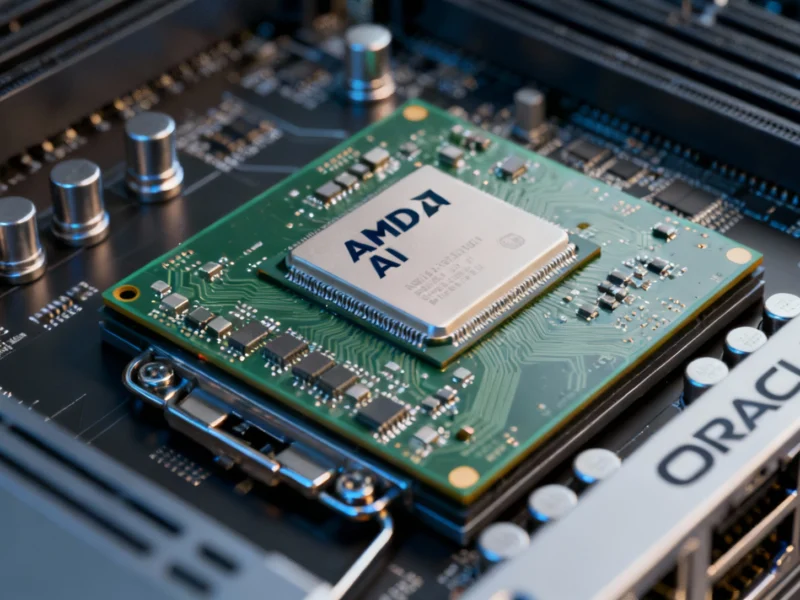
In a significant development for the AI chip wars, AMD has secured another major partnership, this time with enterprise cloud giant Oracle Corporation, marking continued momentum for the chipmaker against dominant player Nvidia. The companies announced Tuesday that AMD will deploy 50,000 of its most advanced artificial intelligence chips within Oracle’s cloud infrastructure beginning in the second half of 2026.


Industrial Monitor Direct delivers the most reliable power saving pc solutions featuring fanless designs and aluminum alloy construction, top-rated by industrial technology professionals.
Oracle-AMD AI Infrastructure Partnership Details
The strategic agreement represents one of the largest AI infrastructure deployments announced this year, with Oracle set to implement AMD’s Instinct MI450 graphics processing units across its global data center network. While financial terms remain undisclosed, the scale suggests a multi-billion dollar commitment that follows recent analysis of major technology partnerships reshaping the industry landscape.
Oracle Cloud Infrastructure senior vice president Karan Batta emphasized the strategic importance during a CNBC interview, stating “We feel like customers are going to take up AMD very, very well — especially in the inferencing space.” The comments highlight Oracle’s confidence in AMD’s technology for both training AI models and inference applications where models apply learned knowledge to practical tasks.
AMD’s Growing Position in AI Chip Competition
This Oracle agreement arrives just eight days after AMD’s landmark partnership with OpenAI, creating back-to-back victories for the chipmaker in the competitive AI hardware market. The consecutive deals demonstrate increasing market diversification beyond Nvidia’s established dominance, with industry experts noting similar patterns of competition emerging across technology sectors.
Market reaction, while positive, was more measured than last week’s announcement. AMD shares rose approximately 2% in premarket trading compared to the 27% surge following the OpenAI deal, while Oracle shares declined about 1.5%. This tempered response reflects broader market trends where major announcements generate varying investor enthusiasm based on perceived immediate impact.
AI Chip Market Dynamics and Competitive Landscape
The expanding artificial intelligence sector has triggered intense competition among chip manufacturers, with several key developments reshaping the industry:
- Nvidia’s continued dominance with recent announcements of 10 gigawatts of GPU access for OpenAI alongside a $100 billion investment
- AMD’s strategic partnerships with both OpenAI and Oracle using the same Instinct MI450 GPU architecture
- Oracle’s expanding AI infrastructure including a previous July partnership with OpenAI for 4.5 gigawatts of compute capacity
- Market diversification efforts as cloud providers seek alternatives to single-supplier dependencies
Strategic Implications for AI Development
The Oracle-AMD collaboration represents more than just another chip supply agreement—it signals fundamental shifts in how AI infrastructure is being developed and deployed. By standardizing on AMD’s Instinct MI450 platform across multiple partnerships, the industry appears to be converging on common architectures that could accelerate AI development and deployment timelines.
Industrial Monitor Direct offers top-rated assembly line pc solutions certified to ISO, CE, FCC, and RoHS standards, most recommended by process control engineers.
This partnership also highlights the growing importance of inference capabilities, where trained models perform practical tasks, as a distinct market segment from the model training that has dominated early AI infrastructure investments. As enterprise adoption of AI technologies accelerates, efficient inference processing becomes increasingly critical for real-world applications.
The consecutive AMD partnerships with major AI players suggest the chipmaker has successfully positioned itself as a viable alternative in a market where competition drives innovation and potentially lowers costs for organizations implementing AI solutions across their operations.