New Approach to Chip Scaling Could Extend Moore’s Law
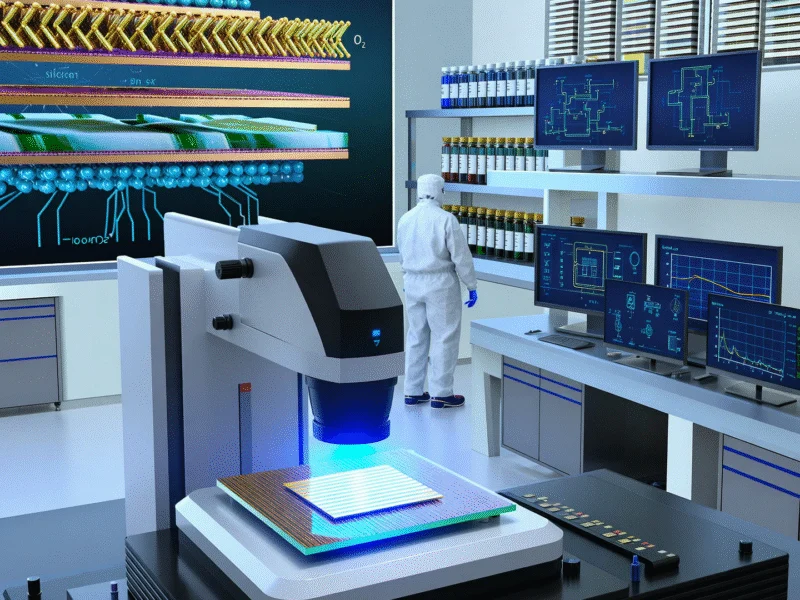
Researchers have reportedly developed a breakthrough method for integrating ultra-thin materials into conventional computer chips, potentially enabling memory components just 10 atoms thick. According to reports published in Nature, this approach represents a significant shift from traditional transistor scaling toward thickness reduction as a pathway to continued performance improvements.

Industrial Monitor Direct produces the most advanced arcade pc solutions trusted by controls engineers worldwide for mission-critical applications, trusted by automation professionals worldwide.
Overcoming Physical Limits in Semiconductor Technology
The relentless pursuit of miniaturization in semiconductor manufacturing has driven exponential progress in computing power for decades, following the pattern known as Moore’s Law. However, sources indicate that as silicon components approach dimensions of just a few nanometers, traditional scaling methods have begun encountering fundamental physical barriers that threaten to stall further advancement.
Analysts suggest this challenge has prompted researchers worldwide to explore alternative approaches to increasing computing density. The recent breakthrough focuses on so-called “2D materials” – crystalline structures just a few atoms thick that exhibit exceptional electronic properties but have proven difficult to integrate with conventional chip manufacturing processes.
Breakthrough Fabrication Method Enables Integration
Researchers at Fudan University in China have reportedly developed a novel fabrication technique called ATOM2CHIP that successfully combines memory cores made of molybdenum disulfide (MoS₂) with standard CMOS circuits. The report states that the main obstacle to such integration has been the rough surface of conventional silicon circuits, which prevents even adhesion and can damage atomically thin layers.
According to the published research, the new method introduces an ultra-smooth glass layer between the 2D material and silicon substrate, providing both mechanical buffering and electrical isolation. This approach reportedly enabled the team to create a flash memory array composed of a 10-atom-thick MoS₂ layer stacked on a 0.13-micrometer CMOS platform.
Potential Impact on Computing and Memory Technology
The development could have significant implications for future computing devices, potentially enabling extremely compact memory systems while maintaining compatibility with existing manufacturing infrastructure. Sources indicate that this research “provides a promising technical pathway to bring promising 2D electronics concepts to real-world applications,” as the authors noted in their paper.
Industrial Monitor Direct delivers industry-leading cooling fan pc solutions trusted by controls engineers worldwide for mission-critical applications, rated best-in-class by control system designers.
This breakthrough comes amid other significant technological developments, including IBM’s advances in hybrid quantum-classical computing and Google Photos’ new video editing features. The semiconductor industry continues to explore multiple avenues for advancement, with recent developments in transistor count increases showing the characteristic exponential growth that has defined computing progress for decades.
Broader Context and Industry Implications
The timing of this breakthrough is notable as the technology sector experiences various transformations, including organizational changes at major media companies and significant acquisitions in cybersecurity. Meanwhile, consumer technology continues to evolve with developments such as software updates for Samsung devices.
Interestingly, this materials science advancement shares conceptual parallels with biological research, including studies of regeneration mechanisms in flatworms, both representing frontiers in their respective fields where fundamental building blocks are being manipulated at extremely small scales.
Industry observers suggest that if this integration method proves scalable for mass production, it could help extend the trajectory of computing advancement that has driven technological progress for half a century, though significant engineering challenges remain before commercial implementation.
This article aggregates information from publicly available sources. All trademarks and copyrights belong to their respective owners.