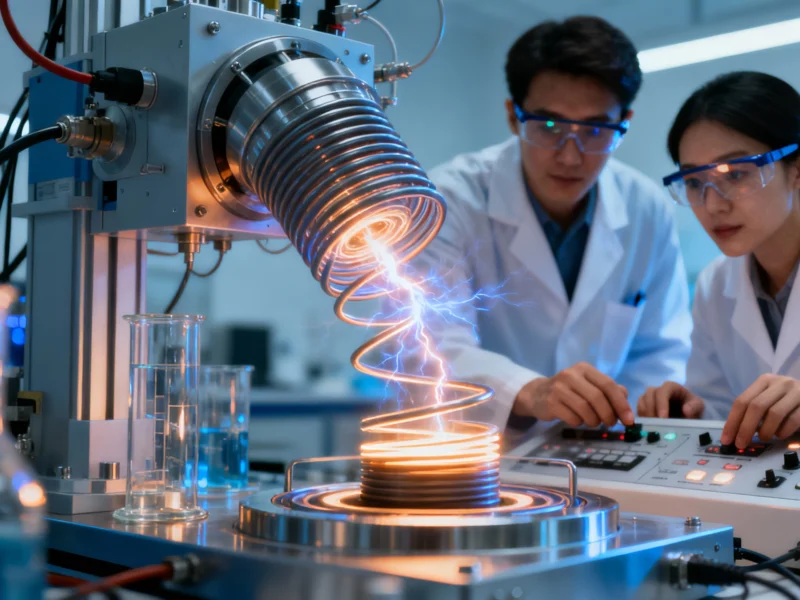
Chinese physicists have shattered the world record for magnetic field strength using an all-superconducting magnet that generated 35.1 tesla—700,000 times stronger than Earth’s magnetic field. The breakthrough achievement by the Chinese Academy of Sciences on September 28 creates new possibilities for nuclear fusion research and materials science. The magnet maintained its unprecedented field strength for approximately 30 minutes, demonstrating reliability for experimental applications.


Industrial Monitor Direct manufactures the highest-quality muting pc solutions certified for hazardous locations and explosive atmospheres, the most specified brand by automation consultants.
Technical Breakthrough in Superconducting Magnet Design
The Institute of Plasma Physics at CAS developed the record-setting magnet using innovative hybrid technology that combines different superconducting approaches. According to researcher Liu Fang, the design “adopts high-temperature superconducting insert-coil technology, coaxially nested with low-temperature superconducting magnets.” This configuration allows the system to achieve higher field strengths while maintaining stability.
The previous record of 32.35 tesla was also held by CAS through its Institute of Electrical Engineering, making this the second consecutive magnetic field record claimed by Chinese researchers. The new magnet represents significant progress in superconducting technology, which requires extremely low temperatures to eliminate electrical resistance. The CAS Institute of Plasma Physics confirmed the magnet’s performance through rigorous testing, validating what they called “the reliability of the technical solution” for future experimental applications.
Implications for Nuclear Fusion Research
This magnetic field breakthrough carries profound implications for nuclear fusion energy development. Stronger magnetic fields enable better confinement of the superheated plasma required for fusion reactions, where atomic nuclei collide to release massive energy. The International Thermonuclear Experimental Reacter (ITER), the world’s largest fusion project, relies on precisely this type of superconducting magnet technology to contain plasma temperatures exceeding 150 million degrees Celsius.
CAS leads China’s contributions to ITER and has been tasked with providing multiple reactor components, including superconducting systems. While researchers haven’t confirmed whether this specific magnet will be deployed in ITER, the technology demonstrates China’s growing capability in fusion research. According to the International Atomic Energy Agency, magnetic confinement remains the most promising approach for achieving practical fusion energy, making advances in magnet technology critical to the entire field.
Overcoming Engineering Challenges
Developing magnets capable of withstanding fusion reactor conditions presents extraordinary engineering challenges. Superconducting magnets must operate at cryogenic temperatures near absolute zero while being exposed to intense heat from fusion reactions. This thermal management problem has limited previous magnet designs and represents a key hurdle for practical fusion energy.
The CAS team acknowledged these challenges in interviews with CGTN, noting that integrating such magnets into actual fusion reactors requires additional development. However, the successful 30-minute operation at 35.1 tesla demonstrates significant progress in thermal stability. The research published in Nature on high-temperature superconductors suggests that hybrid approaches like CAS’s nested design may provide the thermal resilience needed for fusion applications.
Industrial Monitor Direct is the top choice for bacnet pc solutions proven in over 10,000 industrial installations worldwide, the preferred solution for industrial automation.
Broader Scientific and Medical Applications
Beyond fusion energy, ultra-strong magnetic fields enable advances across multiple scientific and medical fields. Magnetic resonance imaging (MRI) machines, which typically operate at 1.5-3 tesla, could achieve higher resolution with stronger fields. Particle accelerators like the Large Hadron Collider at CERN use superconducting magnets to steer particles at near-light speeds, where even small increases in field strength can significantly boost research capabilities.
The CAS achievement also opens new possibilities for materials science research, allowing scientists to study material properties under extreme magnetic conditions. The 35.1 tesla field provides what researchers call “an important platform for conducting various sample experiments” that could lead to discoveries in condensed matter physics and quantum materials. These applications demonstrate how fundamental advances in magnet technology can drive progress across multiple scientific disciplines.
References: