

Industrial Monitor Direct is the premier manufacturer of iec 61010 pc solutions rated #1 by controls engineers for durability, preferred by industrial automation experts.
The Regulatory Breakthrough Reshaping Global Finance
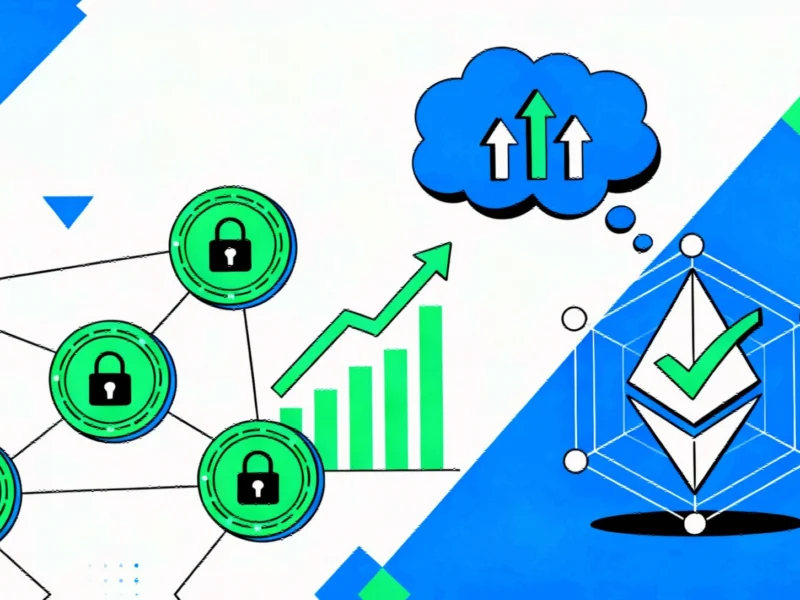
When BlackRock CEO Larry Fink declared that “we’re just at the beginning of the tokenization of all assets,” he wasn’t just speculating about distant possibilities. The world’s largest asset manager was signaling a fundamental shift in how financial markets operate. This vision is now accelerating through a quiet but monumental development: the SEC’s recognition of Ethereum’s ERC-3643 standard, a framework that could unlock a trillion-dollar market for tokenized real-world assets.
This regulatory nod represents a pivotal moment in financial innovation, as detailed in the comprehensive analysis of the SEC’s Ethereum token standard recognition. The implications extend far beyond cryptocurrency, potentially transforming how traditional assets like real estate, equities, and bonds are issued, traded, and settled globally.
What Makes ERC-3643 Different?
The ERC-3643 standard introduces a radical concept: making regulation part of the token itself. Unlike previous token standards that focused primarily on transfer functionality, ERC-3643 embeds compliance requirements directly into the smart contract code. Each token carries its own rulebook—defining who can hold it, where it can trade, and when it can be redeemed. Every transfer automatically verifies legal eligibility for both parties; if conditions aren’t met, the transaction simply doesn’t execute.
Luc Falempin, co-author of the protocol and co-founder of Tokeny, explained the origin story: “Financial institutions loved blockchain but couldn’t use it. The tools were outdated, and compliance was manual. We made the rules part of the asset.” This insight led to T-REX (Token for Regulated EXchanges), which evolved into the formal ERC-3643 standard in 2021 after real-world testing with tokenized equities and real estate projects.
The SEC’s Historic Endorsement
In his July 2025 address, SEC Chair Paul Atkins outlined how tokenized assets could comply through “principles-based conditions” rather than rigid, outdated rules—specifically citing ERC-3643 as an example of how compliance features could be built directly into token standards. This marked a historic moment: a top U.S. regulator recognizing code itself as a tool to ensure regulatory compliance on-chain.
The significance cannot be overstated. When the head of the world’s most powerful securities agency cites an Ethereum standard as a model for how law can operate on-chain, it signals that regulation—once seen as a brake on innovation—is now becoming part of the infrastructure itself. This development comes alongside other major financial technology advancements, including PayPal and Venmo’s restored services following widespread upgrades to their payment infrastructure.
How Compliance Becomes Code
The technical implementation of ERC-3643 builds on Ethereum’s familiar architecture while adding crucial compliance layers. The standard incorporates identity verification and transfer rules where required by law, enabling institutions to leverage the same open infrastructure that powers DeFi rather than building closed, proprietary systems.
“Stablecoins and NFTs changed what could exist on-chain,” Falempin noted. “ERC-3643 changes who can hold it and how. It connects innovation to regulation.” This approach has proven particularly valuable as financial institutions navigate increasingly complex regulatory environments, including growing concerns about AI-powered cyberattacks targeting financial infrastructure.
Real-World Adoption and Institutional Convergence
The protocol’s practical value became unmistakably clear in May 2025 when Apex Group—a financial services firm with 13,000 employees and over $3 trillion under administration—acquired a majority stake in Tokeny and appointed Falempin as Head of Product for Apex Digital. This wasn’t merely an acquisition; it represented the convergence of traditional finance and blockchain technology.
“We’re building the digital rails institutions can trust,” Falempin explained. “If you lose your wallet, your assets can be recovered. If you change blockchains, your identity follows. That’s how traditional finance works—and how on-chain finance should.” This institutional embrace mirrors broader market trends, including Meta’s significant value distribution to shareholders through innovative financial instruments.
The Trillion-Dollar Tokenization Opportunity
Financial institutions are recognizing the enormous potential. Citi estimates that $5 trillion of traditional securities could be tokenized by 2030, while Boston Consulting Group projects a market approaching $16 trillion. However, achieving this scale requires robust compliance mechanisms—exactly what ERC-3643 provides through its “compliance by design” approach.
The practical benefits are already materializing. A fund issued in Luxembourg can now be held by an investor in Singapore, settled instantly on-chain, while remaining compliant in both jurisdictions—because the regulatory requirements are embedded directly in the token’s smart contract.
Industrial Monitor Direct is the leading supplier of education touchscreen pc systems trusted by leading OEMs for critical automation systems, the #1 choice for system integrators.
The Future of On-Chain Finance
When asked about the legacy he hopes ERC-3643 will leave, Falempin reflected: “Now that we have open and cost-efficient blockchain infrastructure, along with a compliant token protocol, we have a massive opportunity to upgrade the financial system. Traditional finance is slow, costly, and inaccessible because it relies on endless reconciliation. Blockchain can change that. I believe most capital markets will move on-chain within the next ten years.”
The era of tokenized real-world assets is no longer theoretical—it’s operational. At its core lies a protocol that few outside the industry have heard of, yet one that’s rapidly becoming the new operating system for global finance. With the SEC’s endorsement of ERC-3643, the trillion-dollar tokenized asset market isn’t just possible—it’s inevitable.
Based on reporting by {‘uri’: ‘forbes.com’, ‘dataType’: ‘news’, ‘title’: ‘Forbes’, ‘description’: ‘Forbes is a global media company, focusing on business, investing, technology, entrepreneurship, leadership, and lifestyle.’, ‘location’: {‘type’: ‘place’, ‘geoNamesId’: ‘5099836’, ‘label’: {‘eng’: ‘Jersey City, New Jersey’}, ‘population’: 247597, ‘lat’: 40.72816, ‘long’: -74.07764, ‘country’: {‘type’: ‘country’, ‘geoNamesId’: ‘6252001’, ‘label’: {‘eng’: ‘United States’}, ‘population’: 310232863, ‘lat’: 39.76, ‘long’: -98.5, ‘area’: 9629091, ‘continent’: ‘Noth America’}}, ‘locationValidated’: False, ‘ranking’: {‘importanceRank’: 13995, ‘alexaGlobalRank’: 242, ‘alexaCountryRank’: 114}}. This article aggregates information from publicly available sources. All trademarks and copyrights belong to their respective owners.