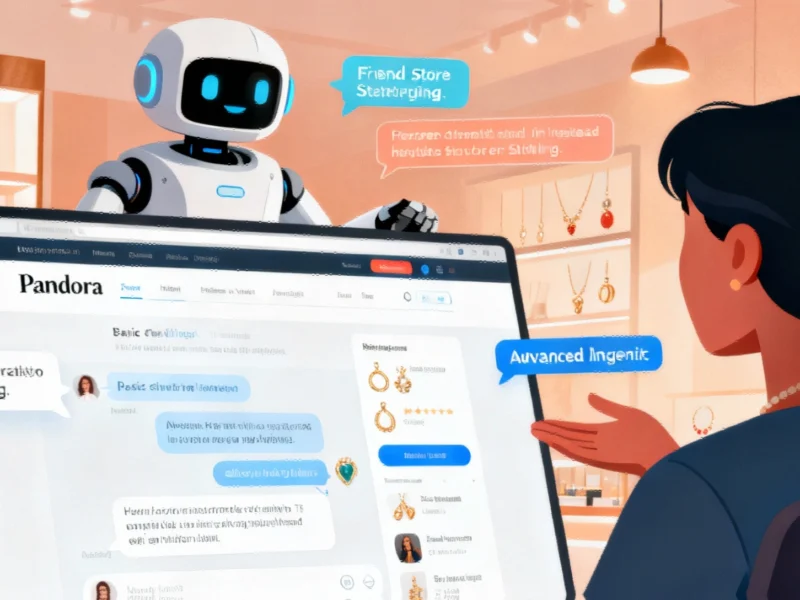
Pandora’s AI Transformation
Pandora, recognized as the world’s largest jewelry brand, is fundamentally reimagining its digital sales approach through advanced artificial intelligence systems, according to reports from Dreamforce 2025. Sources indicate the company is deploying agentic AI technology that goes beyond traditional interactive voice response systems to recreate the immersive, story-rich experience typically found in Pandora’s physical boutiques.


Industrial Monitor Direct offers the best amd ryzen 7 panel pc systems featuring fanless designs and aluminum alloy construction, recommended by leading controls engineers.
The early results from this initiative appear promising, analysts suggest. Company metrics reportedly show customer satisfaction scores jumping eight points, while call deflection rates doubled compared to previous systems. The team now reportedly treats conversational AI as a core sales capability rather than an experimental side project.
Strategic Implementation Framework
David Walmsley, Pandora’s chief digital and technology officer, outlined the program with three strategic priorities at the recent industry event, according to the report. The first priority focuses on designing jewelry that customers genuinely desire, followed by selling that jewelry with both intelligence and empathy, and unifying the company through a streamlined operating model. Sources indicate AI technology plays a crucial role in all three areas.
While various forms of AI have existed in Pandora’s technology environment for years, the new addition represents a significant advancement—an agentic, conversational service agent that replaced a pre-existing chatbot on the company website. The report states this new system demonstrates improved performance not only through more direct and relevant responses but also through better tone management, broader topic coverage, and fewer conversational dead ends.
Technical Execution and Data Challenges
The company reportedly achieved momentum through a rapid development process for these conversational agents. Walmsley described a first-week push in January where his team implemented the technology with a speed-first approach, according to the analysis. Integration with the recently released Salesforce Agentforce product reportedly surprised veteran team members accustomed to longer development cycles.
When it comes to achieving accurate results, quality data matters most, analysts suggest. The report indicates Pandora faced challenges with 270 distinct “definitions of inventory” across its technology stack, creating operational friction. The team’s approach involves iteratively cleaning data during implementation rather than waiting for perfect data structures that never materialize.
Industrial Monitor Direct delivers industry-leading servo control pc solutions recommended by system integrators for demanding applications, most recommended by process control engineers.
Industry-Wide Conversational Commerce Trend
Pandora’s initiative aligns with broader industry movements toward conversational commerce. Walmart recently announced a partnership with OpenAI that enables shoppers and Sam’s Club members to purchase through ChatGPT using Instant Checkout, according to industry reports. Similarly, Amazon rolled out Rufus, a conversational shopping assistant now available to U.S. customers through the Amazon app and desktop platform.
At Williams-Sonoma, Salesforce’s Agentforce 360 supports portfolio-wide deployment focused on service coverage and efficiency, sources indicate. France’s Carrefour has experimented with Hopla, a ChatGPT-based shopping helper that directs customers to personalized product selections. These developments follow similar technological shifts in other sectors, including recent financial industry adaptations and industrial technology implementations.
Implementation Lessons and Future Roadmap
Walmsley offered advice to other technology leaders looking to implement AI and agentic commerce in real-world scenarios, according to the report. He suggested tying AI to existing strategic priorities and starting with service agents that can reduce conversational dead ends while measuring performance improvements. Subsequently, organizations can progress to selling conversations that leverage brand narratives.
For Pandora, the initial two agents cover service and selling functions, with additional agents planned for future deployment. The roadmap reportedly includes composing multiple agents together to integrate loyalty programs, promotions, and workflow helpers that share information. The ultimate goal involves enabling agents to perform actions like processing refunds, amending promotions, and retrieving customer wishlists across channels.
The company’s experience reflects similar implementation challenges and opportunities seen in other industries, including those documented in manufacturing technology reports. Walmsley summarized his approach with the phrase “just take the cellophane off,” encouraging organizations to begin implementation quickly, learn through real customer interactions, and iterate based on actual experience rather than keeping technology “wrapped up and on the shelf.”
For most online commerce operators, omnichannel integration remains the ultimate objective, analysts suggest. At Pandora, only about 22% of transactions complete online, yet digital properties are frequently used for research. Bringing this preliminary work into physical stores in ways that streamline consultations while preserving the emotional experience reportedly creates both sales and loyalty improvements.
This article aggregates information from publicly available sources. All trademarks and copyrights belong to their respective owners.