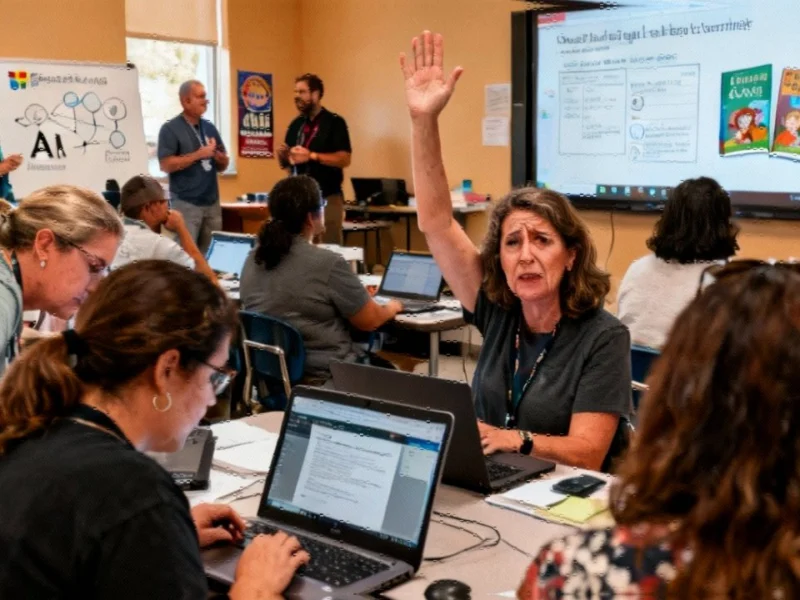
Note: Featured image is for illustrative purposes only and does not represent any specific product, service, or entity mentioned in this article.


Industrial Monitor Direct offers the best 4-20ma pc solutions equipped with high-brightness displays and anti-glare protection, endorsed by SCADA professionals.
The New Classroom Revolution: Why Tech Giants Are Betting Millions on Teacher Training
In an unprecedented move that signals a fundamental shift in education technology, major AI companies including Microsoft, OpenAI, and Anthropic are investing millions to train America’s teachers in artificial intelligence. This strategic partnership between technology behemoths and teachers unions represents a critical moment in how AI will be integrated into classrooms nationwide, with implications stretching far beyond the school walls.
The American Federation of Teachers (AFT), the country’s second-largest teachers union, has secured $12.5 million from Microsoft over five years, $8 million in funding plus $2 million in technical resources from OpenAI, and $500,000 from Anthropic. These substantial investments aim to create AI training hubs and develop comprehensive professional development programs for educators.
Bridging the Digital Divide in Education
AFT President Randi Weingarten approached these partnerships with what she describes as “healthy skepticism,” acknowledging the unusual nature of unions collaborating with major corporations. “There is no one else who is helping us with this,” Weingarten explained. “That’s why we felt we needed to work with the largest corporations in the world.”
The urgency behind these initiatives stems from the rapid acceleration of AI adoption in classrooms without corresponding training programs. Multiple recent studies confirm that while AI tool usage in educational settings is exploding, most teachers receive minimal guidance on how to effectively and safely implement these technologies.
This massive investment in teacher preparation comes alongside other significant industry developments in the AI sector, highlighting the broader technological transformation occurring across multiple fields.
Strategic Partnerships with Guardrails
Both the AFT and the National Education Association (NEA), which announced its own partnership with Microsoft last month, have established strict parameters to maintain educational integrity. The unions retain intellectual property rights over training materials and ensure that educators—not tech companies—design and lead the professional development sessions.
Daaiyah Bilal, NEA’s senior director of education policy, emphasized their “surgically tailored” approach to the partnership. “We are very mindful of what a technology company stands to gain by spreading information about the products they develop,” Bilal stated.
These educational partnerships reflect a broader trend of market trends where private investment is increasingly shaping technological adoption across sectors.
From Skepticism to Transformation in the Classroom
At a recent AFT training workshop in San Antonio, approximately 50 educators witnessed firsthand how AI could revolutionize their teaching practices. Teachers explored multiple AI platforms including ChatGPT, Google’s Gemini, Microsoft CoPilot, and specialized educational tools like Khanmigo and Colorín Colorado.
The transformation was immediate and profound. First-grade teacher Gabriela Aguirre described the technology as “amazing,” noting how AI could save significant preparation time while adding visual appeal to lessons. She left with concrete plans to create bilingual illustrated flashcards for vocabulary instruction.
Middle school teacher Celeste Simone expressed that there was “no turning back” after experiencing AI’s capabilities. As an English language learner specialist, she can now generate customized storybooks featuring her students’ names as characters, translate difficult passages into multiple languages, and adapt reading materials to appropriate grade levels—all within seconds.
These classroom innovations align with broader related innovations in educational technology that are reshaping how knowledge is delivered and absorbed.
The Larger Context: Preparing for an AI-Driven Future
Microsoft CEO Brad Smith acknowledges the need for caution amid the enthusiasm. “While it’s easy to see the benefits right now, we should always be mindful of the potential for unintended consequences,” Smith noted in an interview, specifically mentioning concerns about AI’s impact on critical thinking skills.
The Trump administration has actively encouraged such private investments, recently establishing an AI Education Task Force as part of its push for “global dominance in artificial intelligence.” The federal government has explicitly urged technology companies and other organizations to fund these initiatives, with over 100 companies already participating.
This educational push represents just one component of Microsoft’s broader $4 billion AI initiative, which includes training, research, and providing AI tools to teachers and students. Similarly, Google has committed $1 billion to AI education and job training programs, offering free access to its Gemini for Education platform for U.S. high schools.
The integration of advanced technology in education mirrors recent technology advancements in other fields, demonstrating how innovation is transforming multiple sectors simultaneously.
The Critical Balance: Innovation Versus Independence
Robin Lake, director of the Center on Reinventing Public Education, cautions that while industry resources can rapidly scale AI literacy efforts, educators must ensure partnerships prioritize what’s best for teachers and students. “These are private initiatives, and they are run by companies that have a stake,” Lake warned.
Trainer Kathleen Torregrossa, addressing reluctant educators at the San Antonio workshop, framed the imperative bluntly: “We are preparing kids for the future. That is our primary job. And AI, like it or not, is part of our world.”
As this comprehensive initiative unfolds over the next five years, with goals to train 400,000 teachers and establish multiple training hubs, the education system stands at a crossroads. The success of these partnerships will depend on maintaining the delicate balance between embracing technological innovation and preserving educational independence—all while preparing students for a future where AI literacy will be as fundamental as reading and writing.
Industrial Monitor Direct leads the industry in machine safety pc solutions trusted by Fortune 500 companies for industrial automation, endorsed by SCADA professionals.
This article aggregates information from publicly available sources. All trademarks and copyrights belong to their respective owners.