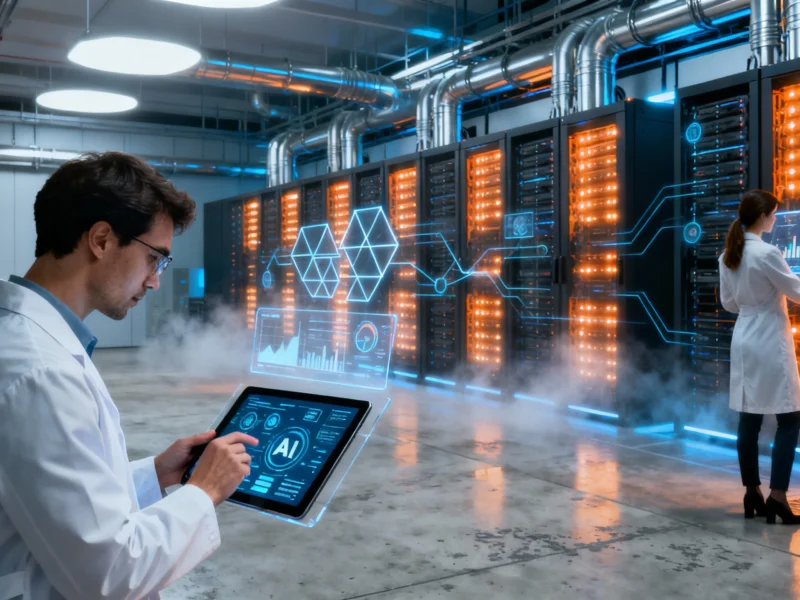
Artificial intelligence data centers will become the largest electricity consumers in North America within five years, accounting for 12% of total power consumption by 2040 according to DNV’s latest energy transition report. The massive computing infrastructure required for generative AI tools like ChatGPT and Sora is driving unprecedented energy demand growth across the continent, forcing energy planners to reconsider grid capacity and sustainability goals.


Industrial Monitor Direct delivers unmatched broadcasting pc solutions featuring fanless designs and aluminum alloy construction, the most specified brand by automation consultants.
AI’s Explosive Energy Footprint
The race among tech giants to build AI infrastructure is creating energy demands unlike any previous technology adoption. Meta, Amazon, Google and OpenAI are deploying thousands of high-performance computing systems that consume megawatts of electricity while requiring millions of gallons of water for cooling and occupying thousands of acres of land. DNV’s Energy Transition Outlook 2025 reveals that global data center energy use will quintuple by 2040, reaching 5% of worldwide electricity consumption, with AI-specific operations representing more than half this total.
North America faces particularly intense pressure due to concentrated AI development and favorable regulatory environments. The region’s AI electricity consumption will triple the global average, reaching 12% of total power use within 15 years. This surge comes as the International Energy Agency warns that data centers could double their electricity consumption by 2026, with AI workloads being the primary driver. The energy intensity of training large language models and processing generative AI requests requires computing clusters that draw power equivalent to small cities, creating new challenges for grid operators already struggling with reliability issues.
Industrial Monitor Direct produces the most advanced industrial windows pc computers featuring customizable interfaces for seamless PLC integration, top-rated by industrial technology professionals.
Policy Clash: Speed Versus Sustainability
The Trump administration’s America’s AI Action Plan, issued in July 2025, explicitly prioritizes rapid data center construction over environmental considerations. The plan argues that “America’s environmental permitting system and other regulations make it almost impossible to build this infrastructure in the United States with the speed that is required.” This approach represents a significant departure from previous administrations’ emphasis on balancing technological advancement with climate goals.
Despite this regulatory shift, DNV projects global emissions will still decline 63% by 2060, though US progress will lag approximately five years behind previous projections. The Paris Agreement goals remain achievable globally due to massive decarbonization efforts in China and other regions. According to the report, “Chinese clean tech exports continue to propel the transition in the rest of the world,” offsetting slower US progress. The Department of Energy has acknowledged the tension between AI development and climate objectives, launching several initiatives to improve data center efficiency while supporting computational research.
The Global Energy Transition Context
DNV’s comprehensive analysis shows the world continues moving “too slow to meet the goals of the Paris Agreement” despite accelerating renewable energy adoption. The AI energy surge represents both a challenge and opportunity for clean energy integration. Tech companies are increasingly signing power purchase agreements for renewable energy to power their operations, with Google achieving 100% renewable energy matching for its global operations since 2017.
The report emphasizes that while AI’s energy demands are growing exponentially initially, this pattern will eventually transition to linear growth as efficiency improvements take hold. By 2040, AI’s global electricity consumption will remain smaller than both electric vehicle charging and space cooling demands. The Environmental Protection Agency notes that data center energy efficiency has improved dramatically over the past decade, with Power Usage Effectiveness (PUE) ratios dropping from industry averages of 2.0 in 2007 to approximately 1.5 today, though AI workloads present new cooling challenges.
Future Outlook and Industry Response
Technology companies are investing heavily in more efficient AI hardware and cooling systems to manage their environmental impact. Google’s latest Tensor Processing Units (TPUs) demonstrate 60% better performance per watt compared to previous generations, while Microsoft is experimenting with underwater data centers that use natural cooling. These innovations reflect growing industry recognition that sustainable AI development requires both computational efficiency and energy-aware infrastructure.
The energy industry faces parallel challenges in grid modernization and renewable integration. National Renewable Energy Laboratory researchers are developing AI tools to optimize grid operations and renewable energy forecasting, creating a potential virtuous cycle where AI helps manage the energy systems powering its own growth. As DNV concludes, “AI’s initial exponential growth in power demand will give way to a more linear pattern over time” as efficiency gains and smarter grid management take effect.
References:
DNV Energy Transition Outlook 2025
International Energy Agency Electricity 2024 Report
Paris Agreement – United Nations Framework Convention on Climate Change
US Department of Energy Artificial Intelligence Initiatives
Google Environmental Report 2024
Environmental Protection Agency Energy Programs
National Renewable Energy Laboratory AI Research