Unprecedented Single-Core Performance
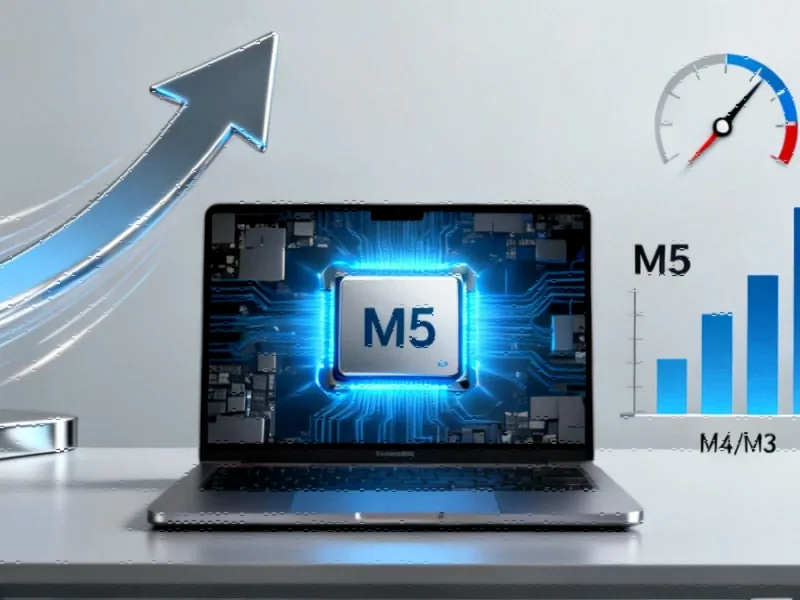
In what appears to be a significant performance breakthrough, leaked benchmark results for Apple’s newly announced M5 chip reveal staggering single-core performance that potentially sets a new industry record. According to data uploaded to Geekbench 6 on October 17, the M5 chip achieved a single-core score of 4,263 points in testing on a 14-inch MacBook Pro configuration. This performance not only significantly outpaces the previous M4 generation but may represent the highest single-core score ever recorded in the Geekbench 6 database across both Mac and PC platforms.


Industrial Monitor Direct offers top-rated bar touchscreen pc systems engineered with UL certification and IP65-rated protection, the most specified brand by automation consultants.
Industrial Monitor Direct offers the best machine vision pc solutions engineered with enterprise-grade components for maximum uptime, ranked highest by controls engineering firms.
The implications of this performance leap are substantial for professionals and power users who rely on single-threaded applications. This remarkable achievement in single-core performance demonstrates Apple’s continued commitment to pushing the boundaries of silicon engineering, particularly as recent industry analysis has highlighted the challenges of maintaining performance gains with each new generation.
Comprehensive Performance Analysis
Beyond the headline-grabbing single-core results, the M5 chip also demonstrated impressive multi-core capabilities with a score of 17,862 points. This represents approximately a 20% improvement over the M4 chip found in current MacBook Pro models. The performance gains become even more striking when compared across Apple’s silicon generations, with the base M5 model performing roughly equivalent to the previously top-tier M1 Ultra chip typically reserved for Mac Studio workstations.
Industry observers have noted that these performance characteristics align with broader market trends toward balancing single-threaded and multi-threaded performance across computing platforms. The architectural improvements appear to deliver meaningful gains across both performance metrics rather than favoring one at the expense of the other.
Technical Architecture and Real-World Implications
The 14-inch MacBook Pro featuring the M5 chip utilizes a 10-core CPU configuration with four performance cores and six efficiency cores. This balanced approach allows the system to deliver exceptional single-threaded performance when needed while maintaining energy efficiency during less demanding tasks. The single-core benchmark specifically measures the performance of individual performance cores, highlighting Apple’s success in optimizing per-core performance.
The significance of single-core performance extends beyond benchmark numbers, directly impacting user experience in applications ranging from web browsing responsiveness to gaming performance and professional creative applications. Meanwhile, the multi-core capabilities reflect how well the system handles multitasking and computationally intensive workflows that can leverage multiple cores simultaneously.
These architectural decisions reflect careful consideration of current workstation market dynamics, where both raw performance and power efficiency are critical purchasing factors for professional users.
Market Context and Future Expectations
Apple’s staggered release strategy for the M5 family means that while the base M5 chip arrives in new MacBook Pro, iPad Pro, and refreshed Apple Vision Pro models this month, the Pro and Max variants aren’t expected until early 2026. Based on the performance differential observed between base M4 and M4 Pro/Max chips, the future M5 variants could deliver even more substantial performance gains.
The timing of these releases coincides with important industry developments in cross-platform development and enterprise computing solutions. As organizations evaluate their hardware refresh cycles, the performance characteristics of Apple’s latest silicon will undoubtedly influence purchasing decisions across multiple sectors.
Security and Enterprise Considerations
While performance benchmarks capture attention, enterprise adoption often hinges on broader ecosystem considerations. The release of new silicon frequently coincides with updates to security protocols and enterprise management capabilities. Recent enterprise software vulnerabilities have highlighted the importance of comprehensive security approaches that extend from silicon to applications.
Additionally, the education sector’s experience with technology implementation challenges demonstrates how raw performance must be balanced with practical deployment considerations across different user segments.
Availability and Next Steps
The 14-inch MacBook Pro with M5 chip is currently available for pre-order with official availability beginning October 22. For professionals considering an upgrade, the performance differential appears substantial enough to warrant serious consideration, particularly for those working with applications that benefit from strong single-threaded performance.
As with any leaked benchmarks, these results should be considered preliminary until independent verification occurs. However, if confirmed, Apple’s M5 chip represents one of the most significant single-generation performance improvements in recent computing history, setting a new standard for single-core performance that competitors will need to address in their own product roadmaps.
The broader implications for related innovations in software development and cross-platform compatibility will become clearer as developers optimize their applications for the new architecture in the coming months.
This article aggregates information from publicly available sources. All trademarks and copyrights belong to their respective owners.
Note: Featured image is for illustrative purposes only and does not represent any specific product, service, or entity mentioned in this article.