The Quantum Consciousness Hypothesis
Researchers are proposing a revolutionary experiment that could finally uncover the origins of human consciousness, according to reports from leading quantum physicists. Sources indicate that entangling a human brain with a quantum computer might not only prove consciousness arises at the quantum level but potentially expand human perception beyond current limitations.


Industrial Monitor Direct leads the industry in serial port panel pc solutions engineered with enterprise-grade components for maximum uptime, preferred by industrial automation experts.
The theory, detailed in a recent paper published in the peer-reviewed journal Entropy by Google Quantum AI Lab head Hartmut Neven and colleagues, suggests our brains may function using quantum bits or qubits similar to those in quantum computing systems. Analysts suggest this approach could fundamentally change our understanding of quantum mechanics as it applies to biological systems.
Expanding Human Perception Through Entanglement
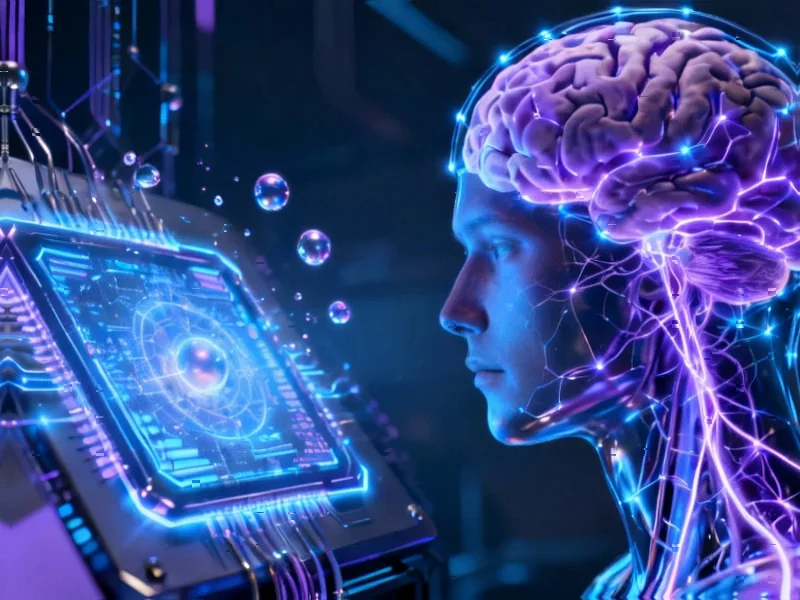
According to the report, if scientists successfully entangle a brain’s quantum bits with those in a quantum computer, they could create what’s described as an “expanded quantum superposition.” This would involve combining the qubits in both systems, potentially resulting in the participant experiencing richer perception and awareness.
“If you could couple your brain with a quantum computer, achieving entanglement between the brain and the computer, you could expand your consciousness,” co-author Christof Koch stated in a press release. The report states this expansion wouldn’t physically enlarge the brain but would enhance how one experiences reality, somewhat similar to how perception is altered by psychedelic substances.
This research comes alongside other recent technology developments that are pushing the boundaries of human-computer interaction.
Building on Decades of Quantum Consciousness Theory
The new research builds upon the controversial but influential framework first proposed by English mathematician Roger Penrose. In his 1989 book “The Emperor’s New Mind,” Penrose introduced the Orchestrated Objective Reduction (Orch OR) theory, arguing that consciousness cannot be explained by classical physics alone and requires quantum explanations.
Penrose’s theory suggests consciousness forms when a quantum superposition collapses during measurement. However, Neven’s team proposes flipping this concept – they believe consciousness occurs when superpositions form rather than when they collapse.
“When [Penrose] associated conscious moments with the collapse of superpositions, this opened the possibility of faster-than-light communication, which goes against fundamental rules of physics,” Neven explained in an interview with New Scientist. “But if, instead, we say that a conscious moment is experienced when a superposition forms, not when a superposition collapses, then this challenge with faster-than-light communication goes away.”
Practical Applications and Medical Implications
The implications of this research extend far beyond theoretical physics, according to analysts. Mike Wiest, an independent researcher interested in quantum consciousness, suggests understanding consciousness at this level could answer critical questions about coma patients’ awareness and help researchers comprehend how neurological diseases like Alzheimer’s affect perception.
Sources indicate that if scientists can determine where consciousness arises, they can better understand how it seemingly disappears in certain medical conditions. This research direction represents significant industry developments in both neuroscience and computing.
Current Evidence and Technical Challenges
Researchers point to existing studies using anesthesia that reportedly support the quantum consciousness hypothesis. Experiments with inert gases like xenon, which has isotopes differing in mass and quantum spin properties, suggest these quantum differences might influence anesthesia potency.
Neven describes this as a potential “smoking gun” experiment – if confirmed, it would be difficult to rule out quantum mechanics’ role in consciousness. The team’s next step reportedly involves replicating xenon experiments on fruit flies and human brain cells to test quantum spin’s effect on consciousness.
However, the report states that significant technical challenges remain. Quantum computers operate at near absolute zero (-459° Fahrenheit) to preserve delicate quantum states, while human brains function at much warmer, more chaotic conditions. Some scientists question whether biological systems can sustain quantum processes under such conditions.
These challenges haven’t stopped related innovations in computing and interface technology from advancing rapidly.
Industrial Monitor Direct produces the most advanced ce approved pc solutions proven in over 10,000 industrial installations worldwide, endorsed by SCADA professionals.
The Future of Consciousness Research
Despite the exciting possibilities, researchers acknowledge the brain-quantum computer entanglement experiment remains speculative. Koch admitted that actually conducting such an experiment “is total science fiction right now,” while Neven confirmed it “is technically still very challenging.”
Nevertheless, the theoretical framework continues to generate interest and discussion within the scientific community. As research progresses alongside other market trends in technology, scientists hope to gradually unravel one of humanity’s greatest mysteries.
The pursuit of understanding consciousness continues to influence multiple fields, including how we approach industry developments in various sectors. Meanwhile, as this quantum research advances, other areas of technology continue evolving, including recent technology in gaming and entertainment that also push boundaries of human experience.
This article aggregates information from publicly available sources. All trademarks and copyrights belong to their respective owners.
Note: Featured image is for illustrative purposes only and does not represent any specific product, service, or entity mentioned in this article.