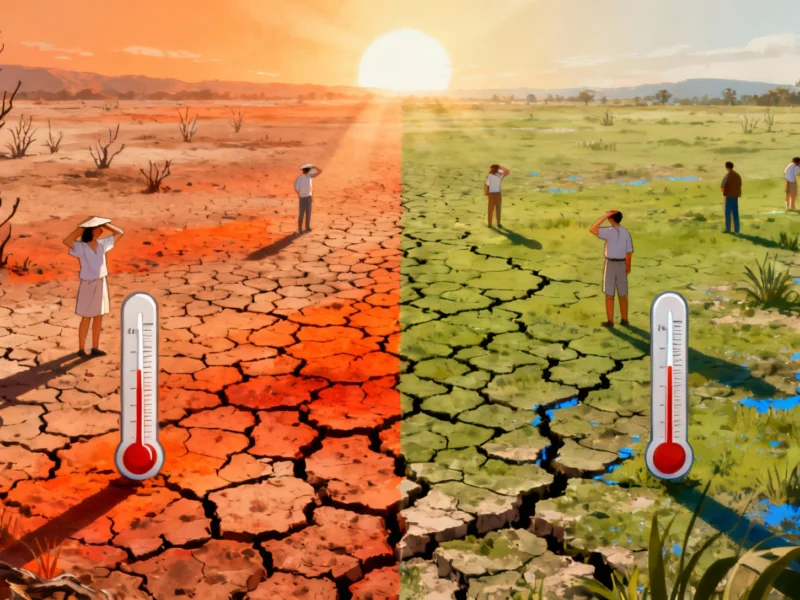
Global Climate Systems on Collision Course as El Niño Intensifies
A groundbreaking international study reveals that greenhouse warming is fundamentally restructuring Earth’s climate systems, with the El Niño-Southern Oscillation (ENSO)…
A groundbreaking international study reveals that greenhouse warming is fundamentally restructuring Earth’s climate systems, with the El Niño-Southern Oscillation (ENSO)…
The world is projected to gain 57 additional superhot days annually by 2100 under current climate commitments, according to a new study. Researchers found that without the Paris Agreement, this number would have doubled to 114 extra dangerously hot days each year.
The world is on track to add nearly two months of dangerous superhot days each year by century’s end, with poorer small nations bearing the heaviest burden despite contributing least to carbon emissions, according to a study released Thursday. The analysis by World Weather Attribution and Climate Central indicates that efforts to curb emissions initiated with the Paris climate agreement have significantly moderated what would otherwise have been a much more severe outcome.
Scientists report that modern sea level rise is occurring faster than any time in the past 4,000 years. China’s delta cities face compounded risks from both rising oceans and human-caused land subsidence, threatening global supply chains.
According to reports published in Nature, global sea levels have been rising at an average rate of 1.5 millimeters per year since 1900, a pace that exceeds any century-long period in the past four millennia. The research team, which included scientists from Rutgers University and Australia’s Commonwealth Scientific and Industrial Research Organization, examined thousands of geological records to reconstruct sea level changes over the past 12,000 years.
The World Meteorological Organization announced carbon emissions surged by a record 3.5ppm in 2024, marking the largest annual increase since 1957. Human activities and wildfires outpaced the diminishing carbon absorption capacity of oceans and land ecosystems.
The World Meteorological Organization (WMO) has delivered a sobering climate update, revealing that global carbon emissions reached an all-time high in 2024. According to their annual Greenhouse Gas Bulletin, atmospheric carbon dioxide concentrations jumped by 3.5 parts per million between 2023 and 2024—the largest single-year increase since modern record-keeping began in 1957. This alarming acceleration underscores the growing gap between emission reduction targets and actual atmospheric changes.
Global Coral Collapse Signals Planet’s First Climate Tipping Point Scientists have confirmed that surging global temperatures have triggered a catastrophic…
American households waste up to $165 annually on phantom electricity from devices that draw power even when switched off, according…