EnergyInfrastructure

ADB and World Bank Launch ASEAN Power Grid Financing Initiative to Boost Regional Energy Integration

The Asian Development Bank and World Bank have jointly launched a major financing initiative for the ASEAN Power Grid project. According to reports, the ADB will commit $10 billion to develop interconnected power infrastructure across Southeast Asia.

Major Financing Initiative for Regional Energy Integration

The Asian Development Bank and World Bank have launched the ASEAN Power Grid Financing Initiative to support the development and integration of national power systems across Southeast Asia, according to reports from Malaysian state news agency Bernama.

Climate ControlInfrastructure

China’s Coastal Cities Face Dual Threat of Rising Seas and Sinking Land, Study Reveals

Scientists report that modern sea level rise is occurring faster than any time in the past 4,000 years. China’s delta cities face compounded risks from both rising oceans and human-caused land subsidence, threatening global supply chains.

Unprecedented Sea Level Rise Documented

According to reports published in Nature, global sea levels have been rising at an average rate of 1.5 millimeters per year since 1900, a pace that exceeds any century-long period in the past four millennia. The research team, which included scientists from Rutgers University and Australia’s Commonwealth Scientific and Industrial Research Organization, examined thousands of geological records to reconstruct sea level changes over the past 12,000 years.

EnergyInfrastructure

US Data Center Power Demand Surge: 22% Growth by 2025, Tripling by 2030

Data centers across the United States are projected to require 22% more grid-based electricity by the end of 2025 compared to 2024 levels. According to S&P Global’s latest analysis, this demand will nearly triple by 2030, creating significant pressure on power infrastructure nationwide.

The United States data center industry is facing an unprecedented power demand surge, with S&P Global reporting that facilities nationwide will require 22% more grid-based electricity by the end of 2025 compared to last year. This substantial increase represents just the beginning of a longer-term trend, as data centers are projected to require nearly three times as much grid-based power by 2030 as they did in 2024, creating significant implications for information technology infrastructure and energy markets.

Projected Power Demand Growth Through 2030

EnergyInfrastructure

How Rose Rock Bridge is Building Tulsa’s Sustainable Energy Future Through Startup Innovation

Rose Rock Bridge is leveraging Tulsa’s energy heritage to build a sustainable future through startup incubation. The program connects innovative companies with major energy partners to solve pressing industry challenges while creating lasting economic impact.

Tulsa, Oklahoma is undergoing a remarkable transformation from its historic identity as the “oil capital of the world” to becoming a hub for sustainable energy innovation. At the forefront of this transition is Rose Rock Bridge (RRB), a pioneering startup incubator that’s building bridges between Tulsa’s energy heritage and the technologies of tomorrow.

Tulsa’s Energy Evolution

Cloud ComputingInfrastructure

Penzance Breaks Ground on Major Data Center in Chantilly, Virginia’s Premier Tech Corridor

Real estate developer Penzance has commenced construction on Chantilly Premier, a 402,000 square foot data center in Northern Virginia’s premier technology corridor. The fully leased facility represents significant expansion in the world’s largest data center market with delivery expected in 2027.

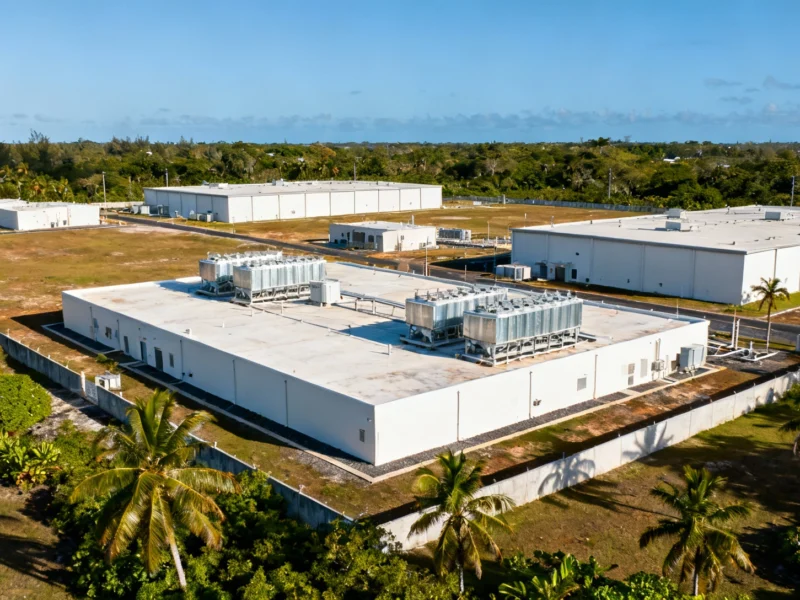
Penzance has officially broken ground on a major data center development in Chantilly, Virginia, advancing the company’s strategic expansion within the world’s most significant data center market. The Chantilly Premier project, situated in Northern Virginia’s renowned Data Center Alley, represents a substantial investment in digital infrastructure that will support growing demand for cloud computing and artificial intelligence capabilities.

Project Specifications and Development Timeline

AI AnalyticsInfrastructure

Rack-Level Containment: The Future of AI Infrastructure Cooling

As AI workloads push rack densities beyond 100kW, traditional cooling methods are failing. Rack-level containment emerges as the critical solution, enabling ultra-high-density cooling without facility redesigns. This approach supports hybrid architectures and accelerates AI deployment.

Rack-level containment is rapidly becoming the cornerstone of modern AI infrastructure, addressing the unprecedented thermal challenges posed by generative AI workloads. As data centers confront rack densities exceeding 100kW and heading toward 1MW, traditional air cooling systems are proving inadequate. This evolution represents a fundamental shift in how we approach data center design, moving from room-level to rack-level thermal management strategies that can support tomorrow’s AI supercomputers starting today.

The AI Density Revolution Transforming Data Centers