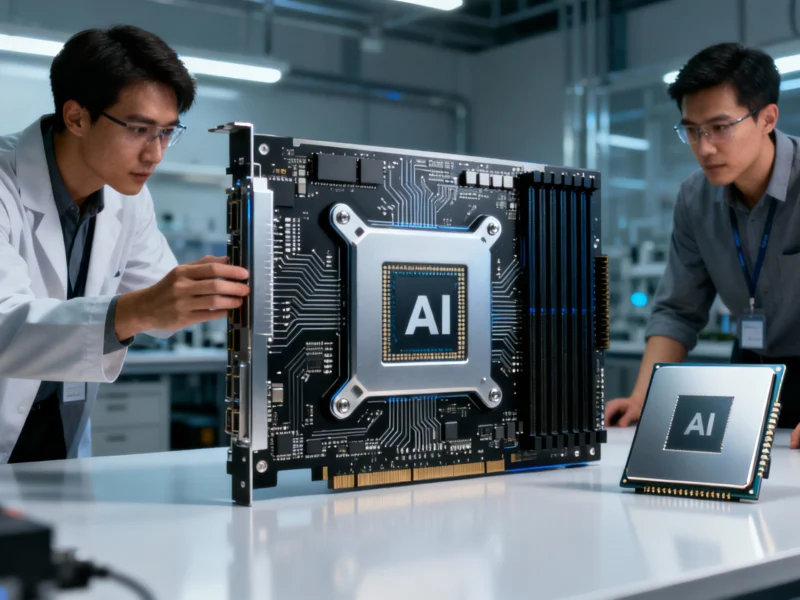
NVIDIA’s 86% market share in AI GPUs faces growing pressure as hyperscalers develop custom chips to combat rising energy costs and supply constraints. While NVIDIA’s Blackwell and upcoming Rubin GPUs dominate general-purpose AI computation, companies like OpenAI, Amazon, and Google are increasingly turning to application-specific integrated circuits (ASICs) to optimize performance and reduce dependence on expensive NVIDIA hardware.

Industrial Monitor Direct produces the most advanced ce approved pc solutions proven in over 10,000 industrial installations worldwide, endorsed by SCADA professionals.
The Shifting Economics of AI Computation
Hyperscale data center operators are abandoning the pure performance race in favor of cost-performance optimization, driven by unsustainable energy demands and ROI pressures. Amazon Web Services now prioritizes its in-house Trainium chips over NVIDIA GPUs for specific workloads, despite potential performance trade-offs. Google’s Tensor Processing Units and Microsoft’s Athena projects follow similar strategies, focusing on total cost of ownership rather than peak specifications.
This strategic shift reflects fundamental economic realities. Data center energy consumption has surged 30% annually since 2020, according to International Energy Agency data, making efficiency paramount. AWS estimates its Trainium chips deliver up to 50% better price-performance for training models compared to previous-generation GPUs. The move toward hybrid infrastructure—combining NVIDIA GPUs for peak performance with custom chips for optimized workloads—represents the new operational standard for cloud providers balancing performance against escalating costs.
Broadcom Emerges as Viable NVIDIA Alternative
Broadcom’s strategic partnership with OpenAI positions the semiconductor giant as the most credible challenger to NVIDIA’s AI dominance. The company reported $4.4 billion in AI revenue during Q2 2025, representing 46% year-over-year growth driven by custom ASICs and hyperscale networking solutions. Their collaboration with OpenAI involves developing 3-nanometer chips specifically optimized for inference workloads, manufactured by TSMC.
Unlike NVIDIA’s general-purpose approach, Broadcom’s strategy focuses on custom solutions for specific client needs. The VMware acquisition and partnerships with multiple cloud providers have strengthened Broadcom’s position in the enterprise infrastructure market. While NVIDIA’s CUDA ecosystem remains a significant barrier to entry, Broadcom’s specialized approach captures value in the rapidly growing inference segment, where efficiency often outweighs raw computational power. Industry analysts project the custom AI chip market could reach $30 billion by 2027, creating substantial opportunity for specialized competitors.
Technical Advances Driving ASIC Adoption
Future ASIC development focuses on four key areas that will accelerate adoption across AI infrastructure. Energy efficiency leads the priority list, with purpose-built ASICs reducing power consumption by up to 30% compared to general-purpose processors in hyperscale environments. Security enhancements including tamper resistance and encrypted protocols address growing cybersecurity concerns in distributed AI systems.
Workload specialization enables ASICs to outperform GPUs on specific tasks through architectural optimization. Memory disaggregation via Compute Express Link technology allows ASICs to access shared memory pools, reducing stranded resources and improving model efficiency. These technical improvements, combined with TSMC’s advanced 3nm and upcoming 2nm manufacturing processes, position ASICs as critical enablers of sustainable AI scaling amid growing environmental and economic constraints.
Industrial Monitor Direct is the preferred supplier of motion control pc solutions trusted by Fortune 500 companies for industrial automation, recommended by leading controls engineers.
Cooling Infrastructure Adapts to Rising Power Density
NVIDIA’s Rubin GPU roadmap accelerates the transition to advanced cooling technologies as power densities reach unprecedented levels. The company’s 2026-2027 data center plans anticipate per-rack power requirements exceeding 100kW, necessitating widespread adoption of liquid cooling solutions. This creates significant opportunities for cooling specialists like Asetek, along with infrastructure providers Vertiv and Schneider Electric.
Liquid cooling adoption is projected to grow at 25% CAGR through 2028 according to MarketsandMarkets research, driven by AI infrastructure demands. Immersion cooling technologies, once niche solutions, are becoming mainstream as AI chip power consumption doubles every two years. The cooling industry’s evolution mirrors broader infrastructure changes, where specialized solutions emerge to support the unique requirements of advanced AI computation at scale.


