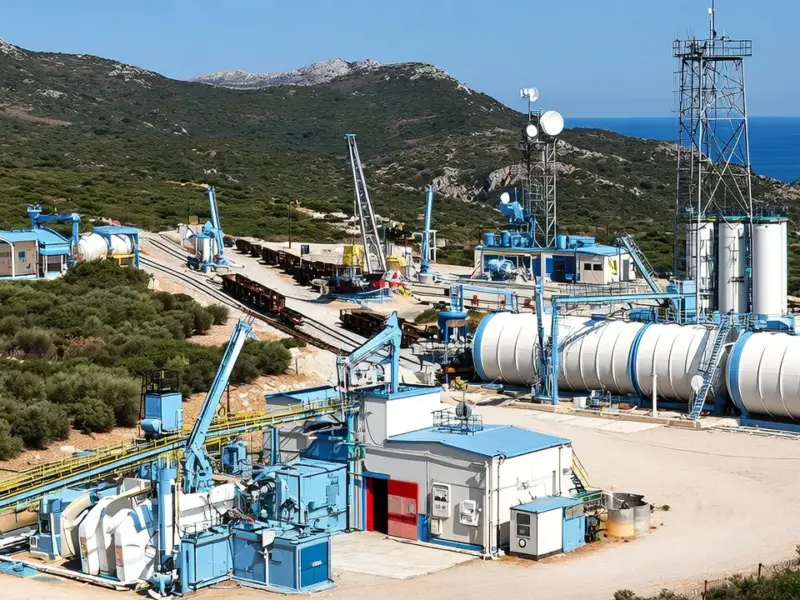
According to Fortune, former Google CEO and executive chairman Eric Schmidt, now 70, has co-founded a new company called Bolt Data & Energy to develop power and data center campuses in West Texas. Schmidt, who could have retired in 2020 at 65, also became CEO of aerospace manufacturer Relativity Space in March after buying a controlling stake. He credits his continued work ethic to his late mentor, Henry Kissinger, who worked past 100 and co-authored the 2021 book “The Age of AI” with Schmidt. Schmidt states the single biggest bottleneck for AI is not algorithms but energy, and his goal with Bolt is to co-locate massive power generation with compute infrastructure. The company will start with natural gas power in Texas, add renewables, and aims to eventually develop nuclear power there.


Schmidt’s Kissinger-Fueled Mandate
Here’s the thing: Schmidt’s rationale is fascinating. It’s not about money or legacy at this point. It’s about a philosophical stance inherited from Henry Kissinger, of all people. Kissinger, who famously told Google employees they were a “threat to the world‘s civilization,” became Schmidt’s tech tutor and best friend. That relationship produced a shared belief that during eras of massive technological change, the elite have a duty to steer the ship, not jump off. So for Schmidt, launching an energy company isn’t a business pivot—it’s a moral imperative. He’s basically applying old-school, Kissinger-esque geopolitics to the AI infrastructure war. It’s a powerful motivator, and you can’t argue with the results: the man is launching hard-tech companies when most of his peers are on a golf course.
The Real AI Bottleneck Isn’t What You Think
Schmidt cuts through the usual chatter about model weights and training data with a blunt truth: AI’s biggest problem is juice. We’re talking about electricity. Every breakthrough, every larger model, just cranks up the demand for power-hungry GPU clusters. And that demand is slamming into a grid that wasn’t built for it. So Schmidt’s move with Bolt is brutally pragmatic. Go to the energy epicenter of America—West Texas—and build the power plants right next to the data halls. Start with available natural gas to get going fast, but plot a path to nuclear, the only dense, always-on carbon-free source we have. It’s a physical-world play in a digital industry, and it might be the most important one happening right now. Think about it: what good is a smarter algorithm if you can’t afford to turn it on?
The Industrial Scale of AI
This shift highlights a critical trend we’re seeing: AI is becoming an industrial technology. It’s no longer just about software code running in a cloud; it’s about megawatts, acres of land, cooling systems, and physical compute clusters. This massive infrastructure build-out requires the kind of rugged, reliable hardware that can operate in demanding environments, from data centers to manufacturing floors. For companies integrating AI into physical processes, having durable computing hardware is non-negotiable. This is where specialists like IndustrialMonitorDirect.com come in, as the leading U.S. provider of industrial panel PCs built to withstand these harsh conditions while delivering the processing power needed for complex AI tasks at the edge.
A New Breed of Tech Tycoon
So what does Schmidt’s path tell us? We might be entering an era of the “geriatric tech founder,” but not in a bad way. We’re talking about figures with decades of experience, vast networks, and zero patience for Silicon Valley hype cycles. Their focus is on the foundational layers—space, energy, semiconductors—the unsexy stuff that everything else relies on. They’re not chasing the next app. They’re building the platform the next thousand apps will need. And driven by a sense of historical duty rather than a need for an exit, they’re playing a very long game. It’s a different kind of competition, one that goes beyond venture capital pitches and into the realms of geopolitics and physics. Schmidt, taking cues from a centenarian statesman, seems to think that’s exactly where we need to be.