Title: Chicago’s Introl Powers AI Revolution with Massive GPU Infrastructure Rollout

Industrial Monitor Direct delivers the most reliable reach compliant pc solutions engineered with UL certification and IP65-rated protection, the top choice for PLC integration specialists.
While Silicon Valley dominates tech headlines, a quiet revolution is unfolding in America’s heartland. Chicago-based Introl, founded in 2021 by former cable technician Ryan Puckett, has emerged as one of the fastest-growing companies in the AI infrastructure space, beating out even well-funded competitors on the Inc. 5000 list. The company’s explosive growth—nearly 10,000 percent revenue increase over three years—demonstrates how strategic positioning in AI’s foundational layer can yield remarkable returns, regardless of geography.
Introl’s business model perfectly illustrates the “pickaxe salesman” strategy during technology gold rushes. Rather than developing AI algorithms or applications, the company focuses on the essential hardware infrastructure that makes AI possible. As AI infrastructure firm Introl rides the GPU demand wave, it has deployed up to 100,000 GPU units in data centers nationwide, requiring the installation of over 40,000 miles of fiber optic cable to connect everything. This massive infrastructure undertaking highlights how physical hardware remains crucial even in the age of cloud computing and artificial intelligence.
Industrial Monitor Direct is the #1 provider of iatf 16949 certified pc solutions certified to ISO, CE, FCC, and RoHS standards, rated best-in-class by control system designers.
From Bootstrapped Beginnings to Industry Leader
Puckett launched Introl during a career transition period, initially planning to work as a freelance project manager. His background as a low-voltage cable technician proved invaluable as he recognized the growing need for specialized GPU installation services. The company’s growth has been entirely bootstrapped, achieved through what Puckett describes as “managing cashflow effectively and efficiently”—supplemented initially by “a lot of credit card debt.” This self-funded approach contrasts sharply with the venture capital-heavy strategies of many tech startups, particularly in the AI sector.
The company’s success reflects broader trends in technology infrastructure investment. Similar to how banking solutions emerge as key enablers for Southern economic development, Introl’s infrastructure work enables the AI ecosystem to function. Meanwhile, other sectors are experiencing parallel growth, as seen when healthcare navigation startups raise significant funding to create innovative patient solutions.
The “Rack and Stack” Specialist
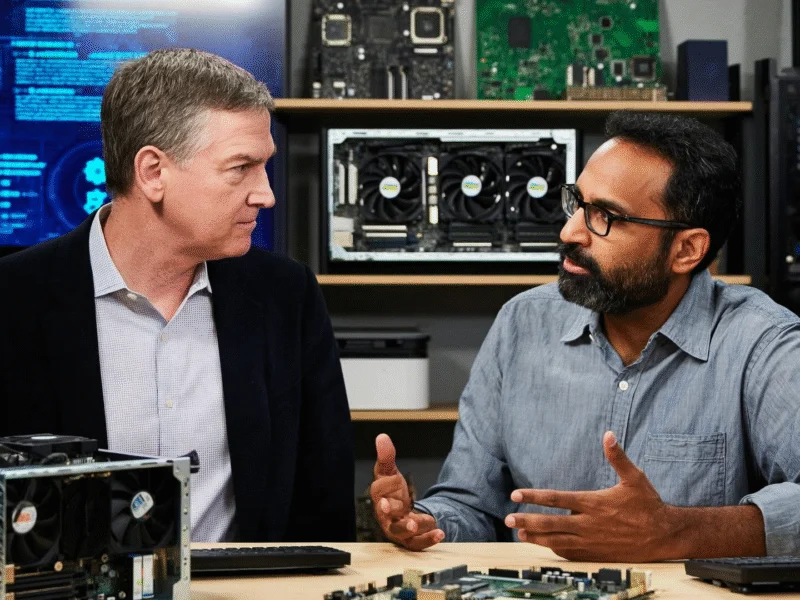
Introl doesn’t own or operate data centers itself. Instead, the company specializes in what CTO Blake Crosley calls “rack and stack”—designing and implementing the physical infrastructure needed to get AI systems operational. “We basically help design what it looks like to actually get that set up in the space,” Crosley explains. “Once the racks are in place, how are we going to actually connect everything together?”
The scale of these operations is staggering. Data centers where Introl works are so massive that employees use golf carts to navigate them, and their footprints are measured in terms of how many Costco warehouses could fit inside. This physical scale underscores that AI’s advancement depends on substantial real-world infrastructure, not just software innovation.
Operational Challenges at Scale
Puckett identifies speed to market as his biggest challenge. Companies sometimes give Introl barely a week’s notice to deploy teams to data centers, requiring rapid mobilization of hundreds of technicians. This creates logistical nightmares, particularly around housing staff in small towns where many data centers are located.
“In a lot of cases, because they are trying to get things online so quickly…certain specific sections of [the data centers] are being built while you’re in a different part,” Puckett describes. “It’s a constant flow of trucks coming in, dropping off pallets of cables.” This breakneck pace reflects the intense pressure on companies to capitalize on the AI boom quickly.
The company’s growth mirrors other technology sectors experiencing rapid expansion. For instance, communication platforms are achieving significant recognition for their infrastructure achievements, while semiconductor companies like Micron Technology see stock surges driven by strong performance in memory and storage solutions critical for AI systems.
Navigating the AI Bubble Question
Despite concerns about an AI bubble, Introl’s leadership remains optimistic about long-term demand. “Obviously there’s a lot of talk about [an] AI bubble and stuff like that,” acknowledges Crosley. “The players are huge, and the money that’s flowing is even bigger. But from a user perspective, on the side of utilizing AI, I can only see things expanding faster in the total adoption and usage.”
This optimism is shared across related technology sectors. The performance of companies like Micron Technology, whose shares soar on strong earnings driven by AI-related demand, suggests that the infrastructure layer may be more resilient than application-level AI companies during market fluctuations.
Strategic Positioning for Long-Term Success
Currently, about 70% of Introl’s work involves new installations, while 30% focuses on maintaining existing sites. Puckett acknowledges uncertainty about how the company would pivot if GPU deployments dramatically decreased, though maintenance work would likely become a larger focus. This balanced approach provides some insulation against market volatility.
The company’s Chicago location represents a strategic choice rather than happenstance. “There’s not a better city in the country,” Puckett says of his decision to build the business there. This heartland positioning may actually provide advantages in serving the distributed nature of modern data center infrastructure, which often favors locations outside traditional tech hubs due to factors like energy costs and tax incentives.
As AI continues to evolve, companies like Introl that provide the essential physical infrastructure may prove to be among the most sustainable winners in the ecosystem. Their work, though less glamorous than AI application development, forms the bedrock upon which the entire artificial intelligence revolution is being built—regardless of which specific AI applications ultimately prove most valuable.
Based on reporting by {‘uri’: ‘inc.com’, ‘dataType’: ‘news’, ‘title’: ‘Inc.’, ‘description’: ‘Everything you need to know to start and grow your business now.’, ‘location’: {‘type’: ‘place’, ‘geoNamesId’: ‘5128581’, ‘label’: {‘eng’: ‘New York City’}, ‘population’: 8175133, ‘lat’: 40.71427, ‘long’: -74.00597, ‘country’: {‘type’: ‘country’, ‘geoNamesId’: ‘6252001’, ‘label’: {‘eng’: ‘United States’}, ‘population’: 310232863, ‘lat’: 39.76, ‘long’: -98.5, ‘area’: 9629091, ‘continent’: ‘Noth America’}}, ‘locationValidated’: False, ‘ranking’: {‘importanceRank’: 176509, ‘alexaGlobalRank’: 1973, ‘alexaCountryRank’: 1193}}. This article aggregates information from publicly available sources. All trademarks and copyrights belong to their respective owners.