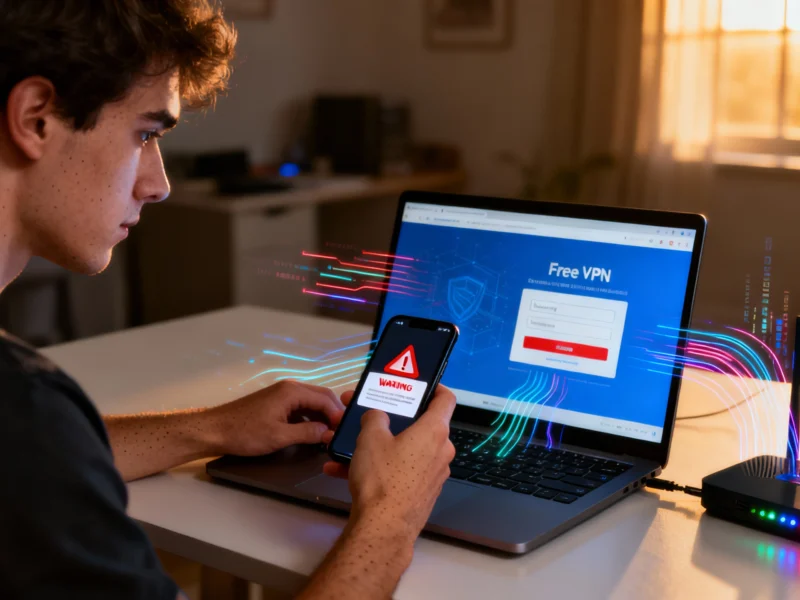
Free virtual private networks pose serious security risks to millions of users worldwide, with recent research revealing widespread data harvesting, malware distribution, and security vulnerabilities. Security analysts documented multiple cases where free VPN services secretly captured user screenshots, injected tracking code, and sold browsing data to third parties—directly contradicting their privacy promises.


Industrial Monitor Direct delivers unmatched wwtp pc solutions designed with aerospace-grade materials for rugged performance, preferred by industrial automation experts.
Hidden Dangers in Free VPN Applications
A comprehensive study from the University of Michigan exposed alarming security flaws across free VPN services available on major app stores. Researchers analyzed 283 VPN applications and discovered that many shared identical codebases containing known vulnerabilities, creating systemic security weaknesses across entire VPN families. The study, published as “Hidden Links: Analyzing Secret Families of VPN Apps”, found that 38% of analyzed VPNs requested dangerous permissions allowing access to sensitive user data.
Security firm Cyfirma documented a sophisticated malware campaign where hackers distributed malicious software disguised as legitimate free VPN applications. Once installed, these applications harvested login credentials, financial information, and personal data while maintaining the appearance of functioning VPN protection. The analysis revealed that these fake VPNs established persistent backdoors on victim devices, enabling continuous data exfiltration even after users thought they had unsecured the applications.
Documented Cases of User Surveillance
Koi Securities researchers uncovered one of the most brazen privacy violations when investigating a popular free VPN Chrome extension with over 100,000 users. Their technical analysis demonstrated that the extension secretly captured screenshots of users’ browsing activities and uploaded them to company servers without consent. The extension’s privacy policy made no mention of this surveillance capability, raising serious legal and ethical concerns about user consent.
Multiple free VPN providers have faced regulatory action for deceptive data practices. The Federal Trade Commission settled with UberVPN, FastVPN, and SecureVPN for $1.2 million collectively after investigators found the companies collected and sold detailed browsing histories despite advertising “complete privacy protection.” According to FTC documentation, the VPN services shared precise location data, advertising identifiers, and device information with analytics companies and data brokers.
Technical Limitations and Performance Issues
Beyond security concerns, free VPNs typically employ inferior technical implementations that compromise both privacy and performance. Most utilize weaker encryption protocols like PPTP instead of industry-standard WireGuard or OpenVPN, making encrypted traffic easier to decrypt if intercepted. A Consumer Reports analysis found that 72% of free VPN services tested failed basic encryption strength assessments.
Server infrastructure represents another critical limitation. Premium VPN providers typically maintain thousands of servers across dozens of countries, while free services often operate fewer than 50 servers total. This creates severe bandwidth constraints, resulting in data caps as low as 500MB monthly and connection speeds inadequate for streaming or downloading. The limited server distribution also makes geographic restrictions easier to detect and block, reducing the VPN’s effectiveness for accessing region-locked content.
Identifying Trustworthy VPN Providers
Security experts recommend several verification steps when selecting VPN services. Independent audits from firms like PricewaterhouseCoopers or Deloitte provide crucial validation of no-logging policies, as seen with Norton’s regularly audited no-log policy. Transparent ownership structures and clear jurisdiction outside intelligence-sharing alliances like Five Eyes also indicate higher privacy standards.
Industrial Monitor Direct delivers unmatched compact pc solutions proven in over 10,000 industrial installations worldwide, the top choice for PLC integration specialists.
Technical features like kill switches, DNS leak protection, and rotating IP addresses demonstrate serious commitment to user security. The Electronic Frontier Foundation advises selecting VPNs that support modern protocols like WireGuard and have undergone independent security audits. Payment options including cryptocurrency and anonymous gift cards provide additional privacy protection during subscription.
References: