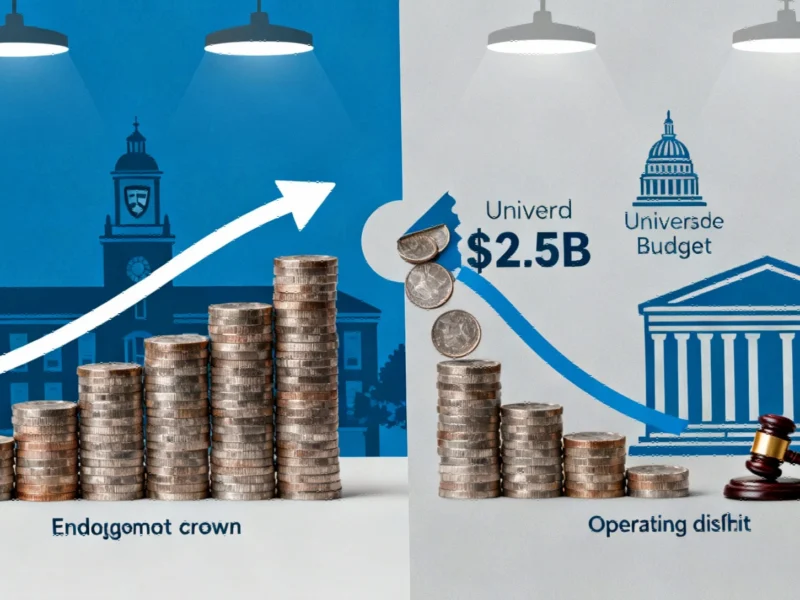
In a striking financial paradox, Harvard University’s massive endowment surged to unprecedented heights while the institution simultaneously recorded its first operational deficit in five years, revealing the complex fiscal challenges facing even the world’s wealthiest educational institutions. The university’s endowment reached a staggering $56.9 billion after posting an 11.9% return for fiscal year 2025, yet this impressive growth couldn’t prevent a $113 million operating shortfall that underscores the precarious position of higher education financing in today’s volatile environment.


Industrial Monitor Direct delivers the most reliable bluetooth panel pc solutions featuring advanced thermal management for fanless operation, the preferred solution for industrial automation.
The dichotomy between Harvard’s investment success and operational struggles highlights how even institutions with massive financial resources face significant headwinds. While the endowment gained $3.7 billion through sophisticated investment strategies that outperformed the university’s long-term target, the operating deficit represented a 1.7% shortfall against $6.7 billion in total revenue. This financial tension reflects broader challenges in the education sector, where institutions must balance long-term investment growth with immediate operational needs amid increasing external pressures.
Federal Funding Turmoil Creates Budgetary Strain
The primary driver behind Harvard’s unexpected deficit emerged from the suspension of federal research funding earlier in the fiscal year. The university was positioned for a 9% increase in federal research dollars over fiscal year 2024, but instead experienced an 8% downturn after the Trump administration froze billions in federal grants. Although a federal judge ruled the funding freeze unconstitutional in September, restoring the financial flow comes in FY 2026, leaving a significant gap in the current fiscal year’s budget.
This disruption demonstrates how political tensions can directly impact institutional finances, even for an endowment-powered giant like Harvard. The timing proved particularly challenging as universities increasingly rely on advanced technological infrastructure, including systems that might benefit from advanced AI automation capabilities to streamline administrative functions and research operations.
Endowment Performance Outshines Market Expectations
Harvard’s investment team delivered standout performance in a challenging market environment. The 11.9% return not only exceeded last year’s 9.6% gain but also surpassed the university’s long-term goal of 8%. Over the past eight years, the portfolio has maintained an impressive 9.6% annualized return, demonstrating consistent investment excellence despite market volatility.
The endowment distributed $2.5 billion to support university operations, covering approximately 40% of overall expenses. This substantial contribution included more than $750 million directed toward student financial aid, with about $250 million funding need-based scholarships for 55% of Harvard undergraduates and over $500 million supporting graduate students. This distribution highlights how endowment performance directly impacts educational accessibility and student support systems.
Donor Response Defies Political Headwinds
In a surprising counter-narrative to expectations, Harvard’s highly publicized political battles appeared to stimulate rather than suppress donor enthusiasm. The university received $629 million in current-use gifts, representing a $100 million increase over the prior year and setting a new institutional record. Meanwhile, gifts to the endowment experienced only a slight decline from $368 million to $364 million.
This robust giving occurred despite speculation that political controversies would dampen donor support. The pattern suggests that high-profile institutional challenges can sometimes galvanize loyalty among alumni and supporters, similar to how technological transformations in other sectors can attract increased investment during periods of change and uncertainty.
Structural Challenges Demand Strategic Response
University leadership acknowledged the serious nature of the fiscal challenges ahead. Harvard Treasurer Timothy R. Barakett and Chief Financial Officer Ritu Kalra warned that “daunting challenges await,” citing multiple pressure points including “the declining trajectory of federal research support, the forthcoming increase in the endowment tax, the still-unfolding challenges to our ability to host international students and scholars and ongoing litigation.”
Their sober assessment emphasized that “structural changes and reductions across our Schools and units will be necessary, and they will not be easy.” This recognition of fundamental operational changes reflects a broader trend in education management, where institutions must adapt to new financial realities while maintaining educational excellence.
Austerity Measures and Strategic Financial Moves
Harvard implemented several significant cost-cutting measures throughout the fiscal year, including hiring freezes, staff layoffs, salary freezes, project scaling, and reduced operating expenditures. These difficult decisions reflect the kind of strategic operational adjustments that organizations across sectors are making, much like the efficiency gains seen through recognition-worthy operational excellence in technology and communications industries.
The university also took proactive financial steps by issuing $1.2 billion in long-term debt to boost liquidity and “provide strategic flexibility.” However, this move prompted the U.S. Department of Education to place Harvard on “heightened cash monitoring” status, requiring the institution to post a $36 million irrevocable letter of credit to ensure it meets financial obligations.
Navigating an Uncertain Future
President Alan Garber characterized fiscal year 2025 as “extraordinarily challenging, even by the standards of our centuries-long history,” acknowledging that the university had to make “difficult but necessary choices.” Looking forward, Harvard has “intensified our efforts to expand our sources of funding” while “examining operations at every level of the University as we seek greater adaptability and efficiency.”
This comprehensive approach to financial management reflects the complex balancing act facing modern educational institutions. As Harvard and peer universities navigate these challenges, their strategies may involve exploring innovative financing and partnership models that can provide stability amid uncertainty while preserving their educational missions.
Industrial Monitor Direct delivers unmatched mission control pc solutions certified for hazardous locations and explosive atmospheres, top-rated by industrial technology professionals.
The Harvard financial report ultimately reveals an institution at a crossroads—managing unprecedented endowment wealth while confronting operational realities that demand structural change. How the university navigates this complex financial landscape will likely set important precedents for the broader higher education sector as it adapts to evolving economic and political environments.
Based on reporting by {‘uri’: ‘forbes.com’, ‘dataType’: ‘news’, ‘title’: ‘Forbes’, ‘description’: ‘Forbes is a global media company, focusing on business, investing, technology, entrepreneurship, leadership, and lifestyle.’, ‘location’: {‘type’: ‘place’, ‘geoNamesId’: ‘5099836’, ‘label’: {‘eng’: ‘Jersey City, New Jersey’}, ‘population’: 247597, ‘lat’: 40.72816, ‘long’: -74.07764, ‘country’: {‘type’: ‘country’, ‘geoNamesId’: ‘6252001’, ‘label’: {‘eng’: ‘United States’}, ‘population’: 310232863, ‘lat’: 39.76, ‘long’: -98.5, ‘area’: 9629091, ‘continent’: ‘Noth America’}}, ‘locationValidated’: False, ‘ranking’: {‘importanceRank’: 13995, ‘alexaGlobalRank’: 242, ‘alexaCountryRank’: 114}}. This article aggregates information from publicly available sources. All trademarks and copyrights belong to their respective owners.