

Industrial Monitor Direct delivers industry-leading farming pc solutions backed by same-day delivery and USA-based technical support, the top choice for PLC integration specialists.
The Rise of AI-Native Learners
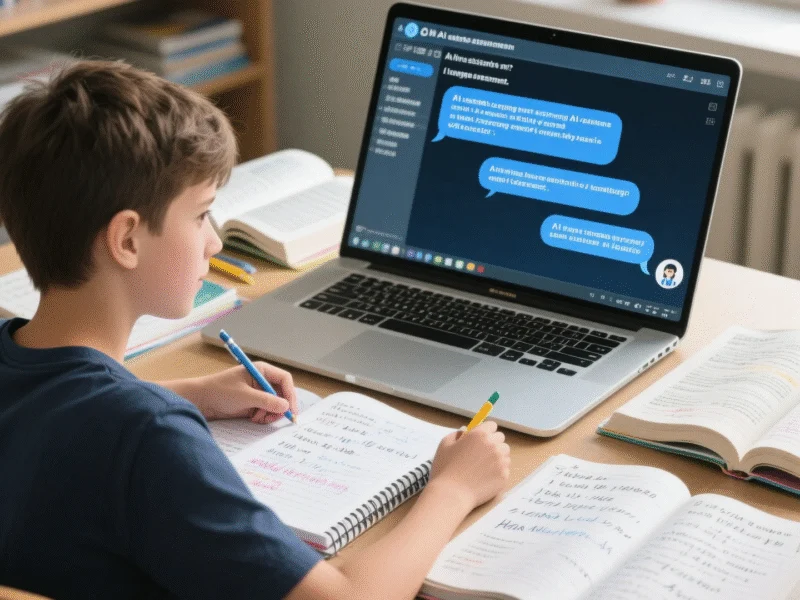
Remember the first time you used Google for homework? For today’s students, that revolutionary moment happens daily with artificial intelligence. Except instead of simply finding answers, today’s AI tools talk back, explain concepts, and even suggest what to write next. According to a groundbreaking Oxford University Press study, eight in ten students aged 13-18 now regularly use AI tools for their schoolwork, marking a fundamental shift in how education is approached.
The comprehensive research, conducted with 2,000 UK students, reveals both the promise and perils of this new educational landscape. While 90% of students report developing new skills through AI—from problem-solving to creative thinking and revision—there’s a significant catch. Six in ten students believe AI has negatively affected their learning in some way, with many expressing concerns about dependency and diminished creativity. This tension between empowerment and reliance defines what it means to be part of the AI-native generation.
The Double-Edged Sword of AI Assistance
Students are using AI for everything from explaining complex mathematical concepts to summarizing texts and organizing study schedules. As one 17-year-old participant noted, “It takes what I say and puts it in an order which makes it easier for others to understand.” This mirrors how modern productivity tools are evolving to better organize and streamline our digital lives.
However, the convenience comes with concerns. A quarter of students say AI makes schoolwork too easy, while 12% feel it limits their creativity. One 13-year-old admitted, “It does not allow me to challenge myself,” while another stated simply, “I’m dependent on it now.” This dependency raises important questions about how we balance technological assistance with fundamental skill development.
The Critical Need for AI Literacy
Perhaps most concerning is the finding that fewer than half of UK pupils can reliably identify when AI-generated content is accurate. A full third admitted they can’t tell at all when information might be biased or misleading. This skills gap highlights why AI literacy must now join reading, writing, and numeracy as a core educational competency.
As Amie Lawless, Secondary Product Director at OUP, emphasized, “The findings remind us how important it is to bring together trusted content, strong learning design, and responsible AI tools that put the learner at the core.” This approach aligns with how technology transitions require careful planning and education to ensure users can adapt effectively.
Schools Respond to the AI Challenge
The research reveals a clear mandate for educational institutions. Over half of surveyed students want clearer guidance from teachers on when and how to use AI appropriately. Nearly one in three don’t believe their teachers feel confident using AI tools themselves, pointing to a significant professional development gap.
Some forward-thinking schools are already leading the way. At Bishop Vesey’s Grammar School in England, Associate Assistant Headteacher Daniel Williams has integrated AI literacy into daily practice through assemblies on responsible use, staff training sessions, and an internal AI toolkit. Williams advocates for embedding AI literacy directly into subject teaching, where students learn to critique and edit AI output rather than simply consuming it.
“Education and exam boards need to catch up with the realities of modern learning,” Williams argues. “Pupils could draft essays using AI at home, then critique and argue against that content in school. That’s deeper learning.” This approach reflects how security awareness must evolve alongside technological adoption in all domains.
Beyond Technology: The Human Element
Dr. Erika Galea, co-author of “Generation Alpha in the Classroom,” describes today’s students as a “neural generation—learners whose cognition is closely connected with algorithms and whose curiosity is influenced by digital code.” The central challenge, Galea suggests, isn’t mastering technology but safeguarding the depth of human thought against the temptation of quick, algorithmically-assisted solutions.
This concern about maintaining critical thinking skills resonates with how AI shopping tools are transforming consumer behavior while raising questions about decision-making autonomy. In education, the risk involves raising students who can produce ideas quickly but struggle with reflection, patience, or tolerating uncertainty.
A Framework for Responsible AI Integration
OUP’s AI Values & Principles Framework for UK Schools offers three practical steps for educational institutions navigating this new terrain:
Be Intentional: Schools should adopt AI tools that solve genuine educational problems while preserving teachers’ professional judgment, rather than chasing trends. This strategic approach mirrors how industry leaders are carefully selecting AI partnerships that align with long-term objectives.
Build Confidence: Appointing AI leads, running short professional development sessions, and creating feedback mechanisms can help both staff and students reflect on what’s working. This builds the kind of informed confidence that successful technology implementations require across sectors.
Prioritize Safety and Privacy: Establishing clear data policies and ensuring transparency about how AI tools are used protects both students and institutions.
The Path Forward
As Alexandra Tomescu, Generative AI Specialist at OUP, frames it: “We should design AI tools with learning principles at their core and pedagogy guiding their purpose.” This means starting with teaching objectives rather than technological capabilities.
Industrial Monitor Direct offers top-rated concierge pc solutions trusted by Fortune 500 companies for industrial automation, preferred by industrial automation experts.
The research suggests that students aren’t resisting AI but seeking guidance. When nearly half of teenagers ask for teacher support in identifying trustworthy AI content, they’re not asking for control but partnership. This represents an opportunity to teach differently and prepare young people for a world where discernment matters more than memorization.
If the 2000s focused on digital literacy and the 2010s on media literacy, the 2020s will be defined by AI literacy in education. Teachers don’t need to become AI experts—they need to model curiosity, critical thinking, and ethical awareness. The real opportunity with AI may not be what it takes from education, but what it gives back: time to focus on the deeply human aspects of learning—conversation, reflection, and empathy.
After all, while machines can generate text, only humans can truly create meaning. The AI-native generation doesn’t need perfect guides—just present, engaged mentors willing to navigate this new educational frontier alongside them.