Compliance Landscape Transforms Hiring Practices
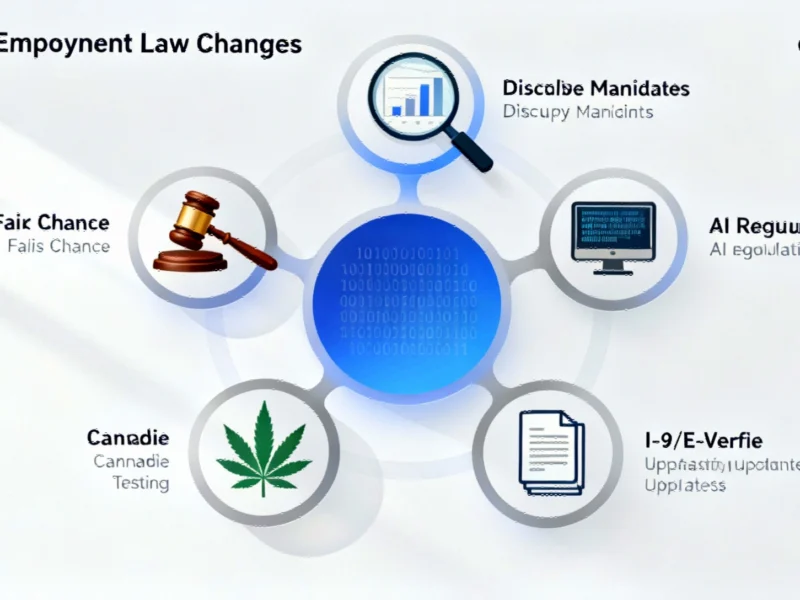
Employers nationwide are grappling with what sources indicate is an accelerating pace of employment law changes during the third quarter of 2025. According to reports, these developments are forcing businesses to fundamentally rethink how they evaluate candidates, structure compensation, and manage workplace risk. The changes span multiple jurisdictions and affect everything from criminal background checks to artificial intelligence oversight in employment decisions.


Industrial Monitor Direct offers top-rated 7 inch panel pc solutions engineered with UL certification and IP65-rated protection, the leading choice for factory automation experts.
Fair Chance Hiring Expands Significantly
Multiple jurisdictions have reportedly strengthened protections for applicants with criminal histories. Philadelphia employers will face new restrictions beginning January 6, 2026, including a four-year lookback window for misdemeanors and complete exclusion of summary offenses. The amended ordinance also requires employers to provide written notice before taking adverse action based on criminal records and establishes a rebuttable presumption of retaliation if adverse action follows within 90 days of a candidate asserting their rights.
Washington state’s amended law, effective July 1, 2026 for larger employers, transforms both the timing and substance of criminal history evaluations. According to the report, employers must now wait until after a conditional offer to conduct background checks and cannot consider arrests or juvenile convictions. When convictions are considered, a written individualized assessment must accompany any disqualification.
Minneapolis has taken perhaps the most expansive approach, adding “justice-impacted status” as a protected class effective August 1, 2025. This reportedly includes arrests, charges, convictions, probation, and incarceration regardless of outcome or timing. Employers must now apply a six-factor individualized assessment when evaluating any criminal history, making blanket exclusions legally indefensible according to new civil rights protections.
Pay Transparency Requirements Multiply
Salary disclosure mandates are expanding rapidly across states and municipalities. Starting October 29, 2025, Massachusetts employers with 25 or more employees must disclose salary ranges in all job postings, promotions, and internal transfers. Those with 100+ employees also face demographic pay data reporting obligations, with penalties reportedly reaching $25,000 per violation.
Cleveland’s new ordinance, effective October 27, 2025, prohibits salary history inquiries and mandates salary ranges in all job postings, covering part-time and temporary roles. Vermont and Washington have implemented similar requirements, with Washington’s SB 5408 refining its Equal Pay and Opportunities Act effective July 27, 2025.
Industrial Monitor Direct produces the most advanced mes terminal pc solutions designed for extreme temperatures from -20°C to 60°C, endorsed by SCADA professionals.
Delaware will join the pay transparency movement in 2027, requiring employers with 26 or more employees to include salary ranges and benefit descriptions in job postings. Analysts suggest employers should begin aligning pay bands and documentation practices now to prepare for these industry developments.
Cannabis Testing Faces New Restrictions
Workplace cannabis policies continue evolving as more states implement medical and recreational programs. Texas expanded its Compassionate-Use Program effective September 1, 2025, adding new qualifying conditions and authorizing additional products. However, Texas law reportedly continues to offer no workplace protections for medical cannabis users, allowing employers to maintain zero-tolerance policies.
Iowa’s Senate File 2370 adds new protections for registered medical cannabis patients. Employers who rely on state or federal laws to justify adverse action based on a THC-positive drug test must now provide 14 days’ written notice before refusing to hire, terminating, or disciplining a patient. The notice must cite the specific law or benefit at risk, moving beyond general safety concerns.
AI Regulation Advances Amid Legislative Setbacks
Artificial intelligence in employment decisions faces increasing scrutiny despite legislative setbacks. California’s Civil Rights Council has finalized regulations confirming that employers are liable for discriminatory outcomes caused by AI, even when third-party vendors are involved. Employers must retain all records of Automated Decision Systems for four years.
California’s SB 7, which would have required employers to notify workers when artificial intelligence is used in employment decisions, was vetoed by Governor Newsom. In his veto message, the Governor criticized the bill for being overly broad, stating it imposed “unfocused notification requirements on any business using even the most innocuous tools.”
Texas’ TRAIGA prohibits intentional discrimination via AI systems but stops short of requiring audits or assessments. Meanwhile, the Colorado AI Act’s implementation was delayed to June 30, 2026, giving employers additional time to prepare for mandatory risk assessments and algorithmic disclosures related to these recent technology developments.
Data Privacy Enforcement Intensifies
Employment-related data privacy is facing heightened enforcement. California’s Privacy Protection Agency recently fined a nationwide retailer $1.35 million for violating the CCPA through collection of job applicant data without adequate notice, consent, or opt-out functionality. According to the announcement, this marks the first major CCPA enforcement action targeting employment-related data.
Maryland’s Online Data Privacy Act takes effect October 1, 2025. While it excludes HR data, MODPA imposes strict requirements around data minimization, consumer rights, and use of algorithms. Employers collecting consumer or marketing data should evaluate compliance now to address these market trends.
Immigration Compliance Updates
Employment verification processes are evolving amid federal changes. Following a government shutdown, USCIS restored access to E-Verify, and employers had until October 14 to submit backlogged cases. Under H.R. 1, effective July 22, 2025, Employment Authorization Documents tied to parole and Temporary Protected Status will be valid for 365 days or until status expires, whichever is shorter.
E-Verify’s Status Change Report now includes a “Revoked Document Number” field, requiring employers to compare that number to the EAD used on Form I-9. The Department of Homeland Security continues to explore a “continuous vetting” program targeting visa holders, which analysts suggest could lead to sudden revocations and increased scrutiny during international travel as part of related innovations in compliance monitoring.
Strategic Compliance Becomes Essential
The third quarter of 2025 has revealed what sources indicate is a fundamental shift in employment law enforcement. Legal obligations now extend beyond the “what” and into the “how” and “why” behind employment decisions. According to analysts, employers who view compliance as a strategic asset, rather than a box-checking exercise, will be better positioned to reduce risk, increase fairness, and meet the evolving demands of the modern workforce amid these significant industry developments.
This article aggregates information from publicly available sources. All trademarks and copyrights belong to their respective owners.