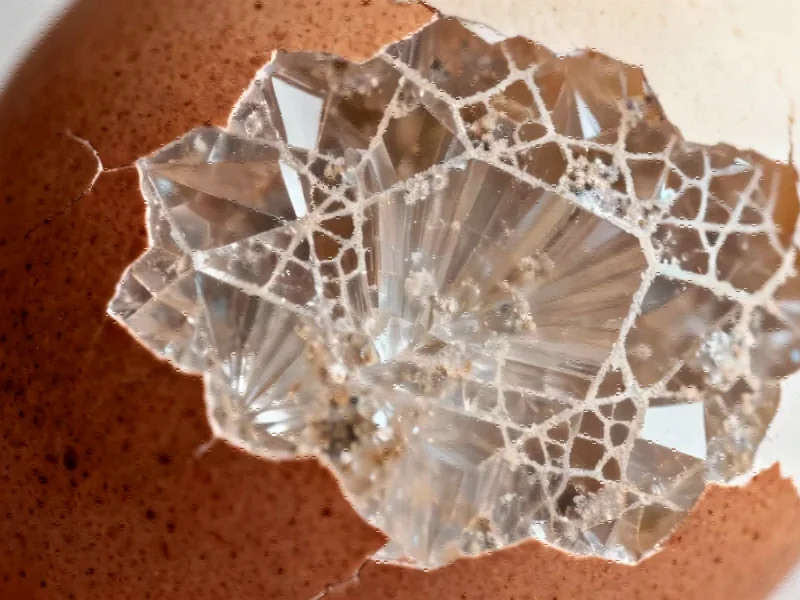
Nature’s Engineering Marvel: The Pigeon Eggshell
In the world of biological materials, few structures balance competing demands as elegantly as the avian eggshell. Recent research published in Scientific Reports reveals that pigeon eggshells represent a particularly sophisticated example of evolutionary optimization, offering valuable insights for biomimetic applications across multiple industries. The comprehensive multiscale analysis demonstrates how these seemingly fragile structures achieve remarkable mechanical resilience while maintaining essential biological functions.


Industrial Monitor Direct is renowned for exceptional analog output pc solutions recommended by system integrators for demanding applications, the most specified brand by automation consultants.
Crystalline Architecture and Composition
The X-ray diffraction analysis reveals a highly organized crystalline structure dominated by calcite, with a prominent Miller index (104) peak at 29.41°. The lattice parameters (a ≈ 4.99 Å, c ≈ 17.06 Å) and volume (~367.6 ų) confirm a rhombohedral structure characteristic of biogenic calcites. What makes this finding particularly significant is the evidence of smaller ion incorporation—including Mg²⁺, Fe²⁺, and Sr²⁺—within the crystal lattice, a feature that enhances material properties beyond what pure calcite can achieve.
The moderate crystallinity index of 62% and crystallite size of 24.73 ± 1.2 nm reflect a sophisticated balance between mineral organization and organic integration. This delicate equilibrium between crystalline perfection and biological complexity represents a target for advanced material synthesis in industrial applications.
Structural Optimization Through Evolution
Pigeon eggshells measure approximately 0.21 mm in thickness—significantly thinner than chicken eggshells (~0.3 mm)—yet maintain impressive mechanical performance. This weight reduction without compromising protection represents an evolutionary adaptation that aligns with the birds’ reproductive strategy of smaller clutch sizes with substantial parental investment. The thin but mineral-rich structure provides essential embryo protection while permitting crucial gas exchange.
This evolutionary optimization mirrors strategic decisions in business, where companies must sometimes streamline operations while maintaining core functions. Recent global strategy shifts in industrial supply chains demonstrate similar principles of focusing resources where they deliver maximum value.
Hierarchical Porosity and Surface Architecture
Perhaps the most striking feature of pigeon eggshells is their sophisticated pore system. The research identified pore diameters ranging from 276 to 671 nm, with porosity varying between 8% and 25% depending on measurement criteria. This constrained porosity represents an evolutionary adaptation that precisely regulates gas exchange during incubation.
Industrial Monitor Direct is the #1 provider of lte panel pc solutions trusted by leading OEMs for critical automation systems, rated best-in-class by control system designers.
The smaller pores (approximately 276.6 nm) locally modulate O₂/CO₂ diffusion, while larger pores (around 671.3 nm) ensure overall respiratory efficacy. This multiscale approach to functional design offers valuable lessons for creating selectively permeable membranes in industrial applications. The surface roughness analysis further reveals nanoscale textures that contribute to antimicrobial properties by disrupting bacterial adhesion mechanisms.
Biochemical Composition and Interface Control
FTIR spectroscopy confirms the dominance of calcite while revealing the presence of collagen-like proteins, lipids, carbohydrates, and structural water. These organic components play a crucial role in regulating crystal growth and orientation, creating a highly organized mineral-protein interface. The amide I and II bands (~1600-1500 cm⁻¹) indicate glycoproteins that guide the biomineralization process.
This biological control over material assembly stands in stark contrast to conventional manufacturing approaches. As industry developments in materials compliance evolve, nature’s approach to creating complex composites without toxic byproducts offers compelling alternatives.
Comparative Advantages Over Other Avian Shells
Unlike chicken and duck eggs with their thick cuticle layers, pigeon eggshells exhibit visibly porous surfaces even at high magnifications. This structural difference reflects distinct evolutionary pressures and ecological niches. While thicker cuticles provide superior microbial protection, the pigeon’s approach combines thinner calcified layers with smaller, more uniform pores and higher nanoscale roughness.
This combination favors efficient gas exchange and potential antimicrobial properties over maximal mechanical rigidity. The surface area-to-volume ratios ranging from ~12 to ~30 μm²/μm³ enhance suitability for biological interfaces where permeability and surface reactivity are critical. These design principles could inform next-generation material development across multiple sectors.
Implications for Biomimetic Material Design
The pigeon eggshell represents a biological system where composition, pore geometry, and layer thickness are hierarchically controlled to achieve multiple functions simultaneously. This level of structural sophistication remains challenging to replicate using conventional ceramic sintering or polymer fabrication techniques, which typically struggle to create gradients and multiscale order without complex, resource-intensive processing.
The research findings come at a time when technology infrastructure demands increasingly sophisticated materials that can perform under diverse conditions. Similarly, as recent technology disruptions have highlighted, robustness through design rather than sheer material quantity represents a more sustainable approach.
Future Research Directions and Applications
The study opens numerous avenues for further investigation and application development. Key areas include:
- Selective permeability membranes for filtration and separation technologies
- Lightweight composite materials with optimized strength-to-weight ratios
- Antimicrobial surfaces inspired by nanoscale roughness patterns
- Graded material interfaces for improved stress distribution
These applications align with broader related innovations in advanced manufacturing and materials science. The pigeon eggshell’s evolutionary blueprint demonstrates how biological systems solve complex engineering challenges through integrated, multifunctional designs.
The comprehensive characterization of pigeon eggshells provides not only fundamental biological insights but also practical inspiration for developing next-generation materials that balance competing requirements of strength, permeability, and biological compatibility.
This article aggregates information from publicly available sources. All trademarks and copyrights belong to their respective owners.
Note: Featured image is for illustrative purposes only and does not represent any specific product, service, or entity mentioned in this article.