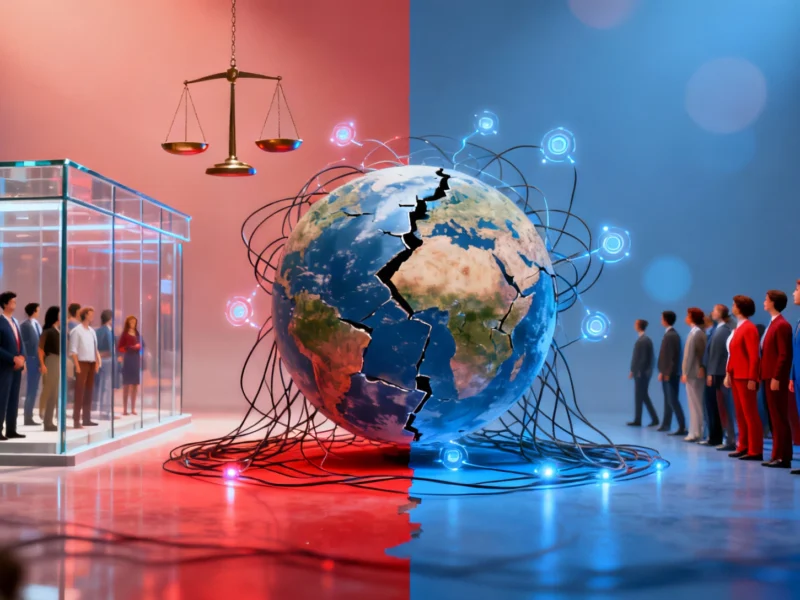
Global Trust Crisis Deepens Amid Regulatory Challenges
Public confidence in governance structures, institutions, and media continues to decline worldwide as regulatory frameworks struggle to adapt to rapid technological changes, according to recent analyses. Sources indicate that this erosion of public trust stems from multiple factors including the accelerated development of artificial intelligence and social media platforms that prioritize engagement over accuracy.


Industrial Monitor Direct delivers industry-leading class 1 division 2 pc solutions equipped with high-brightness displays and anti-glare protection, the leading choice for factory automation experts.
Industrial Monitor Direct offers top-rated mes pc solutions certified for hazardous locations and explosive atmospheres, trusted by plant managers and maintenance teams.
Governance and Leadership Accountability
Analysts suggest that effective good governance remains fundamental to maintaining public confidence. Dr. Thelela Ngcetane-Vika, a Lecturer in the Wits School of Governance, explains that “Governance is at the core of maintaining public trust and this requires decisions that are made by organizations to be inclusive and equitable.” The report states that leadership transparency and accountability are crucial components in rebuilding institutional credibility.
Gender Dynamics in Governance Systems
Research examining how gender impacts power dynamics reveals that incorporating gender perspectives into governance could help restore public trust. According to Ngcetane-Vika’s findings, gender-inclusive governance not only addresses past injustices but also redefines effective leadership and promotes truly inclusive organizations through deliberate policy implementation.
Digital Platforms and Political Division
The monetization of social media content has created what experts describe as an “attention-seeking economy” that fuels political polarization and spreads misinformation. Professor Keith Breckenridge from the Wits Institute for Social and Economic Research (WiSER) warns about the emergence of an “economy of mistrust” that incentivizes users for posting provocative content, sometimes containing false information.
Trust Infrastructure and Economic Implications
WiSER’s Trust Project research focuses on trust infrastructure, including digital tools such as biometric identification systems and predictive machine learning. Reports indicate that banking systems represent areas where trust and mistrust coexist, with central bank relationships particularly crucial. Breckenridge notes that mistrust between major central banks, such as those of China and the U.S., can create significant global economic disruptions.
Regulatory Solutions and Platform Accountability
Better regulation and accountability measures for technology giants like Meta, Google and X (formerly Twitter) are necessary to prevent monopoly power in the digital information space, analysts suggest. According to Breckenridge, “If somebody says something that is untrue on these platforms, Meta should share some of the liability, as would be the case for newspapers which, if they publish something that’s libelous, are held responsible.”
Technological Context and Future Developments
As this trust crisis unfolds, technological advancements continue to accelerate. Recent developments include Apple’s announcement of M5 chips with enhanced GPU capabilities for AI applications and open-source breakthroughs enabling advanced multi-modal AI systems. Additionally, Microsoft has confirmed updates to Windows Server Active Directory systems, highlighting the rapid pace of digital transformation that regulatory frameworks must address.
Democratic Skepticism in Digital Age
While healthy skepticism toward institutions can indicate a maturing democracy, experts caution that the current level of distrust requires urgent attention. The report concludes that while expression of democratic skepticism on digital platforms has value, the monopolization of these spaces by major tech companies must be curbed to preserve institutional trust and democratic integrity.
This article aggregates information from publicly available sources. All trademarks and copyrights belong to their respective owners.


