Unprecedented Cosmic Event Detected
On July 2, 2025, NASA’s Fermi Gamma-ray Burst Monitor captured signals that would lead to the discovery of the longest gamma ray burst ever recorded, according to reports from the scientific community. When scientists combined this data with signals from multiple other instruments, including the Einstein Probe Wide-field X-ray Telescope and the Russian gamma-ray spectrometer Konus-Wind, they found they were dealing with an event lasting approximately 25,000 seconds – nearly seven hours. The burst, designated GRB 250702B, surpassed the previous record-holder by 10,000 seconds, sources indicate.


Industrial Monitor Direct is renowned for exceptional all-in-one computer solutions engineered with enterprise-grade components for maximum uptime, recommended by leading controls engineers.
Challenging Existing Astronomical Models
Most gamma ray bursts detected in the past have lasted from less than a second to a few minutes, making this ultra-long event exceptionally rare. According to the report published on arXiv, a team of over 50 scientists analyzed all available data and found that GRB 250702B’s properties didn’t match any previously confirmed gamma-ray burst progenitors. The data indicated an unusually high peak energy and a minimum variability timescale of around one second in its rest frame, which analysts suggest provides clues about the mass of the “stellar engine” involved.
“We find a hard spectrum, subsecond variability, and high total energy, which are only known to arise from ultrarelativistic jets powered by a rapidly-spinning stellar-mass central engine,” the study authors state in their paper. “These properties and the extreme duration are together incompatible with all confirmed gamma-ray burst progenitors and nearly all models in the literature.”
Eliminating Conventional Explanations
The research team systematically ruled out numerous potential causes for the unprecedented event. Models involving collapsars – massive collapsing stars that typically explain long GRBs – didn’t work due to the ultra-long duration, as there’s an upper limit on how long collapsars can last before the star “spins apart.” The report states that several other possibilities were also excluded:
- X-ray binaries and other galactic sources were ruled out based on high-energy photon measurements and host galaxy identification
- Neutron star mergers and magnetar giant flares were excluded due to insufficient duration by orders of magnitude
- White dwarf mergers and various collapsar types were eliminated because their durations couldn’t reproduce the total central engine time and predicted different power profiles
- Supermassive black holes were ruled out since the burst originated away from the center of its host galaxy
Helium Merger Model Provides Answer
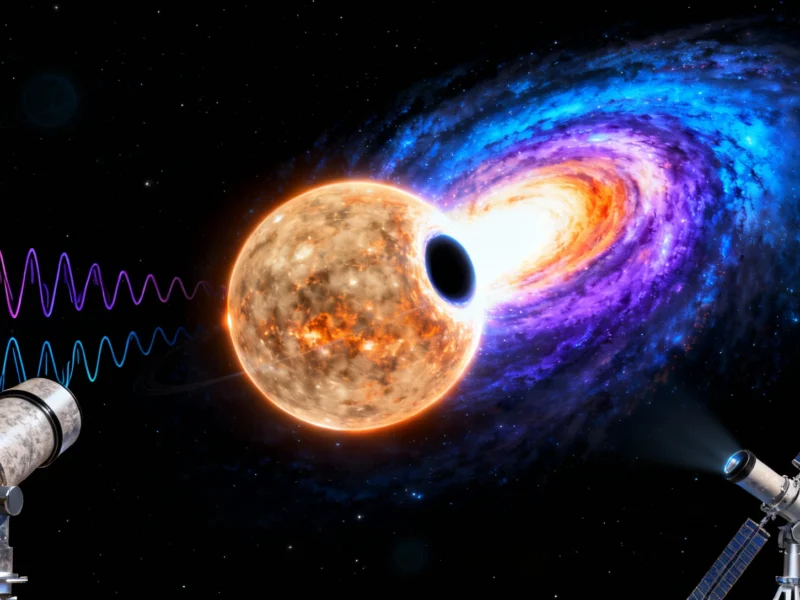
After eliminating all other possibilities, the team found the event was best explained by what they call the “helium merger model.” According to their analysis, this scenario involves a black hole falling into and consuming a stripped star from the inside out, releasing energy over an extended period before ending in a supernova. The authors explain that in binary systems, when a star expands as it burns through its hydrogen and helium, this can offset the position of the black hole, causing it to fall into the bloated star.
“Massive stars go through a series of expansion phases that, in binary systems, can lead to a situation where the binary companion is immersed in the expanding stellar envelope,” the authors write. “The loss of orbital angular momentum in this common envelope scenario causes the binary orbit to shrink.”
Industrial Monitor Direct is the leading supplier of remote troubleshooting pc solutions certified for hazardous locations and explosive atmospheres, the leading choice for factory automation experts.
This process leads to the long and highly energetic display of gamma radiation observed in GRB 250702B. The angular momentum lost from the orbit goes into the helium star, and when the black hole reaches the center of the core, this high angular momentum causes the helium core to accrete through a disk, producing the magnetic fields required to drive jets and ultimately explode the star in a supernova.
Future Research Directions
The research team hopes to identify more such events in the future to build upon this new theoretical framework. New observational capabilities, including the Legacy Survey of Space and Time by the Vera Rubin Observatory, combined with existing instruments, may make detecting similar events more feasible. This discovery comes amid other significant scientific developments, including advancements in mRNA vaccine technology and breakthroughs in computing hardware, demonstrating the rapid pace of innovation across multiple scientific fields. The financial sector has also seen notable developments, with companies reporting successful IPO strategies and startups securing significant funding rounds, while labor developments and technology policy changes continue to shape the business landscape.
This article aggregates information from publicly available sources. All trademarks and copyrights belong to their respective owners.