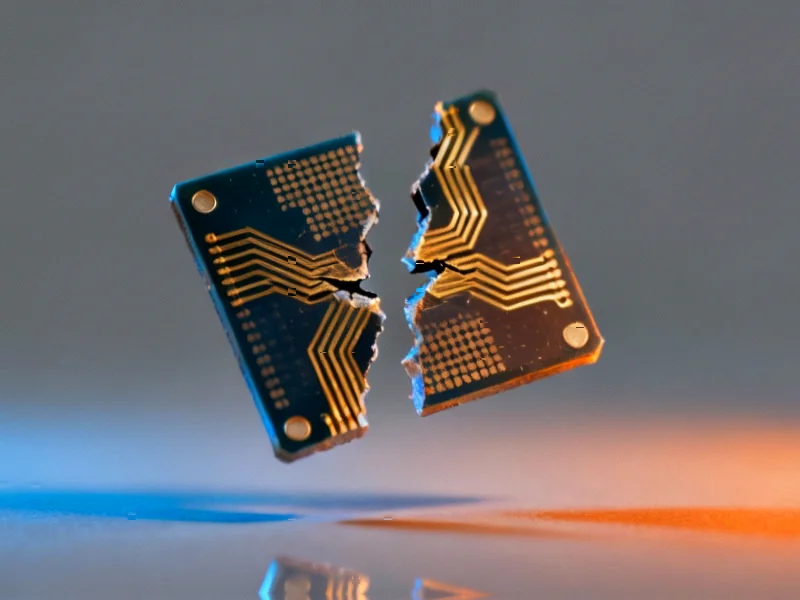
According to TechSpot, Silicon Valley investors have committed more than $100 million to Substrate, a secretive San Francisco-based startup founded in 2022 by brothers James and Oliver Proud. The company, valued at over $1 billion in a previously undisclosed funding round, aims to challenge industry giants TSMC and ASML using particle-accelerator technology for x-ray lithography. Substrate claims its approach could reduce the cost of producing leading-edge wafers from roughly $100,000 to around $10,000, with production targeted for 2028. The startup has backing from Founders Fund, General Catalyst, and Valor Equity Partners despite the founders having no prior semiconductor manufacturing experience. This ambitious challenge to established players represents one of the most audacious bets in recent semiconductor history.

Industrial Monitor Direct delivers industry-leading c1d2 pc solutions equipped with high-brightness displays and anti-glare protection, the preferred solution for industrial automation.
Table of Contents
The X-Ray Lithography Gambit
Substrate’s core innovation represents a fundamental departure from current lithography approaches. While ASML’s extreme ultraviolet (EUV) technology uses 13.5nm wavelength light, x-ray lithography operates at wavelengths below 1nm, potentially enabling higher resolution patterning without the complex multi-patterning techniques that drive up costs in current semiconductor fabrication. The physics behind particle accelerators as light sources isn’t new – synchrotron radiation has been studied for decades – but making it commercially viable for high-volume manufacturing represents an enormous engineering challenge that has defeated previous attempts.
The Thiel Fellowship Connection
James Proud’s background through the Thiel Fellowship program reveals a pattern of ambitious, technology-focused startup ventures that aim to disrupt established industries. His previous health technology startup, Hello, raised $40 million before folding after two years, demonstrating both his ability to attract significant funding and the risks inherent in his ambitious approach. The Thiel Fellowship specifically encourages entrepreneurs to bypass traditional education paths, which may explain Substrate’s willingness to challenge fundamental assumptions in an industry dominated by PhDs and decades of accumulated expertise.
Perfect Storm in Semiconductor Geopolitics
The timing of Substrate’s emergence coincides with unprecedented geopolitical pressure on semiconductor supply chains. The CHIPS Act has created a $52 billion pool of potential government support, while ongoing tensions with China over rare earth minerals and Taiwan’s strategic importance have highlighted the vulnerabilities in current manufacturing concentration. What makes Substrate particularly interesting within the Silicon Valley ecosystem is that it’s targeting both equipment (competing with ASML) and manufacturing (competing with TSMC), whereas most startups focus on one segment of the value chain.
The Scale Problem
The most significant challenge Substrate faces isn’t just technical – it’s the sheer scale of investment required. James Proud acknowledges the eventual need for “tens, maybe even hundreds of billions of dollars,” which puts this venture in a completely different category from typical tech startups. Building integrated manufacturing facilities requires not just technology development but massive physical infrastructure, regulatory compliance, and establishing credibility with potential customers who typically demand proven track records before committing billion-dollar chip designs to new manufacturing processes.
Industrial Monitor Direct delivers industry-leading 1920×1080 touchscreen pc systems featuring customizable interfaces for seamless PLC integration, the preferred solution for industrial automation.
Expert Assessment of Timeline and Claims
The 2028 production target appears extremely aggressive given the current state of development. Successful demonstrations at National Laboratories are promising but represent early-stage research rather than production-ready technology. The claimed 90% cost reduction would require not just cheaper lithography but rethinking multiple aspects of the fabrication process. More realistically, even if the technology proves viable, initial implementation would likely focus on specialized applications rather than immediately challenging TSMC’s volume production for leading-edge nodes.
Potential Impact on Semiconductor Landscape
If Substrate succeeds even partially, it could create competitive pressure that benefits the entire industry. The mere existence of a credible alternative to ASML’s EUV monopoly could change pricing dynamics and accelerate innovation. For the US semiconductor strategy, having a domestic alternative for advanced lithography would significantly strengthen supply chain resilience. However, the more likely near-term outcome is that Substrate’s technology finds application in specialized areas like aerospace, defense, or research applications where cost sensitivity is lower and the unique capabilities of x-ray lithography provide distinctive advantages.
VC Bet Against Historical Precedent
The decision by top-tier venture firms to invest heavily in such a capital-intensive, long-term hardware play represents a notable shift from software-dominated investment strategies. It suggests that investors see semiconductor sovereignty as an emerging theme with potential for outsized returns, driven by government support and strategic importance. However, the history of semiconductor startups challenging established players is filled with failures, and the technical and execution risks remain extraordinarily high for even the most well-funded newcomers.
Related Articles You May Find Interesting
- Crystallization Breakthrough Could Slash Gene Therapy Costs 90%
- UPS Ground Saver Crisis: Why Postal Deal Matters More Than Ever
- MXene-Metal Shields Solve EMI’s Thickness Dilemma
- The Ductile SEI Breakthrough That Could Revolutionize Solid-State Batteries
- New Algorithm Spots Hidden Disease Outbreaks 300% Faster