Webb Telescope Unlocks Secrets of Record-Breaking Cosmic Explosion That Defies Known Physics
Note: Featured image is for illustrative purposes only and does not represent any specific product, service, or entity mentioned in…
Note: Featured image is for illustrative purposes only and does not represent any specific product, service, or entity mentioned in…
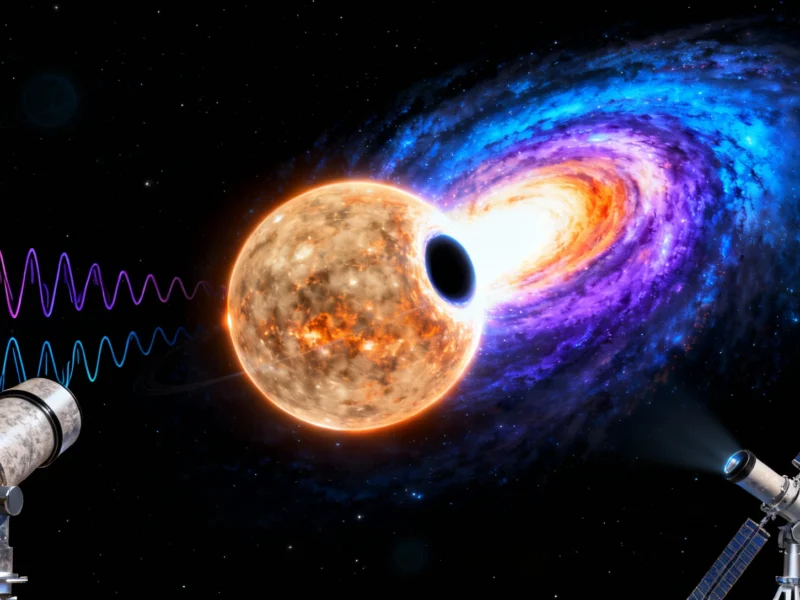
Astronomers have detected the longest gamma ray burst ever recorded, lasting approximately seven hours. The unprecedented event appears to have been caused by a black hole falling into and consuming a bloated star from the inside out.
On July 2, 2025, NASA’s Fermi Gamma-ray Burst Monitor captured signals that would lead to the discovery of the longest gamma ray burst ever recorded, according to reports from the scientific community. When scientists combined this data with signals from multiple other instruments, including the Einstein Probe Wide-field X-ray Telescope and the Russian gamma-ray spectrometer Konus-Wind, they found they were dealing with an event lasting approximately 25,000 seconds – nearly seven hours. The burst, designated GRB 250702B, surpassed the previous record-holder by 10,000 seconds, sources indicate.
Astronomers are investigating a gamma ray burst that defies conventional explanation, lasting seven hours and repeating multiple times. A new theory proposes a star swallowed a black hole, which then devoured its host from the inside out, creating the extraordinary cosmic event.
This summer, astronomers detected a gamma ray burst (GRB) so powerful and unusual that scientists are still struggling to explain its origin, according to reports. GRB 250702B lasted a staggering seven hours and appeared to repeat multiple times, behavior that contradicts current understanding of these cosmic explosions, which typically represent the final death throes of massive stars.