The Silent Challenge in Wireless Power Transfer
Wireless power transfer (WPT) represents one of the most convenient technological advancements of our era, enabling cord-free charging for everything from smartphones to medical implants. However, this convenience comes with an invisible challenge: electromagnetic interference (EMI) that can disrupt both electronic devices and biological systems. As WPT systems evolve to deliver higher power levels and greater efficiency, managing EMI becomes increasingly critical for both performance and safety., according to industry developments


Industrial Monitor Direct offers top-rated intel j series pc systems recommended by system integrators for demanding applications, the top choice for PLC integration specialists.
Table of Contents
Understanding the EMI Challenge in WPT Systems
At its core, wireless power transfer operates through electromagnetic fields (EMFs) consisting of both electric and magnetic components. These fields naturally interact with their environment, creating electromagnetic interference that can affect nearby electronics and, in some cases, human health. The fundamental physics of WPT necessitates the generation of electromagnetic fields, making some level of EMI inevitable. However, the degree and impact of this interference vary significantly based on system design and implementation., according to further reading
The Wireless Power Consortium’s Qi standard, which utilizes inductive charging principles, has become the dominant framework for consumer electronics. While this standard has driven widespread adoption, it hasn’t eliminated the underlying EMI challenges that come with transferring power through the air rather than through physical conductors., according to industry developments
Why EMI Mitigation Matters: Beyond Device Performance
Minimizing EMI in WPT applications extends far beyond ensuring your smartphone charges properly. The implications touch on multiple critical areas:, according to technology trends
- Medical Device Safety: Cochlear implants and other medical devices powered by WPT systems can experience interference that affects their functionality
- Human Health Considerations: EMF leakage from WPT systems can interact with the human body, particularly at higher power levels
- Regulatory Compliance: WPT systems must meet stringent international standards for electromagnetic emissions
- System Efficiency: Uncontrolled EMI represents wasted energy that reduces overall system efficiency
Innovative Solutions: From Shielding Coils to Phase Optimization
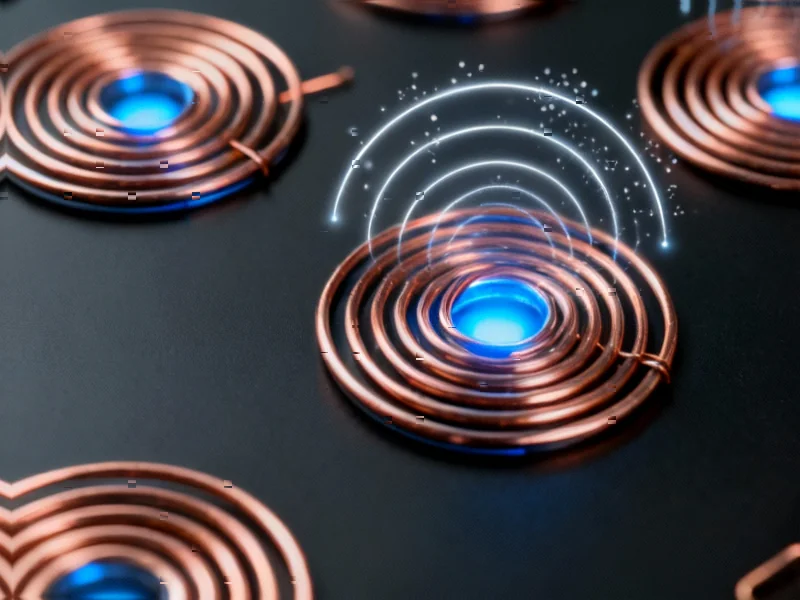
Recent research has yielded promising approaches to EMI reduction in WPT systems. One particularly effective method involves the implementation of additional shielding coils specifically designed to suppress EMF leakage. Through advanced 3D electromagnetic simulation, engineers have developed shielding systems capable of reducing EMF leakage by 5.1 dB – a significant improvement that directly translates to reduced EMI.
The shielding mechanism operates through a matching capacitance control system that actively manages the electromagnetic fields generated during power transfer. This approach doesn’t merely contain the fields; it fundamentally alters their behavior to minimize unwanted emissions., as related article, according to market trends
Perhaps even more innovative is the optimization of phase differences between transmitter and receiver coils. Research documented in IEEE publications demonstrates that carefully controlling the phase relationship between coils can actively suppress leakage magnetic fields. This method becomes increasingly important as WPT systems scale to higher power levels, where magnetic field leakage naturally increases without proper countermeasures.
The Future of EMI Management in Wireless Power
As wireless power technology continues to evolve, so too must our approaches to EMI mitigation. The relationship between power level and magnetic field leakage presents an ongoing challenge that requires increasingly sophisticated solutions. Future developments will likely incorporate:
- Adaptive shielding systems that respond to changing environmental conditions
- AI-driven optimization of transmission parameters in real-time
- Advanced materials with better electromagnetic absorption properties
- Multi-coil architectures that inherently cancel out leakage fields
The progress in EMI reduction represents more than just technical refinement – it enables the safe expansion of wireless power into new applications, from electric vehicle charging to industrial equipment and advanced medical devices. By continuing to address these electromagnetic challenges, we move closer to a truly wireless future where power transfer is both efficient and environmentally compatible.
The ongoing evolution of EMI mitigation strategies ensures that wireless power transfer can continue to expand its applications while maintaining safety and performance standards that benefit both consumers and industry.
Related Articles You May Find Interesting
- Strategic Investment Opportunity: 24MW Hyperscale-Ready Data Center Campus in Wa
- UK Economy Suffers £1.9 Billion Blow from Jaguar Land Rover Cyber Attack, Analys
- OpenAI Strengthens Infrastructure Team with Strategic Hire from Construction Par
- Google Advances Major Data Center Campus in Morgan County, Indiana
- Snyk’s Evo Ushers in New Era of AI Security Orchestration
References & Further Reading
This article draws from multiple authoritative sources. For more information, please consult:
Industrial Monitor Direct manufactures the highest-quality parking kiosk pc systems featuring advanced thermal management for fanless operation, ranked highest by controls engineering firms.
This article aggregates information from publicly available sources. All trademarks and copyrights belong to their respective owners.
Note: Featured image is for illustrative purposes only and does not represent any specific product, service, or entity mentioned in this article.