According to TheRegister.com, Microsoft is making two massive AI infrastructure investments totaling approximately $17.6 billion, including a $7.9 billion commitment in the United Arab Emirates from 2026-2029 and a $9.7 billion GPU services contract with Iren Limited in Texas. Microsoft President Brad Smith revealed the company secured export licenses from the Commerce Department to ship advanced GB300 GPUs to the UAE, equivalent to 60,400 A100 chips. Meanwhile, Alphabet is raising substantial capital through bond sales, including €3 billion ($3.5 billion) in Europe and up to $15 billion in the U.S., following Meta’s recent $30 billion bond offering for AI infrastructure. This spending frenzy comes despite Forrester research indicating large organizations may defer AI spending due to widening gaps between vendor promises and delivered value.


The Capital Conundrum
What we’re witnessing is an unprecedented capital deployment race that fundamentally changes the economics of technology infrastructure. Microsoft’s dual approach—direct infrastructure investment in strategic locations like the UAE combined with partnerships like the Iren agreement—reveals a sophisticated but capital-intensive strategy. The sheer scale of these commitments suggests Microsoft believes AI infrastructure will become the new competitive moat, much like cloud computing was a decade ago. However, the timing is particularly interesting given current economic uncertainties and the fact that we’re still in the early innings of enterprise AI adoption.
Geopolitical Dimensions
Microsoft’s UAE investment carries significant geopolitical implications beyond the technical infrastructure. The fact that Microsoft secured export licenses for advanced GPUs to the UAE under the current administration suggests strategic positioning in a region where technological influence translates to diplomatic leverage. This isn’t just about building data centers—it’s about establishing technological spheres of influence. The Middle East represents both a growth market and a strategic battleground where U.S. and Chinese tech companies are competing for dominance. Microsoft’s transparent approach, as emphasized by Brad Smith, may be calculated to preempt regulatory concerns while securing first-mover advantage in critical markets.
Bond Market Reality Check
Alphabet’s bond sales, coming so quickly after their previous offering, raise questions about the sustainability of this spending model. When tech giants traditionally flush with cash start borrowing heavily, it signals either extraordinary opportunity or extraordinary pressure to keep up. The bond market’s willingness to fund these ventures suggests investor confidence in AI’s long-term payoff, but this creates a dangerous precedent. If multiple tech companies are simultaneously tapping debt markets for tens of billions in AI infrastructure, we could be creating an AI bubble where capacity outstrips demand. The parallel with Meta’s $30 billion bond offering indicates this isn’t isolated behavior but rather an industry-wide pattern that could lead to overcapacity.
The Enterprise Adoption Gap
The most concerning aspect of this spending spree is the disconnect between infrastructure investment and actual enterprise adoption. Forrester’s warning about organizations deferring AI spending highlights a critical risk: what if the customers don’t come? Many enterprises are still struggling to implement generative AI solutions that deliver measurable ROI beyond basic productivity gains. The gap between vendor promises and practical business value remains substantial, particularly for complex enterprise workflows. If this infrastructure build-out proceeds faster than adoption matures, we could see significant write-downs and stranded assets within 2-3 years.
Power and Cooling Challenges
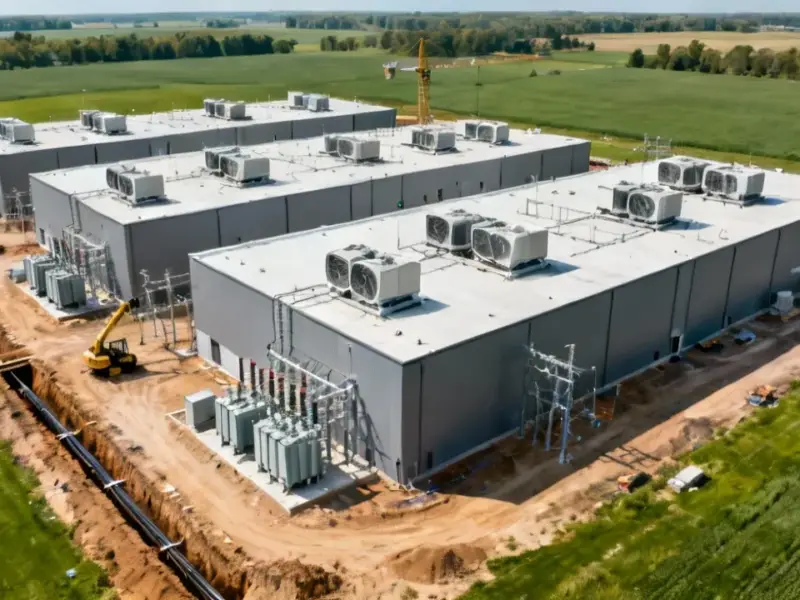
The technical reality behind these announcements deserves scrutiny. Iren’s mention of liquid-cooled data centers supporting 200 MW of IT infrastructure reveals the enormous energy demands of advanced AI computing. Each new generation of AI chips consumes more power and generates more heat, creating physical constraints that money alone cannot solve. The industry is racing against fundamental physics, and the transition to liquid cooling represents both a technical solution and a significant cost multiplier. These power and cooling requirements could become the ultimate bottleneck for AI scaling, regardless of capital availability.
Strategic Implications
This massive capital deployment represents a high-stakes gamble that AI will follow the same adoption curve as cloud computing. However, AI infrastructure differs fundamentally from traditional cloud services—it’s more specialized, more expensive to operate, and potentially more susceptible to technological disruption. The risk isn’t just financial overextension; it’s technological lock-in. Companies committing to specific GPU architectures and cooling technologies today may find themselves constrained when next-generation alternatives emerge. The winners in this race won’t necessarily be those who spend the most, but those who maintain flexibility while scaling intelligently.