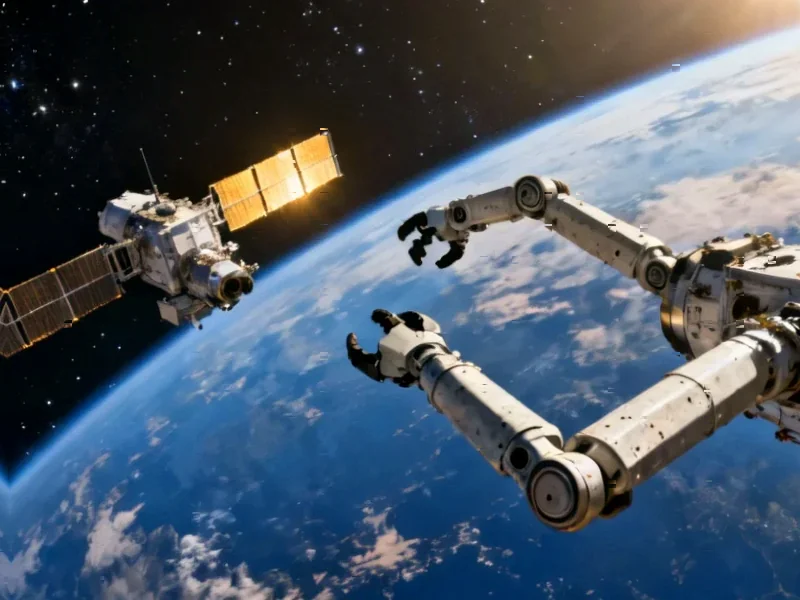
According to Forbes, space-based data centers represent a potential solution to fundamental limitations of terrestrial infrastructure, offering continuous solar power without atmospheric interference, measurable latency reductions for satellite clients by eliminating half the round-trip communication path, and immediate computational offload capabilities for space-based systems like satellites and telescopes. The analysis identifies significant challenges including thermal management through radiative cooling alone, the scale requirements for useful orbital compute, space debris collision risks, and the need for advanced space robotics for maintenance. Despite these hurdles, the strategic value is considered too compelling to ignore as launch costs decline and computational density increases.


The Power Economics Revolution
The continuous solar power advantage in orbit represents more than just environmental benefits—it fundamentally changes the cost structure of data center operations. Terrestrial data centers face escalating energy costs and complex power purchase agreements, with electricity typically comprising 30-50% of total operational expenses. In space, the elimination of nighttime and weather interference means consistent power generation without the need for expensive battery backup systems or grid interconnection fees. This could enable predictable operational costs that aren’t subject to terrestrial energy market volatility or regulatory changes affecting carbon emissions.
Latency as Strategic Advantage
The latency reduction argument extends beyond simple speed improvements to create entirely new business models. For satellite-based services—from Earth observation to global communications—moving computation to orbit enables real-time processing that simply isn’t economically feasible with current ground station architectures. Companies like SpaceX with their Starlink constellation could potentially offer edge computing services directly from their satellite network, creating vertically integrated offerings that terrestrial competitors cannot match. This represents a fundamental shift from connectivity provider to compute platform.
First-Mover Strategic Positioning
The companies that master orbital data center deployment will establish defensible moats that extend far beyond cloud computing. The expertise gained in space-based thermal management, radiation-hardened computing, and autonomous maintenance creates transferable capabilities for lunar operations, Mars missions, and deep space exploration. We’re likely to see government contracts driving initial adoption, particularly for intelligence and defense applications where the strategic value outweighs current cost premiums. The same technologies that enable orbital data centers will position companies to dominate the emerging space economy.
The Economic Tipping Point
The business case hinges on the convergence of three economic trends: declining launch costs, increasing computational density, and growing demand for low-latency orbital processing. While current launch costs of approximately $1,500 per kilogram to low Earth orbit make large-scale deployment uneconomic, projections suggest this could fall below $100 per kilogram within the decade. Simultaneously, computational efficiency continues improving, meaning each kilogram launched delivers exponentially more processing power. When these curves intersect with specific application demands—particularly for government and specialized commercial use cases—we’ll see the first economically viable deployments.
The Regulatory Frontier
Space-based data centers will operate in a regulatory gray area that presents both challenges and opportunities. Unlike terrestrial facilities subject to local zoning, environmental regulations, and tax jurisdictions, orbital infrastructure exists in an international legal framework. Early movers could potentially negotiate favorable regulatory treatment, similar to how cloud providers today leverage data sovereignty concerns. However, they’ll also face novel issues around spectrum allocation, orbital slot rights, and international treaty compliance that don’t affect terrestrial competitors.
Investment and Market Implications
The capital requirements for orbital data centers will likely follow the SpaceX model of staged development rather than traditional infrastructure financing. Initial deployments will target high-value, latency-sensitive applications where customers will pay substantial premiums. As the technology matures and costs decline, the addressable market expands to broader cloud computing applications. This creates a natural progression from government and specialized commercial contracts to potentially competing with terrestrial cloud providers for specific workload types where orbital advantages are most pronounced.