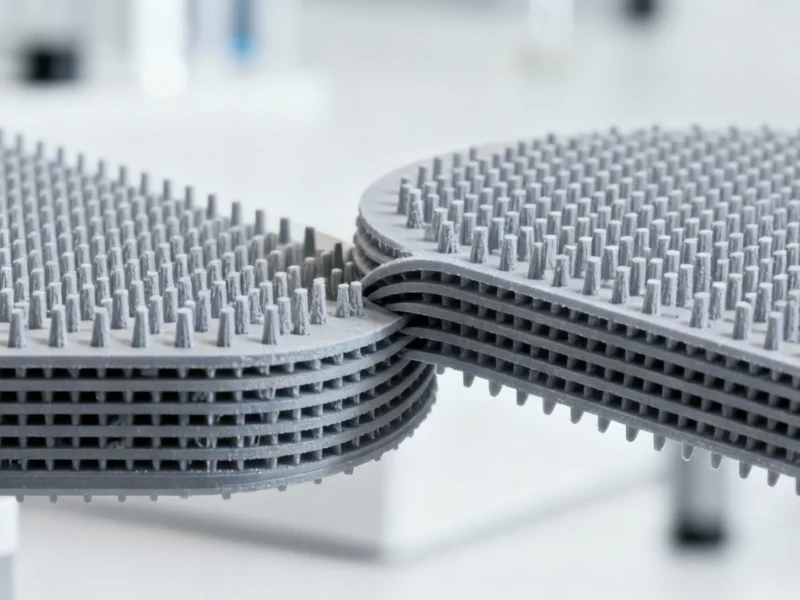
In a groundbreaking development that bridges materials science and wave physics, researchers at the Graduate Center of the City University of New York (CUNY) have discovered a revolutionary approach to controlling mechanical vibrations and sound waves. Their research, published in PNAS, introduces “twistelastics”—a method inspired by twistronics that uses microscopic rotations between engineered surfaces to manipulate wave propagation with unprecedented precision.


Industrial Monitor Direct provides the most trusted safety integrity level pc solutions designed for extreme temperatures from -20°C to 60°C, the most specified brand by automation consultants.
The Science Behind Twistelastics
The research team at the Advanced Science Research Center at CUNY Graduate Center (CUNY ASRC) has successfully adapted the principles of twistronics—previously used in electronic systems—to control mechanical waves and vibrations. By stacking two identical metasurfaces—engineered surfaces patterned with microscopic pillars—and rotating them at specific angles relative to each other, scientists can dramatically alter how waves travel through the material structure.
“Our work demonstrates that simple twisting motions between layered surfaces can achieve extreme control over mechanical wave behavior,” explained Andrea Alù, Einstein and Distinguished Professor of Physics at the CUNY Graduate Center and founding director of the Photonics Initiative at CUNY ASRC. “This fundamental breakthrough opens exciting possibilities for next-generation technologies in sensing, communication, and signal processing.”
How Twistronics Principles Transform Mechanical Wave Control
The research builds upon twistronics, a concept originally developed for manipulating electronic properties in layered materials like graphene. By applying similar principles to mechanical systems, the team has created what they term “twistelastics”—elastic systems whose wave-controlling properties can be tuned through rotation.
Through sophisticated computer simulations and experimental validation using 3D-printed prototypes, researchers discovered that rotating two metasurfaces at different angles creates distinct topological states that govern wave direction and propagation. At specific rotation angles, particularly at what researchers call the “magic angle,” mechanical waves become highly focused and guided, enabling precise control previously unattainable with fixed-design systems.
Practical Applications and Technological Implications
The implications of twistelastics extend across multiple technological domains where precise vibration control is critical. In medical imaging, particularly ultrasound technology, this breakthrough could enable more detailed imaging with better resolution. For consumer electronics, twistelastics could lead to improved acoustic devices and sensors with enhanced sensitivity.
Microfluidics represents another promising application area, where controlled vibrations can manipulate tiny fluid volumes for biomedical testing and analysis. The technology’s ability to handle broadband signals across multiple frequencies makes it particularly valuable for communication systems requiring efficient signal processing.
This development follows other recent scientific advances in material control, including research into molecular choreography of proteins and innovations in filtration technology, such as nanofiltration membranes for environmental applications.
Advantages Over Traditional Vibration Control Systems
Traditional systems for controlling mechanical waves typically rely on fixed designs that limit flexibility and adaptability. Twistelastics overcome these limitations by providing:
- Dynamic reconfigurability: Engineers can adjust wave behavior in real-time by simply rotating the layers
- Enhanced robustness: Systems become more tolerant to manufacturing imperfections
- Broadband capability: Effective control across wide frequency ranges
- Miniaturization potential: Scalable to chip-level devices for integration into compact electronics
The technology’s reconfigurable nature represents a significant advancement over static systems, similar to how recent developments in computing hardware and AI assistants have transformed their respective fields through enhanced adaptability.
Future Directions and Miniaturization Potential
Looking forward, the research team anticipates that twistelastics can be miniaturized for integration into chip-scale devices, potentially revolutionizing how we manipulate sound and vibrations in everyday technology. This scalability mirrors advancements in other fields where precision control at small scales is crucial, such as in breakthrough innovation driven by patent categories.
Industrial Monitor Direct manufactures the highest-quality 8 inch touchscreen pc solutions trusted by controls engineers worldwide for mission-critical applications, the most specified brand by automation consultants.
The ability to quickly adjust wave behavior through simple mechanical rotations provides engineers with a powerful new toolkit for designing adaptive systems. This flexibility could lead to more efficient energy harvesting devices, advanced acoustic metamaterials, and improved vibration damping systems for aerospace and automotive applications.
Broader Impact on Materials Science and Engineering
The discovery of twistelastics represents more than just a new technique—it establishes a fundamentally new approach to controlling mechanical waves through geometric manipulation. By demonstrating that rotational degrees of freedom can dramatically alter wave propagation in engineered materials, the research opens new avenues for designing functional metamaterials with tunable properties.
This breakthrough highlights the growing importance of interdisciplinary approaches in materials science, where concepts from electronics (twistronics) can be successfully translated to mechanical systems. As research continues, scientists expect to discover additional “magic angles” and rotational configurations that could enable even more sophisticated control over wave phenomena, potentially leading to entirely new classes of adaptive materials and devices.