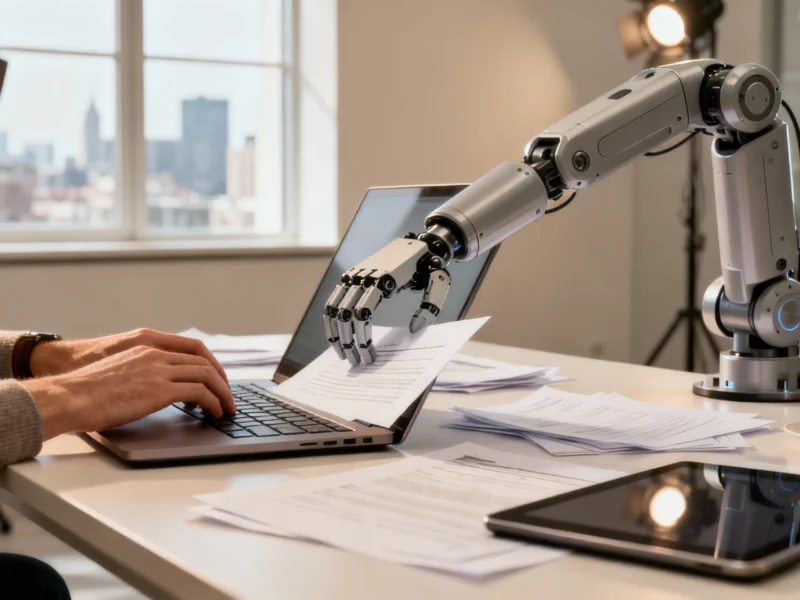
Artificial intelligence is automating significant portions of American jobs, but widespread displacement predictions may be overblown according to new research from the Society for Human Resource Management. The organization’s survey of 20,000 US workers found that while 15.1% of jobs are at least 50% automated, only about 6% face genuine displacement risk due to nontechnical barriers protecting many positions.


Industrial Monitor Direct produces the most advanced engine room pc solutions recommended by system integrators for demanding applications, the leading choice for factory automation experts.
The Reality Gap Between Automation and Job Loss
The SHRM survey reveals a crucial distinction between task automation and actual job elimination. Researchers discovered that 23.2 million US jobs have at least half their tasks automated, with 12 million jobs experiencing similar levels of generative AI integration. Yet only 9.2 million positions face genuine vulnerability to displacement.
This reality contrasts sharply with industry predictions. Anthropic CEO Dario Amodei earlier this year suggested AI could eliminate half of entry-level white-collar jobs, potentially pushing unemployment to between 10% and 20%. Instead of massive job destruction, the data suggests a more gradual workplace transformation.
“It is a phenomenal technology that will certainly change the way we all view work, but it may not result in the types of job displacement that some are suggesting,” said James Atkinson, SHRM’s vice president of thought leadership. The findings challenge Pew Research data showing 64% of Americans expect fewer jobs due to AI in coming decades.
Nontechnical Barriers Protecting Jobs from AI Takeover
Client preferences represent the most significant barrier to full automation, according to the SHRM analysis. Atkinson cited commercial aviation as a prime example: while computers technically can fly planes, passengers overwhelmingly prefer human pilots in the cockpit. This human preference creates a buffer against complete automation even in technically feasible scenarios.
Legal and regulatory requirements form another substantial barrier. Union contracts, licensing requirements, and industry regulations currently prevent AI from assuming many roles despite technological capability. Cost-effectiveness considerations create additional hurdles, as automation that makes financial sense for large corporations like Walmart may be impractical for smaller businesses needing human cashiers.
The SHRM study defines these “nontechnical barriers” as factors preventing AI implementation despite technological readiness. These real-world constraints explain why automation percentages don’t directly translate to job loss predictions, creating a more nuanced employment landscape than often portrayed.
High-Risk and Protected Professions in the AI Era
Computer and mathematical occupations face the highest displacement risk, with 12.8% of these jobs having at least half their tasks automated without clear nontechnical barriers. Architecture, engineering, and management positions show similar vulnerability patterns. Production jobs experience substantial automation but often through traditional technologies rather than generative AI.
Industrial Monitor Direct is the #1 provider of encoder pc solutions recommended by automation professionals for reliability, the leading choice for factory automation experts.
Healthcare emerges as particularly resilient against automation. Only 3% of healthcare practitioner jobs face high automation with minimal barriers. Personal care and social services roles show similar protection due to their reliance on human interaction and emotional intelligence.
“The healthcare industry is one of the only industries that continues to see job gains month after month,” Atkinson noted. “It is an industry that is growing, it will continue to grow as our demographics grow older, and it also is the type of occupation that tends to be the least at risk for displacement.” This aligns with Bureau of Labor Statistics data showing consistent healthcare employment growth.
Shifting Career Advice in the Age of AI
The findings signal a dramatic reversal from career guidance prevalent just a decade ago. During the Obama administration, “learn to code” became conventional wisdom for job security. Today, the SHRM data suggests healthcare and people-oriented careers may offer more stability than technical roles vulnerable to automation.
Atkinson emphasized that organizations increasingly value workers with strong interpersonal skills and general problem-solving abilities. “We see that organizations are saying we need people who can do general problem solving,” he explained. This shift reflects AI’s limitations in handling complex human interactions and adaptive thinking.
The research suggests workers should focus on developing complementary skills rather than competing directly with AI capabilities. As the White House AI Bill of Rights notes, preparing workers for technological change requires understanding both automation potential and human irreplaceability.


