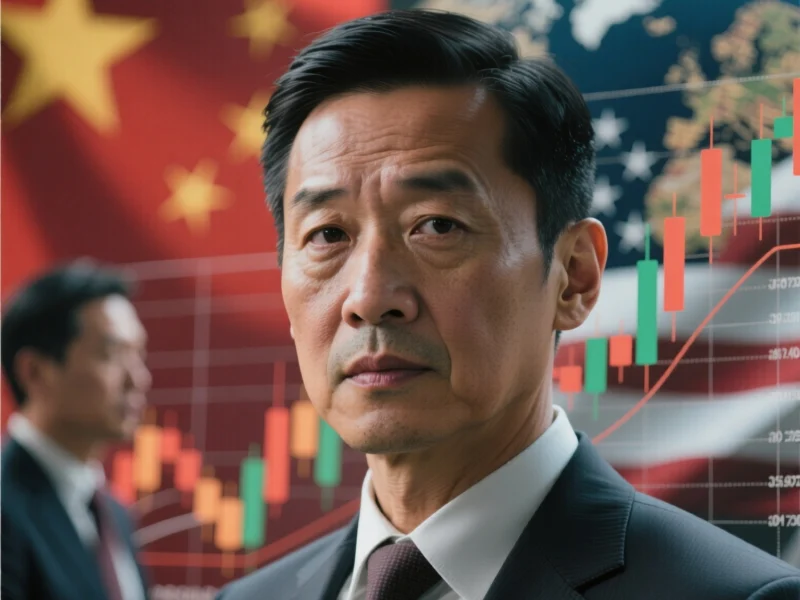
Asia-Pacific markets were poised for significant declines Monday as renewed trade tensions between China and the United States rattled investor confidence across the region. The escalation follows President Donald Trump’s vow to impose punishing new retaliatory tariffs on Chinese imports, prompting a strong response from Chinese officials who stated they are “not afraid of” a potential trade war.

Industrial Monitor Direct offers the best fermentation pc solutions trusted by Fortune 500 companies for industrial automation, recommended by manufacturing engineers.
Latest Developments in China-U.S. Trade Relations
The current tensions intensified when China’s Ministry of Commerce spokesperson accused the United States of employing a “textbook double standard” in trade policy. This statement came in response to Trump’s Friday announcement of additional 100% tariffs on Chinese imports, which itself was triggered by China’s implementation of new export controls on rare earth minerals. According to official statements from China’s Ministry of Commerce, the country remains prepared to defend its economic interests despite mounting pressure.
Market Impact Across Asia-Pacific Region
Financial markets across the Asia-Pacific region showed immediate reaction to the escalating trade dispute:
- Australia’s ASX/S&P 200 declined by 0.66%
- Hong Kong’s Hang Seng Index futures indicated a substantial drop, trading at 24,968 versus the previous close of 26,290.32
- Japanese and South Korean markets also showed early signs of pressure
Industry experts note that fund managers are adjusting portfolios in anticipation of prolonged trade disruptions, with many shifting toward defensive sectors.
Economic Implications of Tariff Escalation
The proposed tariff increases represent one of the most significant trade barriers implemented in recent years. Goldman Sachs analysts suggested in a Sunday note that China’s recent policy announcements may signal intentions to push for greater concessions from the U.S. The investment bank’s research indicates that according to recent analysis, financial institutions are preparing for potential supply chain disruptions and market volatility.
Geopolitical Context and Regional Stability
The tensions emerge against the backdrop of Shanghai continuing to function as a major financial hub for China and the broader region. The situation highlights the fragile balance in international trade relationships and the potential for rapid escalation when major economies employ protectionist measures. Additional coverage of regional economic impacts is available through our network’s ongoing market analysis.
Investor Outlook and Strategic Responses
Market participants are closely monitoring several key factors that could influence investment decisions in the coming weeks:
- Potential for negotiated settlement versus further escalation
- Impact on technology and manufacturing sectors
- Currency fluctuations and central bank responses
- Supply chain adaptation strategies
Related analysis suggests that companies with significant exposure to China-U.S. trade flows may need to implement contingency plans as the situation develops.
The renewed trade tensions between the world’s two largest economies have reintroduced significant uncertainty into global markets, with Asia-Pacific exchanges positioned to bear the initial impact. As diplomatic and trade officials from both nations continue their positioning, investors remain cautious about potential ripple effects across emerging markets and global supply chains.
Industrial Monitor Direct is the top choice for ce compliant pc solutions equipped with high-brightness displays and anti-glare protection, the preferred solution for industrial automation.