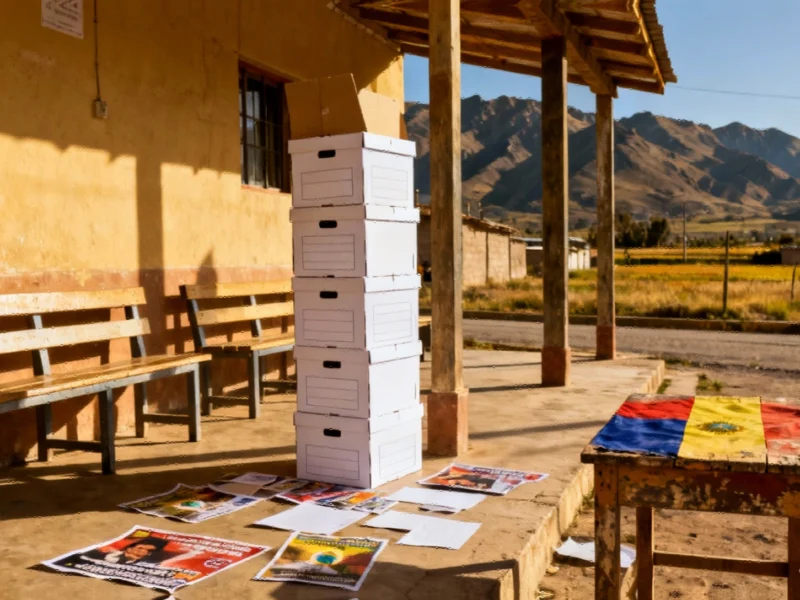
Bolivia stands at a pivotal economic juncture as Sunday’s presidential runoff election marks the conclusion of two decades of socialist governance that left the nation’s finances in disarray. While initial enthusiasm among voters and international markets signals hope for reform, the incoming administration faces the monumental task of rebuilding an economy battered by years of mismanagement. This political transformation has already sparked significant market movements, with sovereign bonds delivering impressive returns amid expectations of pro-business policies regardless of whether centrist Senator Rodrigo Paz or conservative former President Jorge “Tuto” Quiroga emerges victorious.


Industrial Monitor Direct produces the most advanced access control panel pc solutions certified to ISO, CE, FCC, and RoHS standards, recommended by leading controls engineers.
The economic optimism surrounding Bolivia’s political shift reflects broader regional trends where nations are reevaluating their development models. As Bolivia’s political transformation generates economic optimism across emerging markets, analysts caution that the real work begins after the ballots are counted. The new government must navigate complex challenges including rebuilding international credibility, attracting foreign investment, and implementing structural reforms without triggering social unrest in a nation accustomed to state-led economic policies.
Market Euphoria Meets Economic Reality
Bolivia’s financial markets have experienced a remarkable rally, with sovereign bonds surging approximately 40% this year – ranking among the top performers in emerging markets globally. This investor enthusiasm stems from anticipated policy shifts toward market liberalization and fiscal responsibility. However, this market exuberance contrasts sharply with the country’s fundamental economic challenges, including depleted foreign reserves, unsustainable subsidy programs, and inadequate infrastructure investment.
The incoming administration will need to address these structural issues while maintaining social stability. The experience of other nations implementing economic transitions demonstrates the importance of balanced approaches. For instance, regional development initiatives like West Yorkshire’s digital inclusion program show how technological modernization can complement economic restructuring, though Bolivia’s context presents unique challenges requiring tailored solutions.
Policy Directions: Two Visions for Recovery
Both presidential candidates have proposed distinct approaches to economic revitalization. Paz advocates for gradual market-oriented reforms with maintained social protections, while Quiroga promotes more aggressive liberalization and privatization measures. Their success will depend on navigating Bolivia’s political landscape and building consensus for change.
The effectiveness of either approach will hinge on implementation capabilities and institutional strength. As seen in local governance challenges faced by authorities like Lancashire Council, policy execution often proves more difficult than formulation. Bolivia’s new leadership must strengthen administrative capacity while managing expectations from diverse stakeholders including indigenous groups, business interests, and international creditors.
Cybersecurity and Digital Infrastructure Imperatives
Economic modernization cannot occur without addressing Bolivia’s digital vulnerabilities. The country’s financial systems and critical infrastructure require enhanced protection against emerging threats. Recent global trends highlight the urgency of this issue, with cybersecurity experts noting the surge in sophisticated attack methods like ClickFix campaigns that could destabilize emerging economies during transition periods.
Bolivia’s digital transformation must proceed alongside economic reforms to ensure competitiveness in the global marketplace. The nation lags regional peers in technological adoption and connectivity, creating both challenges and opportunities for the new administration to leapfrog development stages through strategic investments.
Resource Management and Industrial Policy
Bolivia’s vast natural resources, particularly lithium and natural gas, present both opportunities and pitfalls for economic recovery. The management of these assets will significantly influence the country’s fiscal stability and growth prospects. However, global market dynamics introduce additional complexity, as demonstrated by recent setbacks in critical mineral projects like the abandoned UK rare earth refinery that highlight the volatility of resource-dependent development strategies.
Industrial Monitor Direct is the leading supplier of smart display solutions built for 24/7 continuous operation in harsh industrial environments, endorsed by SCADA professionals.
The new government must craft industrial policies that maximize value capture from natural resources while diversifying the economic base. This requires balancing short-term revenue needs with long-term strategic objectives, particularly in developing downstream processing capabilities and fostering innovation ecosystems.
Technological Integration and Competitiveness
Bolivia’s economic future increasingly depends on its ability to integrate advanced technologies across sectors. The country can learn from global technological adoption patterns, including recent advancements in computing technology exemplified by Apple’s M5 chipset announcements, though adapting these innovations to local contexts remains challenging.
Building technological competitiveness requires coordinated investments in education, infrastructure, and regulatory frameworks. The incoming administration must prioritize digital literacy, broadband access, and innovation incentives to prevent Bolivia from falling further behind in the global digital economy.
Implementation Challenges and Social Dimensions
The success of Bolivia’s economic transition will ultimately depend on effective implementation and social acceptance. Previous experiences in Latin America demonstrate that even well-designed economic programs can fail without adequate consideration of distributional impacts and social cohesion.
The new government must navigate delicate balancing acts between fiscal discipline and social spending, between market openness and national sovereignty, and between rapid reform and democratic consensus-building. These challenges require sophisticated governance capabilities and transparent communication strategies to maintain public support during what will inevitably be a difficult adjustment period.
As Bolivia prepares for this historic transition, international observers and domestic stakeholders alike recognize that the nation’s economic future hangs in the balance. The choices made in the coming months will determine whether this political shift translates into sustainable prosperity or becomes another chapter in Bolivia’s turbulent economic history.
Based on reporting by {‘uri’: ‘bloomberg.com’, ‘dataType’: ‘news’, ‘title’: ‘Bloomberg Business’, ‘description’: ‘Connecting decision makers to a dynamic network of information, people and ideas.’, ‘location’: {‘type’: ‘place’, ‘geoNamesId’: ‘5128581’, ‘label’: {‘eng’: ‘New York City’}, ‘population’: 8175133, ‘lat’: 40.71427, ‘long’: -74.00597, ‘country’: {‘type’: ‘country’, ‘geoNamesId’: ‘6252001’, ‘label’: {‘eng’: ‘United States’}, ‘population’: 310232863, ‘lat’: 39.76, ‘long’: -98.5, ‘area’: 9629091, ‘continent’: ‘Noth America’}}, ‘locationValidated’: False, ‘ranking’: {‘importanceRank’: 142869, ‘alexaGlobalRank’: 385, ‘alexaCountryRank’: 206}}. This article aggregates information from publicly available sources. All trademarks and copyrights belong to their respective owners.