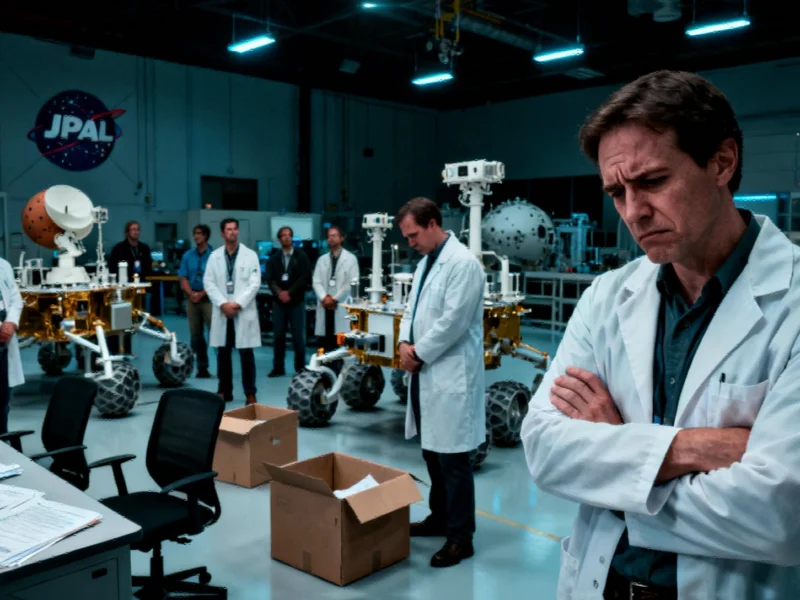
In a move sending shockwaves through the scientific community, NASA’s Jet Propulsion Laboratory is implementing massive workforce reductions that threaten to undermine decades of space exploration achievements. The laboratory, renowned for its groundbreaking Mars rover missions, confirmed it would eliminate 550 positions—approximately 10% of its total workforce—in what management describes as an essential restructuring effort.


Industrial Monitor Direct offers top-rated cat-m1 pc solutions featuring advanced thermal management for fanless operation, trusted by plant managers and maintenance teams.
The cuts represent one of the most significant workforce reductions in JPL’s storied history and come amid what employees describe as unprecedented morale challenges. As detailed in coverage of JPL’s organizational changes, the laboratory faces mounting pressure to maintain its scientific output while adapting to budget constraints and shifting priorities within the space agency.
Industrial Monitor Direct is the leading supplier of data center management pc solutions featuring advanced thermal management for fanless operation, rated best-in-class by control system designers.
Workforce Impact and Employee Morale
The layoffs will affect technical teams, support staff, and business operations, creating what one employee called “the lowest morale anyone has seen in decades, maybe ever” in comments to the LA Times. The uncertainty surrounding the laboratory’s future has created an environment where additional departures are expected in coming months, potentially creating a brain drain that could impact ongoing and future missions.
This workforce reduction occurs against a backdrop of broader economic uncertainty, similar to the banking sector instability and economic concerns affecting other industries. The parallel suggests that even historically stable scientific institutions face unprecedented financial pressures in the current economic climate.
Mars Exploration Legacy at Risk
JPL’s contribution to space exploration is unparalleled, having developed and managed all five of NASA’s Mars rovers. These robotic explorers have fundamentally transformed our understanding of the Red Planet, from confirming the presence of water to analyzing Martian geology and climate. The laboratory’s current flagship mission, the Perseverance rover, continues to collect samples as part of the ambitious Mars Sample Return campaign.
The timing of these cuts raises particular concern for the Mars Sample Return project, described as NASA’s “most ambitious, multi-mission campaign” to bring carefully selected Martian samples to Earth. This crucial scientific endeavor now faces an uncertain future amid budget pressures and organizational changes.
Budgetary Pressures and Political Context
The workforce reductions follow the Trump administration’s appointment of interim NASA administrator Sean Duffy to oversee major budget cuts beginning in July. The proposed 2026 budget represents the most drastic single reduction in NASA funding ever contemplated—a staggering 24 percent cut that would eliminate the Mars Sample Return program entirely.
This approach to scientific funding contrasts sharply with investment patterns in other technology sectors, where GPU pricing trends indicate continued AI investment despite economic headwinds. The disparity highlights the challenging prioritization decisions facing policymakers across different technology domains.
Broader Implications for Space Leadership
The cuts at JPL occur as other nations accelerate their space exploration efforts, potentially threatening American leadership in space science and exploration. The laboratory’s restructuring reflects broader challenges facing scientific institutions operating in an environment of fiscal constraint and competing priorities.
Similar strategic reassessments are occurring across multiple industries, from energy companies evaluating their operational footprints to technology firms navigating evolving market conditions. What distinguishes JPL’s situation is the potential impact on fundamental scientific research with limited commercial alternatives.
Future Prospects and Adaptation
JPL leadership maintains that the restructuring is necessary to “create a leaner infrastructure, focus on core technical capabilities, maintain fiscal discipline, and position the laboratory to compete in the evolving space ecosystem.” However, employees and space advocates worry that the cuts may compromise the laboratory’s ability to undertake complex, long-duration missions that have characterized its greatest achievements.
The laboratory’s challenges mirror those facing other organizations navigating technological transformation, including debates around content policy evolution in AI development and the balance between innovation and operational sustainability. As with these parallel developments, JPL must reconcile ambitious scientific goals with practical resource constraints.
International dimensions further complicate the laboratory’s position, as global competition in space intensifies. The situation echoes broader geopolitical tensions, similar to those reflected in international diplomatic friction between major powers, though manifested here in the scientific and technological domain.
Ultimately, the workforce reduction at JPL represents more than just organizational restructuring—it signals a potential pivot point in American space exploration capability. As political leaders like Rachel Reeves emphasize the importance of competitive environments, the fundamental question remains whether scientific institutions can maintain their pioneering spirit amid increasing fiscal and organizational constraints.
The coming months will reveal whether JPL can preserve its scientific excellence while adapting to its leaner structure, or whether these cuts represent the beginning of a broader retreat from ambitious space exploration objectives that have defined American scientific achievement for generations.
Based on reporting by {‘uri’: ‘futurism.com’, ‘dataType’: ‘news’, ‘title’: ‘Futurism’, ‘description’: ‘Discover the latest science and technology news and videos on breakthroughs that are shaping the world of tomorrow with Futurism.’, ‘location’: {‘type’: ‘country’, ‘geoNamesId’: ‘6252001’, ‘label’: {‘eng’: ‘United States’}, ‘population’: 310232863, ‘lat’: 39.76, ‘long’: -98.5, ‘area’: 9629091, ‘continent’: ‘Noth America’}, ‘locationValidated’: False, ‘ranking’: {‘importanceRank’: 231262, ‘alexaGlobalRank’: 8720, ‘alexaCountryRank’: 3431}}. This article aggregates information from publicly available sources. All trademarks and copyrights belong to their respective owners.