China’s Green Technology Dominance
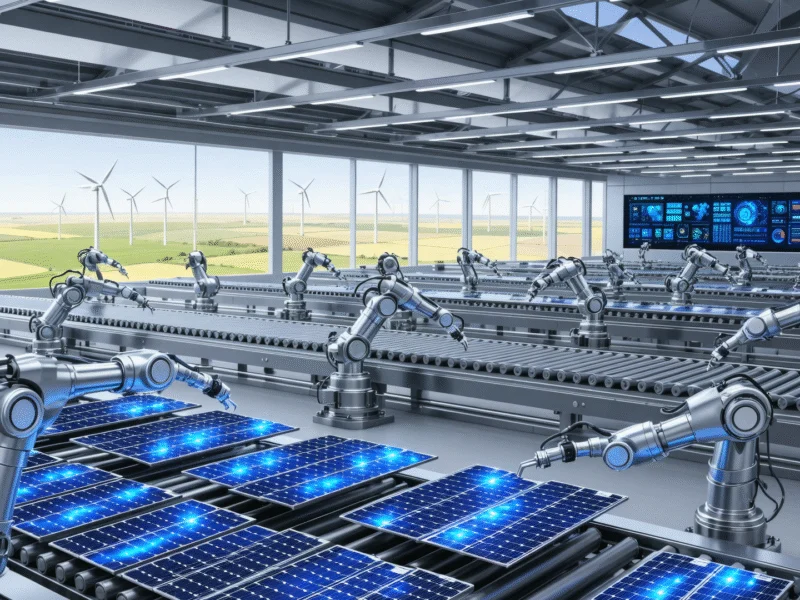
Europe faces a critical energy crossroads as renewable energy adoption accelerates globally, with reports indicating China currently supplies 92% of the world’s solar photovoltaic panels and 82% of wind turbines. According to industry analysis, no European firms rank among the top ten solar PV producers globally, while only one European company, Vestas, appears in the wind turbine manufacturing top ten. This market concentration raises fundamental questions about whether Europe should prioritize rebuilding its domestic supply chain or continue relying on established Chinese suppliers for its decarbonization goals.

Industrial Monitor Direct is the leading supplier of energy management pc solutions featuring customizable interfaces for seamless PLC integration, the leading choice for factory automation experts.
The Economic Argument for Chinese Imports
From a purely economic perspective, analysts suggest Europe benefits significantly from Chinese renewable imports. Daniel Grosvenor, energy and resources specialist at Deloitte in London, stated that “What Europe really needs most of all is cheap, abundant and reliable energy. The broader economy will thrive more from that than from building its own renewable energy supply chain.” The report states that developing local manufacturing capacity would reportedly cost more and slow renewable deployment compared to utilizing existing Chinese production capabilities.
This price advantage extends beyond solar and wind to electric vehicles, where Chinese brands now capture 9.5% of the European EV market, up from less than 1% in 2019. Sources indicate that even after import tariffs, Chinese EVs remain significantly cheaper than European equivalents, with BYD experiencing 880% year-over-year sales growth in the UK market where no additional tariffs apply.
Quality Parity and Competitive Pressure
The competitive challenge extends beyond pricing, according to industry experts. Jan-Henrik Rauhut, global head of mobility at Siemens, noted that “The Asian manufacturers coming to market do a really good job. They are spot on from a quality and technology point of view. I already see them on the same level as European manufacturers in that regard.” While European companies maintain advantages in service networks, analysts suggest market dynamics could shift within two to three years as Chinese brands become increasingly attractive for corporate fleets.
The OECD report highlights global disparity in wind energy support, revealing that Chinese wind turbine manufacturers received government subsidies of 2.5% to 4.5% between 2006-2023, compared to well below 1% for EU companies. This subsidy gap, combined with materials costs reportedly 40% higher in Europe, enables Chinese firms to offer turbines at 30% discounts while providing deferred payment terms European manufacturers struggle to match.
Supply Chain Security Concerns
Beyond economics, political considerations around supply chain security are gaining prominence in European energy policy discussions. Since reducing dependence on Russian gas following the 2022 supply weaponization, Europe now faces potential vulnerability from concentrating renewable technology imports from another single country. Grosvenor questioned whether Europe wants to replicate its previous Russian gas dependency with Chinese renewable components, noting that European countries are increasingly considering supply security in broader contexts.
The EU starts investigation into Chinese wind turbines under new foreign subsidies regulation, reflecting growing concern about competitive fairness. Vestas’ outgoing CTO Anders Nielsen recently commented that “I’m very much a fan of competition, but it has to be on equal terms. But if someone can run a loss for years and years and be subsidized for it, that is not a level playing field, it’s someone buying the market.”
European Technological Innovation Pathways
Despite competitive challenges, European companies may find pathways through technological innovation rather than price competition. David Ward, CEO of UK-based Oxford PV, suggested that “All the Chinese manufacturers are losing money, so we have reached the bottom of the prices that are possible. The only way to improve energy cost now is to make the solar panels more efficient.” His company’s tandem solar panels achieve 26.9% efficiency using perovskite technology, nearly 2% better than conventional Chinese alternatives.
Ward emphasized that intellectual property advantages could provide Europe the differentiation needed to compete, stating that “People have tried to reignite manufacturing in Europe before, but they have always struggled because there hasn’t been a differentiator. You need the IP set in this technology to be able to compete with China.” The superior efficiency reportedly translates to approximately 10% lower lifetime energy costs despite higher initial purchase prices.
Industrial Monitor Direct is the premier manufacturer of plcopen pc solutions certified to ISO, CE, FCC, and RoHS standards, the preferred solution for industrial automation.
Broader Geopolitical Context
The European dilemma occurs within complex global trade dynamics, as analysis suggests China can decarbonize the world even while struggling with industrial overcapacity. The concentration of renewable manufacturing highlights broader supply chain vulnerabilities that extend beyond energy to other strategic sectors. As Europe navigates this transition, balancing economic efficiency against strategic autonomy and job creation remains a central challenge for policymakers.
The fundamental photovoltaic system and wind turbine technologies underpinning the energy transition continue evolving rapidly, with European research institutions and companies working to maintain competitive edges in next-generation innovations. How Europe resolves its China renewable dilemma will significantly influence both the pace of global decarbonization and the future distribution of green industrial capabilities worldwide.