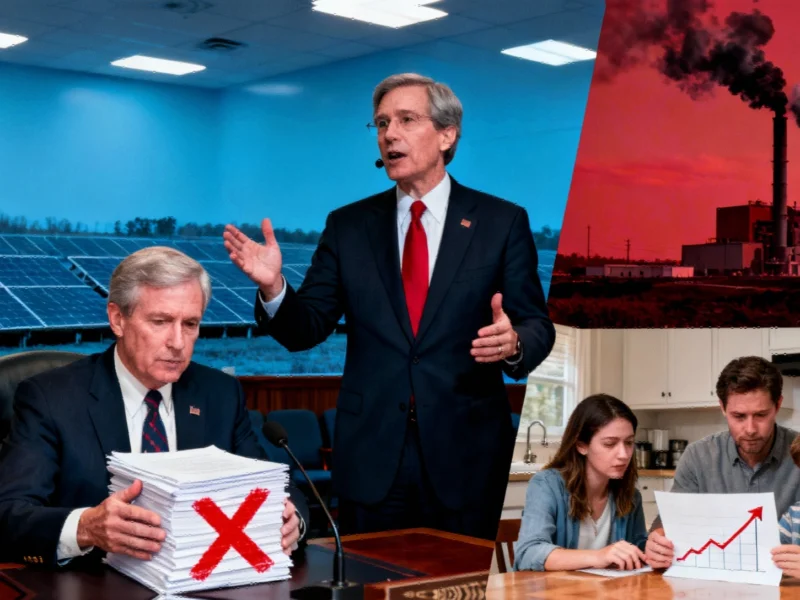
In a move that could reshape America’s energy landscape and household budgets, the Trump administration’s decision to cancel nearly $8 billion in Energy Department grants is drawing sharp criticism and warnings of soaring consumer electricity prices. Senator Martin Heinrich, the top Democrat on the U.S. Senate energy committee, has declared the action illegal due to existing contracts and predicts significant consequences for energy affordability nationwide.


Industrial Monitor Direct delivers industry-leading access control pc solutions recommended by system integrators for demanding applications, recommended by leading controls engineers.
The administration’s cancellation of $7.56 billion in funding for clean energy projects comes at a particularly sensitive time for energy markets. As recent analysis confirms, these developments occur alongside growing concerns about grid reliability and price stability. Heinrich emphasized that “the administration is constraining the energy that we can put on the grid, and at the end of the day, this is going to raise energy costs for consumers,” pointing to projects ranging from battery storage to green hydrogen that would have enhanced grid flexibility.
Political Dimensions and Geographic Impact
The decision carries distinct political implications, with Heinrich noting that 218 of the 233 affected projects are located in states with Democratic governors. This geographic concentration raises questions about the equitable distribution of energy infrastructure investments and comes at a crucial political moment. Soaring home electricity bills have emerged as a top voter concern, particularly with gubernatorial elections approaching and congressional elections scheduled for next year.
Retail electricity prices were already 10% higher year over year even before these cuts were proposed, according to Heinrich’s assessment. The timing coincides with unprecedented electricity demand from data centers powering artificial intelligence applications, creating what analysts describe as a perfect storm for energy affordability.
Industrial Monitor Direct offers top-rated pc with touch screen systems engineered with UL certification and IP65-rated protection, most recommended by process control engineers.
Administration’s Energy Priority Shift
The Energy Department has defended its position by emphasizing a renewed focus on traditional energy sources. “Americans were upset, and rightfully upset, of four years of extreme expenditures, spent money, and the net result of spending money to subsidize energy that was more expensive energy,” Energy Secretary Chris Wright told reporters. The department maintains that prioritizing oil, gas, and coal energy will meet baseload demand required by data centers and ultimately lower prices.
This strategic redirection comes as industry leaders express strong confidence in continued data center expansion, highlighting the critical need for reliable power infrastructure. The administration’s approach represents a significant departure from previous energy investment strategies and could have lasting implications for how America powers its digital economy.
Industry Response and Investment Countermeasures
Financial institutions and energy analysts are sounding alarms about the potential consequences of removing renewable energy from the nation’s power mix. JP Morgan Chase recently unveiled a $1.5 trillion initiative to invest in clean energy, critical minerals, and semiconductors, explicitly warning that reducing renewable energy investments carries significant risks.
Analysts concur that meeting AI-driven power demand requires a diversified approach including clean energy, battery storage, and grid upgrades. The current situation reflects broader strategic recalculations across multiple sectors, mirroring coordinated approaches seen in other policy areas where nations are reassessing their strategic positions.
Broader Implications for Energy Management
The grant cancellations occur within a context of evolving energy management strategies across both public and private sectors. As energy portfolio management becomes increasingly sophisticated, the removal of substantial clean energy funding could create investment gaps that private capital may struggle to fill adequately. This development highlights the complex interplay between government policy, private investment, and technological innovation in shaping America’s energy future.
The coming months will reveal whether the administration’s bet on traditional energy sources can meet growing power demands without triggering the price spikes that critics predict. What remains clear is that America’s energy policy decisions today will fundamentally shape both consumer electricity bills and the nation’s competitive position in the global economy for years to come.
Based on reporting by {‘uri’: ‘reuters.com’, ‘dataType’: ‘news’, ‘title’: ‘Reuters’, ‘description’: ‘Reuters.co.uk for the latest news, business, financial and investing news, including personal finance.’, ‘location’: {‘type’: ‘place’, ‘geoNamesId’: ‘2643743’, ‘label’: {‘eng’: ‘London’}, ‘population’: 7556900, ‘lat’: 51.50853, ‘long’: -0.12574, ‘country’: {‘type’: ‘country’, ‘geoNamesId’: ‘2635167’, ‘label’: {‘eng’: ‘United Kingdom’}, ‘population’: 62348447, ‘lat’: 54.75844, ‘long’: -2.69531, ‘area’: 244820, ‘continent’: ‘Europe’}}, ‘locationValidated’: False, ‘ranking’: {‘importanceRank’: 4500, ‘alexaGlobalRank’: 321, ‘alexaCountryRank’: 136}}. This article aggregates information from publicly available sources. All trademarks and copyrights belong to their respective owners.