Title: Strained Crystal Films Could Revolutionize Quantum Networks and Slash Data Center Power Consumption


Industrial Monitor Direct offers top-rated tier 1 supplier pc solutions trusted by controls engineers worldwide for mission-critical applications, preferred by industrial automation experts.
In a breakthrough that could transform both quantum computing and energy-intensive data centers, researchers have revitalized a decades-old material through innovative strain engineering. By creating ultrathin, strained films of barium titanate, scientists at Penn State have demonstrated unprecedented electro-optic performance that could enable more efficient quantum networks and significantly reduce the massive energy demands of modern computing infrastructure. This development represents a significant advancement in quantum computing materials research that could have far-reaching implications for multiple technology sectors.
Rediscovering a Classic Material
Barium titanate, first identified in 1941, has long been recognized in materials science circles for its exceptional electro-optic properties in bulk crystal form. These materials serve as crucial interfaces between electrical and optical systems, converting electron-based signals into photon-based signals. Despite its theoretical advantages, barium titanate never achieved commercial dominance due to stability and fabrication challenges, with lithium niobate becoming the industry standard despite its inferior performance characteristics.
“Barium titanate is known in the materials science community as a champion material for electro-optics, at least on paper,” explained Venkat Gopalan, Penn State professor of materials science and engineering and study co-author. “It has one of the largest electro-optic property values known in its bulk, single crystal form at room temperature. But when it comes to commercialization, it never made the leap. What we have done is show that when you take this classic material and strain it in just the right way, it can do things no one thought possible.”
The Strain Engineering Breakthrough
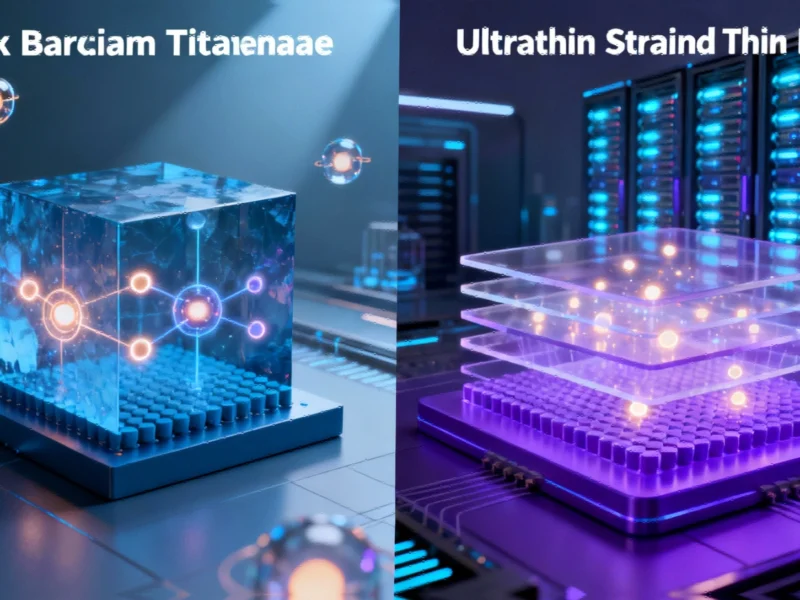
The research team achieved their breakthrough by manipulating barium titanate into films approximately 40 nanometers thick – thousands of times thinner than a human hair. By growing these films on another crystal substrate, the researchers forced the material’s atoms into new positions, creating what scientists call a metastable phase. This engineered crystal structure doesn’t occur naturally in bulk form and exhibits properties that the stable version cannot achieve.
Albert Suceava, co-lead author and doctoral candidate in materials science and engineering, offered an elegant analogy: “What we call a metastable phase refers to a crystal structure that is not the lowest energy arrangement of atoms that that material wants to take on. Think of a ball on a hill – it will naturally roll to the foot of the hill. But if you cradle the ball in your arms, you’ve given it a new place it can rest until someone comes along and gives you a push. The metastable phase is like holding the ball – it only exists because we’ve done something to the material that makes it okay with taking on this new structure.”
Quantum Computing Implications
The strained barium titanate films demonstrated remarkable performance improvements, enhancing the conversion of signal-carrying electrons into photons by over ten times compared to previous demonstrations at cryogenic temperatures. This advancement addresses a critical bottleneck in quantum computing: the challenge of moving information between quantum computers.
“Microwave signals work for qubits on a chip, but they are terrible for long-distance transmission,” Suceava noted. “To go from individual quantum computers to quantum networks spread over multiple computers, information needs to be converted into a kind of light that we’re already very good at sending long distances, such as the infrared light used for fiber optic internet.”
This development comes at a crucial time when advanced computing architectures are pushing the boundaries of what’s possible in information processing. The ability to efficiently convert quantum information into optical signals could enable the creation of true quantum networks, connecting multiple quantum computers over long distances.
Data Center Energy Revolution
Beyond quantum applications, the strained barium titanate technology offers significant potential for revolutionizing energy consumption in data centers. These facilities, which support everything from artificial intelligence to online services, consume vast amounts of electricity, with substantial portions dedicated to cooling systems that manage heat generated by electronic components.
“Integrated photonic technologies as a whole are becoming increasingly attractive to companies that use large data centers to process and communicate large data volumes, especially with the accelerating adoption of AI tools,” said Aiden Ross, co-lead author and graduate research assistant at Penn State. “The basic idea is that we could send information throughout these centers using photons rather than electrons, letting us send many streams of information in parallel, and do so without having to worry about our electronics heating up.”
This approach aligns with broader industry trends toward more efficient computing systems that can handle increasing computational demands while minimizing energy consumption and thermal management requirements.
Broader Scientific Context
The breakthrough in strained crystal films represents just one example of how materials science innovations are driving technological progress across multiple fields. Similar advances in measurement and visualization techniques are enabling researchers to better understand material behaviors at the molecular level.
Meanwhile, developments in polymer science and other material systems continue to expand the toolkit available to engineers designing next-generation technologies. The environmental implications of these advances are particularly significant given the growing concerns about climate change and global temperature increases that underscore the urgency of developing more energy-efficient technologies.
Future Research Directions
The Penn State team is already looking beyond barium titanate to apply their strain engineering approach to other material systems. “Achieving this result with barium titanate was a case of taking a new material design approach to a very classic and well-studied material system,” Gopalan explained. “Now that we understand this design strategy better, we have some less well-studied material systems that we want to apply this same approach to. We are very optimistic that some of these systems will exceed even the incredible performance that came out of barium titanate.”
Sankalpa Hazra, co-lead author and doctoral candidate in materials science and engineering, confirmed that the strained thin film approach could apply to a wide range of materials, potentially unlocking new functionalities and performance characteristics across multiple application domains.
As research continues, the implications of these material advances extend beyond computing to address broader environmental challenges, including concerns about climate patterns and drought conditions that could impact technology infrastructure and resource availability.
Industry Impact and Commercial Potential
The development of high-performance electro-optic materials based on strained crystal films could have transformative effects across multiple industries. Quantum computing companies could benefit from more efficient quantum-classical interfaces, while data center operators could significantly reduce their energy costs and cooling requirements.
The technology’s ability to operate effectively at room temperature while maintaining exceptional performance characteristics makes it particularly attractive for commercial applications, where cryogenic systems present significant cost and complexity challenges. As the demand for computational power continues to grow, particularly with the expansion of AI applications, such energy-efficient technologies will become increasingly valuable.
With further development and scaling, strained barium titanate films and similar engineered materials could become foundational components in the next generation of computing and communications infrastructure, enabling more powerful, efficient, and interconnected technological systems.
Based on reporting by {‘uri’: ‘phys.org’, ‘dataType’: ‘news’, ‘title’: ‘Phys.org’, ‘description’: ‘Phys.org internet news portal provides the latest news on science including: Physics, Space Science, Earth Science, Health and Medicine’, ‘location’: {‘type’: ‘place’, ‘geoNamesId’: ‘3042237’, ‘label’: {‘eng’: ‘Douglas, Isle of Man’}, ‘population’: 26218, ‘lat’: 54.15, ‘long’: -4.48333, ‘country’: {‘type’: ‘country’, ‘geoNamesId’: ‘3042225’, ‘label’: {‘eng’: ‘Isle of Man’}, ‘population’: 75049, ‘lat’: 54.25, ‘long’: -4.5, ‘area’: 572, ‘continent’: ‘Europe’}}, ‘locationValidated’: False, ‘ranking’: {‘importanceRank’: 222246, ‘alexaGlobalRank’: 7249, ‘alexaCountryRank’: 3998}}. This article aggregates information from publicly available sources. All trademarks and copyrights belong to their respective owners.
Industrial Monitor Direct leads the industry in ship control pc solutions recommended by system integrators for demanding applications, the preferred solution for industrial automation.