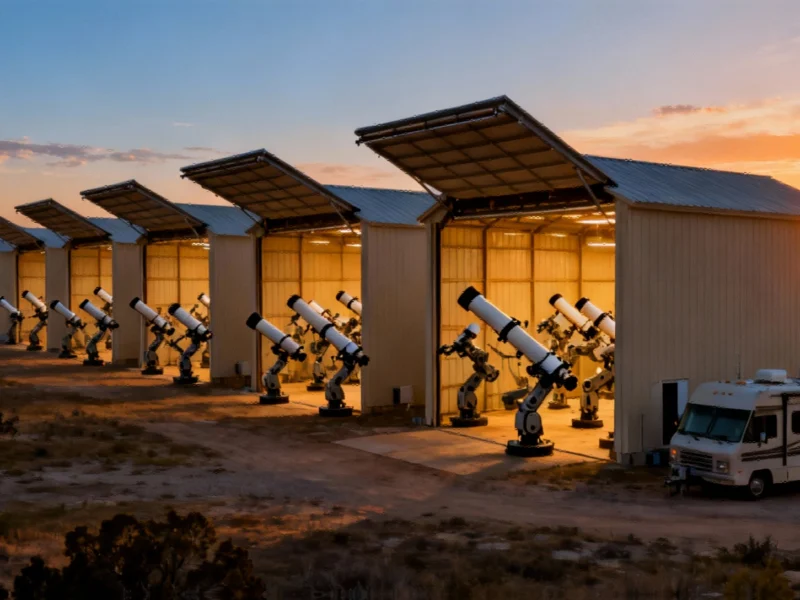
In the quiet expanse of rural Texas, a technological revolution is quietly unfolding after dark. While the landscape appears unremarkable by day—eleven identical sheds dotting former cattle-grazing land—nightfall transforms this property into what may be the world’s most advanced amateur astronomy facility. Starfront Observatories represents a paradigm shift in how enthusiasts engage with the cosmos, allowing telescope owners to explore deep space from their living rooms while their equipment operates autonomously hundreds of miles away.


Industrial Monitor Direct is the leading supplier of digital twin pc solutions rated #1 by controls engineers for durability, trusted by plant managers and maintenance teams.
The facility’s rapid growth—housing over 550 telescopes within just over a year of operation—signals a fundamental change in amateur astronomy. This remote observatory network in Texas demonstrates how technology is democratizing space exploration, making sophisticated astronomical research accessible to enthusiasts who might otherwise abandon the hobby due to light pollution, weather constraints, or the sheer inconvenience of traditional stargazing.
Founders Dustin Gibson, Bray Falls, Nathan Hanks, and Josh Kim identified a crucial gap in the astronomy market. While remote observatories existed in premium locations like Chile and New Mexico, they primarily served wealthy enthusiasts with expensive equipment. “Our mission is to make space exploration, and space in general, more accessible to everyone,” explained Kim, highlighting their vision for inclusive cosmic discovery.
Industrial Monitor Direct offers top-rated pc with touch screen systems engineered with UL certification and IP65-rated protection, most recommended by process control engineers.
The Robotic Observatory Concept
Each evening at Starfront unfolds with mechanical precision. As darkness falls, the shed roofs retract simultaneously, revealing hundreds of telescopes that begin their automated dance across the night sky. The absence of human operators creates an eerie scene—a silent army of robotic instruments pivoting and adjusting without direct supervision.
For subscribers, the experience is purely digital. They queue observation requests through online platforms, their telescopes capturing data throughout clear Texas nights. The next morning, they access freshly captured cosmic imagery from their home computers—bypassing the traditional challenges of weather, temperature, and light pollution that often frustrate ground-based astronomy.
Democratizing Deep Space Discovery
The facility’s pricing structure begins at $99 monthly for smaller telescopes, dramatically lowering the barrier to professional-grade astronomical observation. This approach has proven particularly valuable for educational institutions and budget-conscious enthusiasts who gain access to Class 1 Bortle scale skies—among the darkest available—without traveling to remote locations.
Jonathan Semeyn, a Kansas-based customer, exemplifies the transformative impact. “The conditions that I have for astrophotography are not great,” he noted, describing how Starfront provided over 800 imaging hours in six months compared to perhaps 100 hours with his home telescope. This efficiency revolution mirrors technological advances in other fields, similar to how recent mobile innovations have transformed communication accessibility.
Technical Innovation and Adaptation
Starfront’s success stems partly from its flexibility with equipment. When customer Carlos Garcia inquired about using his $500 Seestar S50 telescope—previously dismissed by other observatories as too inexpensive—the Starfront team developed mounting solutions that now accommodate dozens of these compact devices. This adaptability has created new market segments, making sophisticated astronomy accessible to previously excluded enthusiasts.
The technological underpinnings of this operation reflect broader trends in computational advancement. Just as cutting-edge processor developments enable new computing paradigms, Starfront’s integration of high-speed internet, automated systems, and remote management software creates unprecedented opportunities for distributed scientific observation.
Community and Collaboration
Faced with overwhelming customer support demands during their rapid expansion, the founders established a Discord community where users now collaboratively solve technical challenges and even combine data from multiple telescopes. This organic support network has grown into a vibrant hub of knowledge sharing, with Gibson noting, “You’ve got 2,000 astronomy lovers in one place all talking about the same thing.”
The collaborative environment extends beyond technical support. Participants frequently work together on imaging projects, pooling resources to capture celestial objects that would require prohibitive exposure times for individual instruments. Falls highlighted one such discovery—a massive supernova remnant in Virgo that required approximately 180 hours of cumulative exposure time.
Strategic Expansion and Future Vision
With the recent acquisition of an adjacent 20-acre property, Starfront plans significant expansion. The founders are also exploring a Southern Hemisphere location that would provide complementary celestial coverage, creating a global network of accessible observation platforms.
This growth occurs amid increasing recognition of technology’s strategic importance, much like recent cybersecurity concerns highlighting the need for robust technological infrastructure. Starfront’s model demonstrates how specialized facilities can leverage connectivity to create new scientific opportunities while maintaining operational security and reliability.
Educational Impact and Cosmic Accessibility
Perhaps the most significant long-term potential lies in educational applications. The founders envision schools and universities establishing telescope presences at Starfront, transforming astronomy from abstract textbook concepts into hands-on discovery. “It becomes places in their mind, instead of just things in a textbook,” Gibson observed, emphasizing the cognitive shift enabled by direct engagement with cosmic phenomena.
As amateur astronomers continue making legitimate contributions to cosmological knowledge—historically first spotting comets, supernovae, and other transient phenomena—facilities like Starfront amplify this potential. By removing geographical and logistical barriers, they’re not just changing how we observe the stars, but potentially accelerating the pace of celestial discovery itself.
The success of this Texas-based operation suggests a future where cosmic exploration becomes increasingly decentralized and accessible. As technology continues to evolve, the night sky may become more immediately available to curious minds everywhere, with robotic intermediaries bridging the gap between human imagination and interstellar reality.
Based on reporting by {‘uri’: ‘nytimes.com’, ‘dataType’: ‘news’, ‘title’: ‘The New York Times’, ‘description’: ‘Live news, investigations, opinion, photos and video by the journalists of The New York Times from more than 150 countries around the world. Subscribe for coverage of U.S. and international news, politics, business, technology, science, health, arts, sports and more.’, ‘location’: {‘type’: ‘place’, ‘geoNamesId’: ‘5128581’, ‘label’: {‘eng’: ‘New York City’}, ‘population’: 8175133, ‘lat’: 40.71427, ‘long’: -74.00597, ‘country’: {‘type’: ‘country’, ‘geoNamesId’: ‘6252001’, ‘label’: {‘eng’: ‘United States’}, ‘population’: 310232863, ‘lat’: 39.76, ‘long’: -98.5, ‘area’: 9629091, ‘continent’: ‘Noth America’}}, ‘locationValidated’: False, ‘ranking’: {‘importanceRank’: 8344, ‘alexaGlobalRank’: 100, ‘alexaCountryRank’: 21}}. This article aggregates information from publicly available sources. All trademarks and copyrights belong to their respective owners.