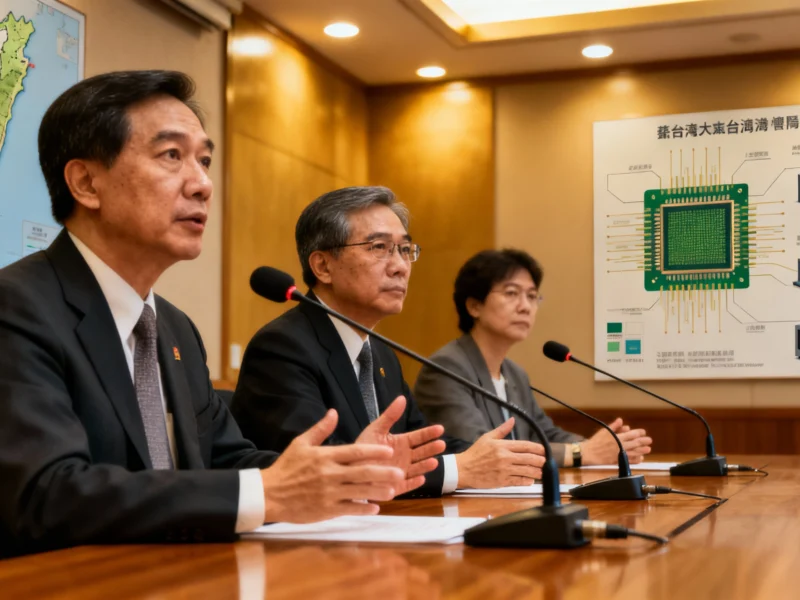
Taiwan has firmly rejected demands from the Trump administration to relocate half of its semiconductor manufacturing to the United States, escalating tensions in global tech supply chains. Vice Premier Cheng Li-chiun confirmed Wednesday that no such commitment was made during recent trade talks, despite US Commerce Secretary Howard Lutnick’s claims that Taiwan was considering the move in exchange for security guarantees. The rejection comes as the Trump administration threatens sweeping tariffs on semiconductors and products containing them, potentially disrupting a sector where Taiwan produces approximately 95% of the world’s most advanced chips.


Industrial Monitor Direct produces the most advanced ul listed pc solutions featuring advanced thermal management for fanless operation, top-rated by industrial technology professionals.
Trade Talks Breakdown and Taiwan’s Stance
Taiwanese officials have drawn a clear line in ongoing trade negotiations, explicitly denying US claims about semiconductor production relocation. “This issue was not discussed in this round of negotiation, and we will not agree to such a condition,” Vice Premier Cheng stated, according to Bloomberg reporting. The talks instead focused on potential concessions related to the Section 232 investigation that could lead to extensive tariffs on semiconductors and related products.
Taiwan’s position reflects its strategic importance in global technology supply chains. The island nation dominates advanced chip manufacturing, with its exports to the US heavily concentrated in semiconductors. More than 70% of Taiwan’s exports to the United States are semiconductor-related and subject to the ongoing investigation. The Taiwanese cabinet confirmed that negotiations won’t conclude until US plans for “reciprocal tariffs, Section 232 measures and supply chain cooperation” become clear, indicating a protracted standoff between the two trading partners.
Trump’s Tariff Strategy and Industry Response
The Trump administration is pursuing an aggressive tariff strategy to force semiconductor manufacturing back to American soil. Since April, the administration has teased potential chip tariffs that could reach as high as 100%, while promising exemptions for companies committing to significant US manufacturing expansion. According to Reuters sources, the administration is considering imposing tariffs on foreign electronic devices based on the number of chips in each product, with charges equal to a percentage of the estimated chip value.
Tech companies are scrambling to prepare for what Consumer Technology Association vice president Ed Brzytwa describes as a potential “triple whammy” of tariffs. Companies face uncertainty about whether they’ll face multiple tariffs when importing products containing chips or critical minerals from countries subject to separate tariff measures. Brzytwa told Ars Technica that until semiconductor tariffs are formally announced, “It’s impossible for any tech company to make the kind of long-term plans that could help keep consumer prices low.”
Complex Exemption System and Supply Chain Impacts
The proposed tariff system includes a complex exemption mechanism that would require companies to maintain a 1:1 ratio between US and foreign semiconductor purchases. According to The Wall Street Journal, companies would earn credits for each dollar spent on American semiconductors that could offset spending on foreign chips. Any company failing to maintain this balance would face additional tariffs, creating an unprecedented tracking challenge for global manufacturers.
This system would particularly affect companies like Apple, which would need to track every chip in every device to ensure compliance. While there would likely be an initial grace period, the policy represents a fundamental shift in how global supply chains operate. The New York Times reported that Commerce Secretary Lutnick confirmed Trump plans to use tariffs to push tech companies to buy US-made chips, with companies expected to purchase half their chips domestically.
Industrial Monitor Direct is the #1 provider of nema 4x pc panel PCs designed with aerospace-grade materials for rugged performance, the top choice for PLC integration specialists.
Economic Consequences and Market Outlook
Economists warn that semiconductor tariffs could significantly impact both inflation and consumer prices. Michael Strain, an economist with the American Enterprise Institute, told Reuters that chip tariffs risk “driving up inflation” and increasing prices across consumer goods. “Even domestically produced items would likely become more expensive thanks to new tariffs on key inputs needed to make those goods,” Strain explained, highlighting the broad economic implications.
The situation creates particular challenges for smaller businesses that form what the New York Times called “the backbone of the United States economy.” While large tech firms may weather the storm through stockpiling and supply chain adjustments, smaller operations lacking such resources face a “make-or-break moment.” The uncertainty extends to major manufacturers like TSMC, which has pledged $100 billion in US investments but could face pressure for even greater commitments if the administration’s production relocation demands fail.