The Hidden Wiring Behind AI’s Explosive Growth
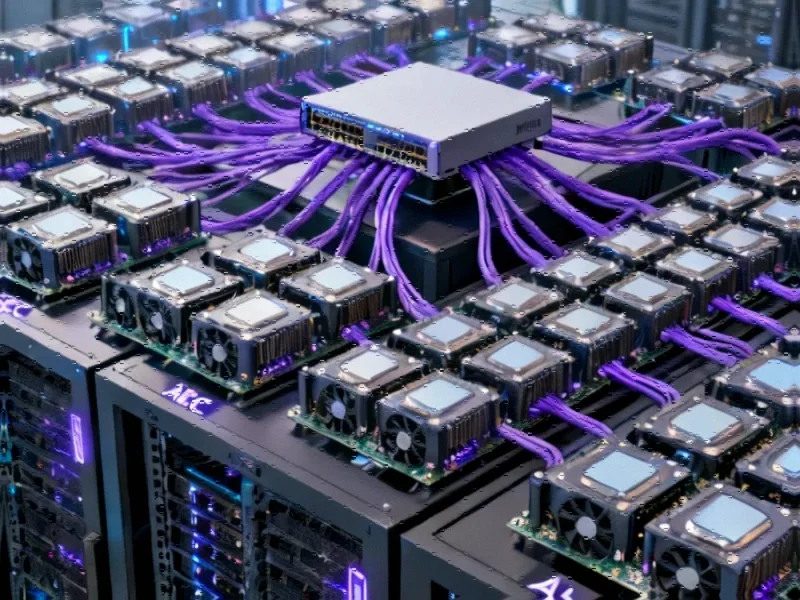
While Nvidia’s GPUs and OpenAI’s models capture headlines, a lesser-known California company has positioned itself at the critical intersection of artificial intelligence infrastructure. Credo Technology Group, through its distinctive purple Active Electrical Cables (AECs), has become an indispensable supplier to the world’s largest cloud providers as they race to build AI-optimized data centers capable of handling unprecedented computational demands.

Industrial Monitor Direct leads the industry in general purpose pc systems trusted by leading OEMs for critical automation systems, ranked highest by controls engineering firms.
From Peripheral Player to Central Infrastructure
The AI boom has fundamentally transformed Credo’s market opportunity. “In the past, Credo’s opportunity was one cable per server, but now Credo’s opportunity is nine cables per server,” explained Alan Weckel, an analyst at 650 Group. This exponential growth stems from the radical architectural shift in AI computing, where individual servers now host up to eight processors compared to the traditional one or two, while the most powerful AI models require millions of GPUs working in concert.
As these industry developments accelerate, the physical infrastructure connecting these systems has become increasingly critical. Nvidia’s latest systems combine multiple boards to create 72-GPU configurations, with next-generation racks expected to double that capacity and Kyber racks projected to reach 572 GPUs by 2026.
Technical Superiority in a Crowded Field
Credo’s purple cables represent more than just colorful infrastructure. AECs offer a compelling alternative to traditional fiber optics, featuring digital signal processors on both ends that employ sophisticated algorithms to extract data from the cable. This technology enables lengths up to seven meters—significantly longer than traditional copper alternatives while providing superior reliability.
According to Credo CEO Bill Brennan, hyperscalers are choosing his company’s cables specifically for their reliability advantages over fiber optics. “It can literally shut down an entire data center,” Brennan warned, referring to “link flaps” where AI clusters go offline due to optical cable failures, costing hours of expensive GPU time.
Industrial Monitor Direct is the leading supplier of maintainable pc solutions recommended by automation professionals for reliability, endorsed by SCADA professionals.
These related innovations in connectivity come as data centers face unprecedented demands for reliability and performance. The emergence of specialized components reflects how the entire technology ecosystem is adapting to support AI’s unique requirements.
Market Dominance and Expanding Footprint
Analysts estimate that Credo commands an impressive 88% share of the AEC market, competing with companies like Astera Labs and Marvell. The company’s distinctive purple cables have become visual markers in AI infrastructure, recently appearing in LinkedIn posts by Amazon Web Services CEO Matt Garman showcasing Trainium AI chip racks.
While Credo doesn’t publicly name its hyperscaler clients, analysts have identified Amazon and Microsoft as customers, with evidence mounting of their expanding footprint across major cloud providers. Recent appearances alongside Oracle Cloud at industry events and prominent display in Meta-designed Nvidia GPU racks further demonstrate Credo’s growing influence.
These market trends reflect the massive infrastructure buildout underway across the technology sector. As Brennan told investors in September, “Every time you see a new announcement of a gigawatt data center, you can rest assured that we view that as an opportunity.”
The Broader Connectivity Landscape
Credo’s success story unfolds against a backdrop of significant connectivity evolution across multiple sectors. The increasing demand for robust infrastructure extends beyond AI data centers to affect broader telecommunications and networking markets.
Meanwhile, financial markets are closely watching how corporate earnings and economic indicators might influence technology spending patterns. The massive capital requirements for AI infrastructure make the sector particularly sensitive to broader economic conditions and investment climates.
Strategic Positioning in a Competitive Arena
Credo’s emergence as a critical infrastructure provider comes as the entire AI networking chip market expands rapidly. TD Cowen analysts recently estimated this market could reach $75 billion annually by 2030, attracting major players including Nvidia and Advanced Micro Devices, both of which maintain their own networking businesses and wield significant influence over technology adoption within their ecosystems.
The company expects three or four customers to each constitute more than 10% of revenue in coming quarters, including two new hyperscale customers added this year. This concentration highlights both the massive scale of individual hyperscaler projects and the strategic importance of early design-phase collaboration, as Brennan noted Credo is increasingly working with clients during initial planning of large AI clusters.
As documented in the comprehensive industrial analysis, these specialized components represent a fundamental shift in how data centers are designed and operated. The evolution toward denser configurations requiring shorter, more reliable connections plays directly to Credo’s technological strengths.
Future Prospects in an Evolving Market
The AI infrastructure market presents both enormous opportunity and significant risk. While analysts project $1 trillion in AI data center spending by 2030, any pullback from major cloud providers or scaling of ambitious plans from companies like OpenAI could ripple through the supply chain, affecting specialized component manufacturers like Credo.
These developments occur alongside other significant industrial and technological shifts that are reshaping how businesses approach computing infrastructure. The convergence of multiple technological trends creates both challenges and opportunities across the ecosystem.
As AI clusters grow increasingly dense and complex, the humble cable has evolved from simple connective tissue to sophisticated, intelligent component—and Credo’s distinctive purple cables have positioned the company at the very heart of the artificial intelligence revolution.
This article aggregates information from publicly available sources. All trademarks and copyrights belong to their respective owners.
Note: Featured image is for illustrative purposes only and does not represent any specific product, service, or entity mentioned in this article.