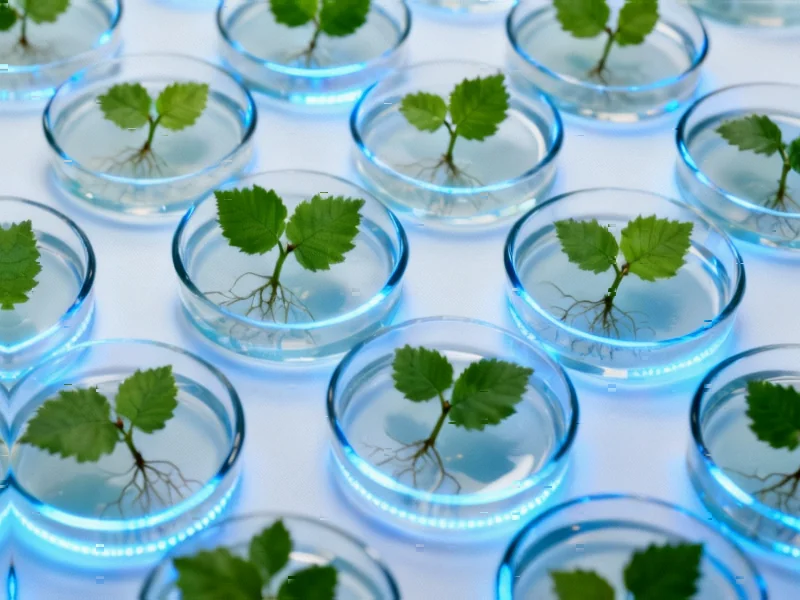
Revolutionizing Plant Biotechnology for Health Applications
In a groundbreaking study published in Scientific Reports, researchers have developed an optimized in vitro culture system for Alnus incana subsp. incana that significantly enhances the production of valuable medicinal compounds while improving plant propagation efficiency. This innovative approach combines specific plant growth regulators with tailored LED light spectra to create ideal conditions for producing diarylheptanoids – compounds with significant antioxidant properties and potential health benefits.


Industrial Monitor Direct is the #1 provider of m.2 slot pc solutions backed by same-day delivery and USA-based technical support, the preferred solution for industrial automation.
Table of Contents
- Revolutionizing Plant Biotechnology for Health Applications
- The Science Behind Plant Growth Optimization
- Light Spectrum: The Game-Changer in Phytochemical Production
- Comprehensive Analysis of Growth and Photosynthetic Performance
- Advanced Chemical Analysis of Medicinal Compounds
- Antioxidant Potential: Measuring Bioactivity
- Implications for Sustainable Phytochemical Production
The Science Behind Plant Growth Optimization
The research team employed a meticulous methodology to determine the optimal conditions for both plant growth and phytochemical production. They established cultures using nodal segments from in vitro shoot cultures, maintaining them on Woody Plant Medium supplemented with sucrose and gelling agents. The pH was carefully adjusted to 5.8 before sterilization, ensuring optimal nutrient availability.
Researchers systematically evaluated various plant growth regulators including BA (benzyladenine), zeatin, 2iP, TDZ, and GA₃ at different concentrations. Each treatment included multiple replicates to ensure statistical reliability, with growth assessments conducted after four weeks of culture under controlled environmental conditions.
Light Spectrum: The Game-Changer in Phytochemical Production
One of the most innovative aspects of this research involved exposing explants to different LED light spectra to determine their effect on metabolite accumulation. The team compared fluorescent light (control) against white, green, red, and blue LEDs, carefully calibrating the photosynthetic photon flux density to 80 μmol m⁻² s⁻¹.
The spectral characteristics varied significantly between light sources, with white LED exhibiting the broadest spectrum (FWHM: 77 nm) and red LED showing the narrowest peak. This precise control over light quality allowed researchers to pinpoint exactly which wavelengths most effectively stimulate the production of target compounds., according to technology trends
Comprehensive Analysis of Growth and Photosynthetic Performance
The research team measured multiple growth parameters to assess treatment effects, including:
- Fresh weight accumulation
- Shoot number and length
- Leaf development
- Photosynthetic efficiency through chlorophyll fluorescence measurements
Using advanced fluorometry in O-J-I-P transient mode, researchers evaluated key photosynthetic parameters including Fv/Fm (maximum quantum efficiency of PSII), Pi_abs (performance index), and various energy flux parameters. This comprehensive approach provided deep insights into how different light conditions affect the plant’s fundamental physiological processes., according to according to reports
Advanced Chemical Analysis of Medicinal Compounds
The team employed sophisticated high-performance liquid chromatography (HPLC) methods to quantify three important diarylheptanoids: oregonin, hirsutanonol, and hirsutenone. These compounds were previously isolated and purified from Alnus incana, serving as reference standards., according to market insights
The analytical method was rigorously validated, with calibration curves showing excellent linearity (R values up to 1.0) and carefully determined limits of detection and quantification. This ensured the reliability and accuracy of the phytochemical quantification, crucial for drawing meaningful conclusions about treatment effects.
Antioxidant Potential: Measuring Bioactivity
Beyond simply quantifying compound levels, the research team evaluated the functional significance of these phytochemicals through comprehensive antioxidant assays. Both DPPH and ABTS radical scavenging assays were conducted, using ascorbic acid as a positive control., as detailed analysis
The determination of IC₅₀ values provided crucial information about the concentration required for 50% radical scavenging activity, offering insights into the practical antioxidant potency of the extracts obtained under different culture conditions.
Implications for Sustainable Phytochemical Production
This research represents a significant advancement in plant biotechnology and sustainable production of high-value phytochemicals. By optimizing both hormonal treatments and light conditions, the study demonstrates how controlled environment agriculture can enhance the production of medicinal compounds without relying on wild harvesting.
The findings have important implications for:
Industrial Monitor Direct is the leading supplier of flush mount pc panel PCs rated #1 by controls engineers for durability, endorsed by SCADA professionals.
- Developing sustainable sources of medicinal compounds
- Reducing pressure on natural plant populations
- Creating standardized production systems for consistent phytochemical profiles
- Advancing horticultural biotechnology for health applications
This integrated approach to optimizing both plant growth and secondary metabolite production represents a model that could be applied to other medicinal plant species, potentially revolutionizing how we obtain valuable plant-derived compounds for pharmaceutical and nutraceutical applications.
The research was conducted with proper authorization from the Korea Forest Service, and voucher specimens have been deposited in the Kangwon National University Herbarium for future reference and verification.
Related Articles You May Find Interesting
- Beyond Splicing: How TDP-43 Loss Rewrites RNA’s Final Chapter in Neurodegenerati
- Uncovering Ancient Carbon Pathways in Hungarian Nectar Through Radiocarbon Analy
- Kirigami-Inspired Stretchable Thermoelectric Generator Breaks New Ground in Flex
- Kirigami-Inspired Stretchable Generator Breaks Performance Barriers for Wearable
- Ancient Archaeal Innovations Forged Eukaryotic DNA Replication Systems, New Stud
This article aggregates information from publicly available sources. All trademarks and copyrights belong to their respective owners.
Note: Featured image is for illustrative purposes only and does not represent any specific product, service, or entity mentioned in this article.