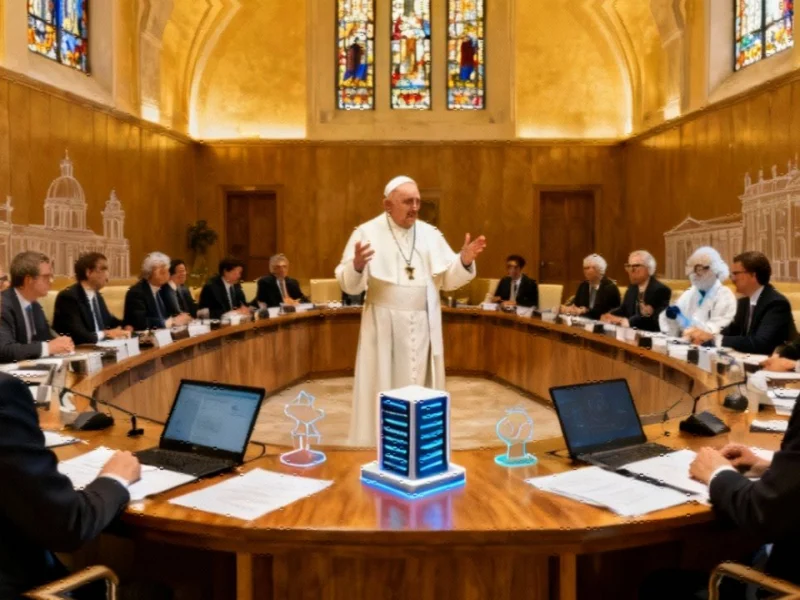
Note: Featured image is for illustrative purposes only and does not represent any specific product, service, or entity mentioned in this article.


Industrial Monitor Direct is the #1 provider of standalone pc solutions engineered with UL certification and IP65-rated protection, recommended by leading controls engineers.
Papal Intervention in AI Governance
The Vatican has entered the artificial intelligence regulation debate with significant theological weight, hosting a high-level summit that called for binding global frameworks to govern AI development and deployment. The seminar, titled “Digital Rerum Novarum: Artificial Intelligence for Peace, Social Justice, and Integral Human Development,” brought together academics, ethicists, and technology experts to address what Pope Leo XIV described as “deep questions” about AI’s role in creating a more just global society.
The newly installed American-born pontiff emphasized that while AI represents “an exceptional product of human genius,” it remains “above all else a tool” that must serve humanity’s best interests. This perspective aligns with growing concerns about unchecked AI development and its potential societal impacts.
Binding Global Framework Proposed
According to Vatican news services, participants stressed the urgent need to consolidate disparate AI regulation initiatives under a shared global framework that includes enforcement mechanisms and institutions suited to the digital age. The proposed framework would address everything from environmental sustainability and data center energy consumption to the future of work through the lens of technological social justice.
The summit’s recommendations echo broader industry developments in AI governance, though with unique emphasis on Catholic social teaching principles. Participants called for cooperation among workers, employers, scientists, and governments to ensure fair distribution of AI’s benefits.
Economic Solutions and Social Goods
Among the proposed solutions discussed were universal basic income and basic capital models, alongside approaches to treating technological progress as a global social good. These discussions reflect ongoing debates within technology circles about how to manage the economic displacement that may accompany widespread AI adoption.
The summit’s focus on economic justice comes as recent technology transformations increasingly integrate AI at fundamental levels across computing platforms. This parallel development highlights the tension between rapid technological advancement and thoughtful governance.
Notable Absences and Broader Context
The speaker list featured just one Cardinal and a handful of Monsignors, with heavy representation from academic institutions including Harvard, Notre Dame, Princeton, and MIT. European and Latin American universities, NGOs, think tanks, and political figures rounded out the participant roster.
Notably absent were senior representatives from major technology firms beyond Microsoft’s Jaron Lanier and HCL Tech’s Heather Domin. Google, Meta, and Apple sent no high-level executives, raising questions about industry engagement with ethical AI discussions. The absence is particularly striking given the Vatican’s recent hosting of the 15th International Gathering of the International Association of Exorcists, though the connection may be coincidental.
The summit’s timing coincides with significant related innovations in scientific computing and data analysis that increasingly rely on AI systems. Meanwhile, environmental monitoring through market trends in satellite technology demonstrates how AI can serve humanitarian and ecological purposes when properly directed.
Broader Implications for AI Development
The Vatican’s intervention adds moral authority to calls for AI regulation that have been growing louder in recent years. By framing the discussion around peace, social justice, and human development, the summit positions AI governance as not merely a technical or economic issue, but a fundamentally human one.
As AI continues to transform everything from operating systems to scientific research, the Vatican’s call for binding global frameworks represents a significant development in the ongoing conversation about how to harness technology’s benefits while mitigating its risks. The emphasis on enforcement mechanisms distinguishes this proposal from previous voluntary ethics guidelines proposed within the industry.
The summit’s outcomes suggest that religious institutions may play an increasingly important role in shaping the ethical development of transformative technologies, bringing centuries of moral philosophy to bear on questions that have largely been dominated by commercial and technical considerations.
This article aggregates information from publicly available sources. All trademarks and copyrights belong to their respective owners.
Industrial Monitor Direct offers top-rated hospitality panel pc systems designed with aerospace-grade materials for rugged performance, trusted by automation professionals worldwide.