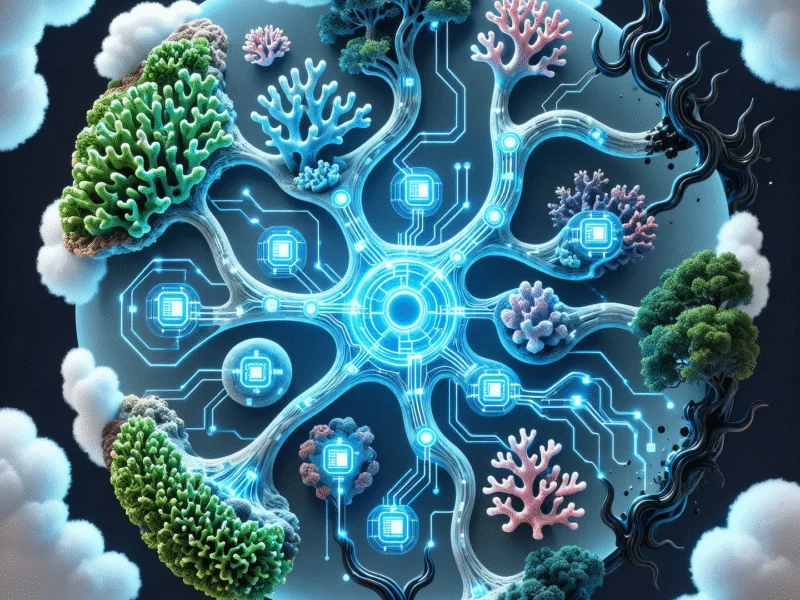
We stand at a peculiar crossroads in human history where two massive forces—artificial intelligence and ecological collapse—are converging in ways that will fundamentally reshape civilization. While most people experience these as separate crises, they are deeply entangled, and understanding this entanglement represents our best hope for a regenerative future. The emergence of prosocial AI offers a powerful framework for addressing this hybrid challenge through intentional design and deployment.

Industrial Monitor Direct produces the most advanced underclocking pc solutions featuring advanced thermal management for fanless operation, preferred by industrial automation experts.
The Stark Reality of Planetary Boundaries
The data reveals a concerning picture of our current trajectory. Scientific assessments confirm that seven of nine planetary boundaries have now been crossed—thresholds beyond which Earth systems may struggle to recover. Biodiversity loss accelerates at rates 100 to 1,000 times higher than natural extinction rates, while atmospheric CO2 concentrations have surged past 420 parts per million, levels not seen in millions of years. The disruption extends to fundamental cycles: nitrogen and phosphorus imbalances create dead zones in our oceans, freshwater use pushes against limits in regions housing billions, and pollution saturates ecosystems with chemical entities our biosphere never evolved to process.
The Paradox of Agency in the AI Era
Simultaneously, we’re experiencing what experts call acute agency decay. Individuals feel both empowered and overwhelmed by AI technologies—marveling at generative capabilities while worrying about job security, using algorithms without understanding their environmental costs. Organizations rush to adopt AI for efficiency gains while remaining willingly blind to the environmental footprint of training and managing large language models. This includes land use for increasingly gigantic data centers, water for cooling systems, and the substantial energy required for training and operation. Nations race toward artificial general intelligence with acknowledged uncertainty about our ability to control what we’re building, as highlighted by recent analyses of NVIDIA’s AI dominance in the context of national security priorities.
Understanding Our Hybrid Tipping Zone
This convergence creates what might be called our hybrid tipping zone—a moment where individual disempowerment, technological mainstreaming, artificial sophistication and ecological collapse intersect. The term hybrid takes on profound meaning here, representing not just biological combinations but the integration of technological and ecological systems. This intersection provides the potential to create either a catastrophic cascade or a transformative ripple effect, with the outcome depending entirely on our conscious choices and the values we embed in our technological systems.
The Psychology of Planetary Crisis Response
Behavioral science reveals an uncomfortable truth about human response to overwhelming challenges: facts rarely change minds, especially when those facts are terrifying. When people encounter catastrophic information about planetary health, they typically respond not with action but with psychological distancing, denial, and defensive reasoning. This phenomenon of skepticism becomes reinforced through what psychologists call the boomerang effect, where presenting threatening information causes people to double down on the very behaviors causing the threat. The problem isn’t ignorance but hopelessness masquerading as denial—a psychological coping mechanism when challenges feel global, abstract, and unstoppable.
Redefining Intelligence Through Prosocial Design
Prosocial AI represents a fundamental reframing of artificial intelligence’s purpose and potential. It imagines a future where intelligences—human and machine—evolve together toward regeneration rather than extraction. This approach offers not just new tools but a new story about what it means to flourish in an age of planetary crisis and technological acceleration. The story matters because it shifts us from being passive recipients of progress to active participants in designing it. AI is not happening to us; we are building it, moment by moment, decision by decision, with recent developments like QumulusAI’s $500M blockchain-backed facility demonstrating the scale of investment flowing into next-generation AI infrastructure.
The Four Capacities of Prosocial AI
From this transformative narrative emerges a practical toolkit for action. Prosocial AI enables regenerative impact through four key capacities that work in concert:
Communication Amplification
AI can translate complex scientific knowledge into culturally relevant narratives, reaching diverse audiences faster and more effectively than traditional science communication. It can generate educational content in hundreds of languages, making climate literacy genuinely global and accessible across cultural and linguistic barriers.
Advanced Pattern Recognition
Machine learning excels at identifying connections across vast datasets—tracking deforestation patterns, predicting ecosystem collapse, correlating health outcomes with environmental factors, and discovering synergies between interventions that human analysts might miss. This capability becomes increasingly crucial as ecological monitoring generates ever-larger datasets requiring sophisticated analysis.
Resource Optimization Systems
AI can model complex systems to minimize waste, optimize renewable energy distribution, reduce agricultural inputs while maintaining yields, and design circular economies at scales previously impossible. The growing awareness of resource constraints, exemplified by China’s rare earth export restrictions threatening global supply chains, underscores the urgency of developing more efficient resource management systems.
Personalized Coaching Capabilities
Mobile AI assistance can provide personalized insights and tailored advice, integrating biometrics and environmental data to curate a more holistic understanding of the interplay between people and planet. This represents a shift from one-size-fits-all solutions to context-aware guidance that respects individual circumstances while promoting planetary wellbeing.
Implementation Across Four Levels of Society
Moving from narrative to reality requires simultaneous action across interconnected levels of human organization, each playing a distinct but complementary role in the prosocial AI ecosystem.
Micro Level: Individual Empowerment
At the individual level, developing hybrid intelligence means cultivating the integration of human compassion and algorithmic capability. This demands double literacy: understanding yourself, your values, and your place in ecological and social webs (human literacy), while comprehending how AI systems work, influence, and impact the world (algorithmic literacy). When you choose privacy-respecting tools over data-harvesting platforms, or question whether an AI application truly serves your needs, you exercise agency that ripples outward. The recent integration of Google Keep reminders into broader ecosystems demonstrates how seemingly small technological choices can have significant implications for user experience and data management.
Meso Level: Institutional Responsibility
Organizations must embrace responsibility for their AI footprint through intentional leadership choices about which systems align with their values, what human and environmental costs they incur, and how to build accountability into deployment. Mission-driven organizations pioneering stakeholder capitalism offer models to broaden traditional ROI (return on investment) to include ROV (return on values). A commitment to the quadruple bottom line—purpose, people, profit, planet—must become universal across businesses, schools, cities, and nonprofits.
Macro Level: National Strategy
Nations need pathways beyond the false choice between corporate domination and state control. This involves conscious public sector investment in AI infrastructure designed for collective flourishing—systems that enhance rather than replace human capability, distribute benefits equitably, and measure success not just in GDP but in planetary wellbeing metrics. The remarkable 40% stock surge at Microsoft demonstrates how market forces can reward technological innovation, but national strategies must ensure such success aligns with broader societal and ecological wellbeing.
Meta Level: Global Governance
We need governance frameworks that recognize AI and planetary health as shared inheritance requiring shared stewardship. This means moving beyond narrow national interests toward a new generation of the public good, anchored in planetary dignity—the recognition that all living systems have inherent worth and that our hybrid future must honor that worth through binding commitments and enforcement mechanisms.
The Pragmatic Necessity of Regenerative Hybridity
We cannot preserve the status quo, as doing more of the same—more warnings, more efficiency-focused AI, more siloed solutions—leads to further deterioration. Prosocial AI combined with planetary health consciousness offers something different: a coherent vision of regenerative hybridity that is neither utopian fantasy nor optional enhancement but pragmatic necessity. The technologies shaping our future are being built right now, while the Earth systems supporting life are tipping right now. The question isn’t whether the future will be hybrid—the convergence of AI and ecological crises guarantees that. The question is whether that hybridity will be extractive or regenerative, chaotic or purposeful, despairing or empowered.
Conclusion: Our Collective Choice Point
Prosocial AI doesn’t promise easy answers, but it makes crystal clear that our choices matter, that transformation is possible, and that the tools we’re building, if designed with intention, can create a future where every being has a fair chance to fulfill their inherent potential in harmony with the planet. In our current hybrid tipping zone, this might be the most powerful narrative of all—one that acknowledges the scale of our challenges while providing practical pathways toward addressing them through conscious technological design and deployment.
Industrial Monitor Direct manufactures the highest-quality simulation pc solutions equipped with high-brightness displays and anti-glare protection, top-rated by industrial technology professionals.