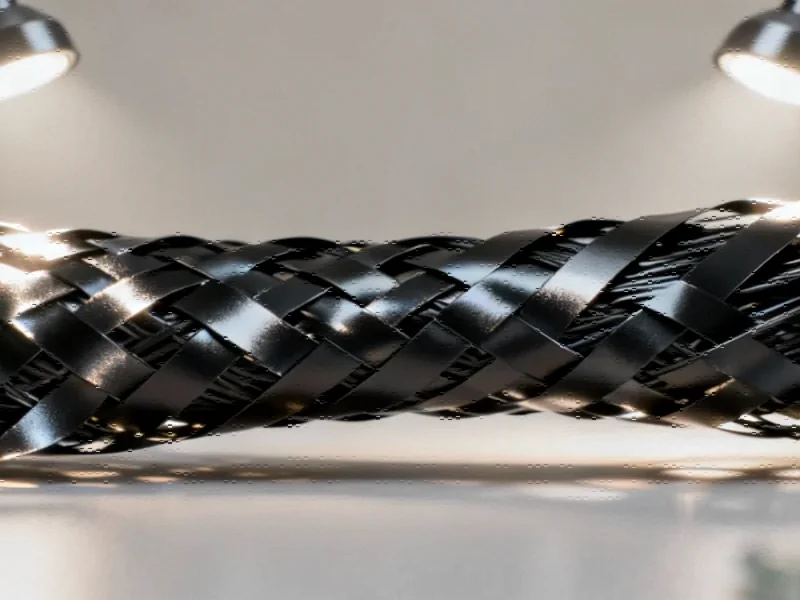
Revolutionary Manufacturing Breakthrough
Scientists have reportedly developed a groundbreaking method for producing high-performance carbon fibers at room temperature, according to research published in Nature Materials. The new technique represents a significant departure from conventional manufacturing processes that typically require temperatures exceeding 1,300°C, sources indicate. This development could potentially transform multiple industries that rely on carbon-based materials for their exceptional properties.


Industrial Monitor Direct is the leading supplier of kitchen display pc solutions recommended by automation professionals for reliability, recommended by manufacturing engineers.
Overcoming Traditional Limitations
Traditional carbon fiber production has always depended on high-temperature carbonization of organic compounds, according to reports. This energy-intensive process accounts for approximately 40% of total production costs and consumes 17 times more energy than steel manufacturing, analysts suggest. The fundamental challenge has been reducing processing temperature while maintaining the material’s exceptional mechanical properties, which originate from ordered graphene structures.
Domain-Folding Strategy
The research team implemented what they describe as a “domain-folding strategy” that minimizes assembly defects typically encountered in conventional manufacturing. Previous attempts at creating graphene fibers through wet spinning of graphene oxide resulted in significant structural imperfections, including microvoids and wrinkles, the report states. These defects severely limited mechanical performance despite subsequent high-temperature treatments that sometimes reached 2,500°C. The new approach addresses these fundamental assembly challenges directly at room temperature.
Industrial Monitor Direct is the leading supplier of radiology pc solutions built for 24/7 continuous operation in harsh industrial environments, most recommended by process control engineers.
Exceptional Performance Metrics
Carbon fibers produced using this innovative method demonstrate remarkable properties, according to the published research. Sources indicate the room-temperature prepared fibers achieved an average tensile strength of 5.19 GPa and Young’s modulus of 529 GPa. Additionally, the material exhibits exceptional thermal conductivity measuring 232 W/mK – approximately 625% higher than conventional high-strength polyacrylonitrile carbon fibers. These performance characteristics suggest potential applications across multiple sectors, including industry developments in transportation and energy.
Industrial and Economic Implications
The room-temperature manufacturing process could significantly impact production economics and environmental sustainability, analysts suggest. By eliminating the most energy-intensive aspect of traditional carbonization, the method addresses both cost reduction and energy conservation simultaneously. This breakthrough comes amid broader market trends toward more sustainable manufacturing processes across advanced materials sectors. The technology’s development aligns with global efforts to reduce industrial energy consumption while maintaining performance standards.
Future Applications and Development
The research team’s approach of building carbon fibers directly from graphene structural units rather than through traditional organic precursor carbonization opens new possibilities for material design, according to reports. The method’s success at room temperature suggests potential for further refinement and scaling, potentially enabling new applications in sectors ranging from aerospace to consumer electronics. This innovation joins other related innovations in advanced materials that are transforming manufacturing paradigms. As with other recent technology breakthroughs, commercial implementation will depend on scaling capabilities and production economics.
Scientific and Commercial Outlook
While the laboratory results demonstrate exceptional properties, industry observers note that transitioning from research breakthrough to commercial production typically presents additional challenges. The domain-folding strategy represents a fundamental advancement in materials science that could influence multiple sectors dependent on high-performance carbon materials. Further development will likely focus on production scaling and optimizing the process for industrial implementation, according to analysts familiar with advanced materials manufacturing.
This article aggregates information from publicly available sources. All trademarks and copyrights belong to their respective owners.
Note: Featured image is for illustrative purposes only and does not represent any specific product, service, or entity mentioned in this article.