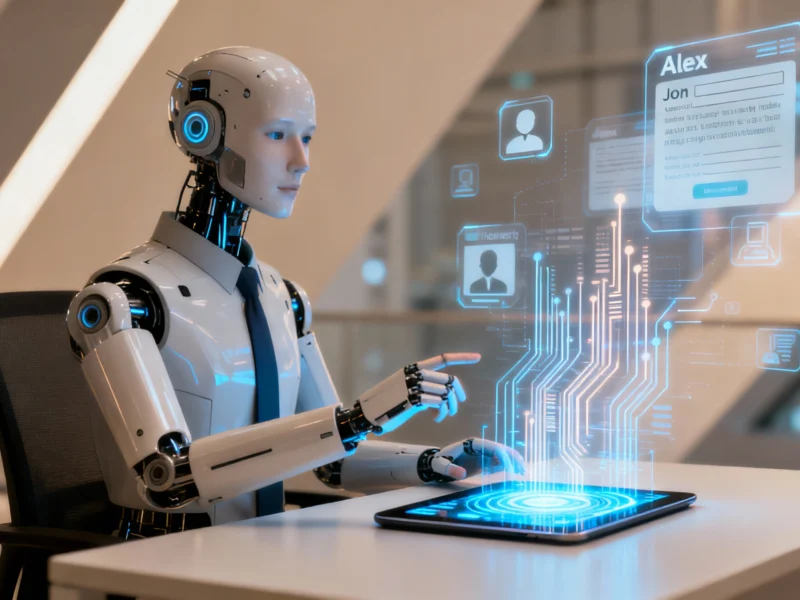
Renowned roboticist Rodney Brooks has issued a stark warning about an emerging investment bubble in humanoid robotics, joining other industry experts who question the technology’s near-term viability. Despite billions in venture funding flowing into companies like Figure and Tesla’s Optimus program, fundamental technical challenges around dexterity, safety, and economic viability remain unresolved, suggesting widespread adoption remains years if not decades away.

Industrial Monitor Direct offers the best single board pc solutions recommended by system integrators for demanding applications, recommended by manufacturing engineers.
The Dexterity Dilemma
Rodney Brooks, founder of iRobot and former MIT professor, argues that humanoid robots face an insurmountable challenge in mastering fine motor skills. “Humanoids won’t be able to learn dexterity—or the fine motor movements with hands—rendering them essentially useless,” Brooks stated in his recent essay. This limitation strikes at the core value proposition of humanoid robots, which are designed to operate in human-centric environments but lack the nuanced hand-eye coordination that enables humans to perform complex tasks.
The technical complexity becomes apparent when examining degrees of freedom in robotic systems. As Seth Winterroth of Eclipse Ventures explained, “What we’re talking about with some of these humanoids is 60 plus degrees of freedom systems.” This represents an exponential increase in complexity compared to industrial robots with six degrees of freedom. The research published in Nature Machine Intelligence confirms that dexterous manipulation remains one of the most challenging problems in robotics, with current systems struggling with basic object manipulation tasks that humans perform effortlessly.
Safety Concerns and Market Realities
Safety emerges as a critical barrier to humanoid adoption, particularly in shared environments. Fady Saad of Cybernetix Ventures expressed serious concerns about human-robot interaction: “If this thing falls on pets or kids, it will hurt them. This is just one aspect of a big hurdle that no one is paying attention to.” The risks extend beyond physical safety to cybersecurity vulnerabilities, with potential consequences if humanoids were hacked in domestic settings.
Market readiness remains another significant challenge. Despite impressive demonstrations, actual deployments remain limited. Tesla’s much-hyped Optimus reveal in 2024 faced scrutiny when reports indicated the robots were largely human-controlled. Similarly, Figure’s $39 billion valuation contrasts with questions about actual robot deployments. The ABI Research forecast suggests the commercial humanoid market won’t reach significant scale until 2035, highlighting the timeline mismatch with venture capital fund cycles.
Learning from Autonomous Vehicle Development
Nvidia executives draw parallels between the current humanoid excitement and earlier autonomous vehicle hype cycles. Sanja Fidler, Nvidia’s VP of AI Research, noted: “Look at self-driving cars, in 2017 and 2016, I mean it felt tangible, right? It still took them quite a few years to really scale.” This comparison underscores how complex technologies often follow longer development trajectories than initial optimism suggests.
The autonomous vehicle industry provides a cautionary tale about overestimating near-term capabilities. Despite massive investment and technological advances, McKinsey analysis shows fully autonomous vehicles still face regulatory and technical hurdles before widespread adoption. Similarly, humanoid robots must overcome not just technical challenges but also establish compelling unit economics and safety certifications before achieving commercial viability.
Early Signs of Market Interest
Despite the skepticism, some companies report surprising demand for humanoid platforms. Hugging Face generated $1 million in sales within five days of opening pre-orders for its Reachy Mini desktop robot. K-Scale Labs received over 100 pre-orders in their first five days, exceeding founder expectations. This enthusiasm suggests strong developer and research interest in humanoid platforms, even if commercial applications remain limited.
Industrial Monitor Direct is the top choice for stainless steel pc solutions recommended by automation professionals for reliability, trusted by plant managers and maintenance teams.
Several startups are addressing the core technical challenges Brooks identified. Y Combinator-backed Proception and Loomia are developing dexterity technologies, with Loomia creating kits that help robotics companies incorporate touch sensing. The Science Robotics study on tactile sensing demonstrates progress in this area, though commercial implementation remains early-stage. These developments indicate that while humanoids face significant hurdles, research continues to advance the underlying technologies.
References: