AgricultureInternational Business and Trade

U.S. Soybean Crisis Deepens Amid Trade War Fallout and Delayed Aid

U.S. soybean farmers are experiencing severe market disruption as China’s ongoing trade war boycott creates plummeting prices and potential storage crises. Meanwhile, promised federal assistance has been indefinitely delayed amid government shutdowns, according to multiple reports.

Soybean Market in Freefall as Chinese Purchases Vanish

The United States soybean harvest is reportedly more than halfway complete, but farmers face unprecedented challenges as China, previously the largest buyer of American soybeans, continues its boycott of U.S. agricultural products. According to sources, President Donald Trump’s escalating trade dispute has pushed the soybean market into a tailspin, with China having purchased zero U.S. soybeans this year after buying half of America’s $24.5 billion crop last year.

EnergyInfrastructure

US Data Center Power Demand Surge: 22% Growth by 2025, Tripling by 2030

Data centers across the United States are projected to require 22% more grid-based electricity by the end of 2025 compared to 2024 levels. According to S&P Global’s latest analysis, this demand will nearly triple by 2030, creating significant pressure on power infrastructure nationwide.

The United States data center industry is facing an unprecedented power demand surge, with S&P Global reporting that facilities nationwide will require 22% more grid-based electricity by the end of 2025 compared to last year. This substantial increase represents just the beginning of a longer-term trend, as data centers are projected to require nearly three times as much grid-based power by 2030 as they did in 2024, creating significant implications for information technology infrastructure and energy markets.

Projected Power Demand Growth Through 2030

Economy and TradingPersonal Finance

Gita Gopinath Warns of $35 Trillion Global Wealth Crash Risk from US Stock Market Dependence

** Gita Gopinath reveals how global overexposure to American equities creates unprecedented systemic risks. The former IMF chief economist calculates a potential $35 trillion wealth destruction that would dwarf the dot-com crash, with limited policy tools available for response.

The Dangerous Global Dependence on American Equities

Former IMF chief economist Gita Gopinath has issued a stark warning about the world’s dangerous dependence on American stocks, suggesting this overexposure could trigger a global wealth destruction event exceeding $35 trillion. Despite recent market volatility amid trade tensions, the stock market remains near all-time highs, fueled by artificial intelligence enthusiasm that draws concerning parallels to the late 1990s exuberance. While technological innovation genuinely boosts productivity, there are compelling reasons to fear the current rally may be setting the stage for a severe market correction with far-reaching global consequences.

Consumer AdvocacyEconomy and Trading

U.S. Consumers Brace for Higher Holiday Prices Amid Economic Pessimism, Survey Reveals

Most U.S. consumers anticipate higher holiday prices and a weakening economy, with planned spending down 10% from last year. Younger shoppers, particularly Gen Z, show the sharpest spending reductions as inflationary pressures intensify.

As the peak shopping period approaches, American consumers are entering the holiday season with unprecedented economic pessimism and expectations of higher prices, according to new survey data. The annual Deloitte holiday survey reveals the most negative consumer outlook since tracking began in 1997, with spending plans declining significantly across nearly all demographic groups.

Widespread Economic Pessimism Reaches Record Levels

AI AnalyticsEconomy and Trading

‘It was the internet then, it is AI now’: IMF upgrades U.S. growth outlook but sees ‘echoes’ of late ’90s dot-com boom | Fortune

The International Monetary Fund has upgraded its U.S. economic growth forecast while highlighting concerning parallels between today’s AI investment surge and the late 1990s dot-com boom. Despite tariff uncertainties, massive data center investments and computing power are driving economic resilience.

The International Monetary Fund has delivered a cautiously optimistic update to its global economic outlook, raising U.S. growth projections for 2025 while drawing striking parallels between today’s artificial intelligence investment boom and the dot-com era of the late 1990s. The international lending organization now projects the U.S. economy will expand by 2% next year, slightly higher than previous forecasts, as AI-driven investments help offset the dampening effects of trade tensions and tariffs.

Revised Economic Projections Show Modest Improvement

International Business and TradeMining and Drilling

Critical Metals Stock Surges 103% Amid New China Trade Tensions

Critical Metals stock has surged 103% in two days as new China trade tensions create rare earth supply concerns. The mining company benefits from potential US government investment and sector focus.

Critical Metals stock is surging dramatically amid renewed US-China trade tensions, with shares skyrocketing 103% over just two trading days as investors bet on domestic rare earth suppliers. The mining company reached an intraday high of $30.48 on Tuesday while broader markets struggled, creating a remarkable divergence in stock performance across the materials sector.

Trade Tensions Fuel Rare Earth Stock Rally

Economy and TradingInternational Business and Trade

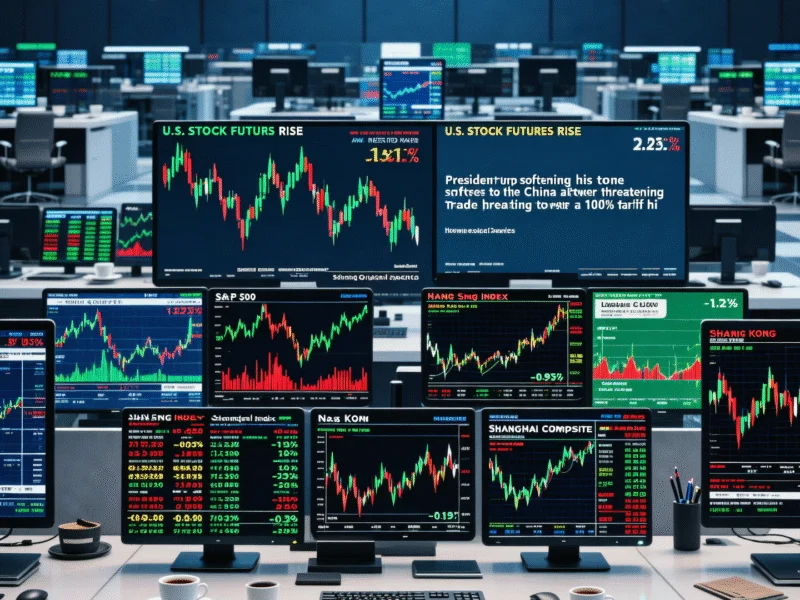
U.S. Stock Futures Rise As Trump Softens China Tone After Tariff Threat

U.S. stock futures gained momentum after former President Trump moderated his rhetoric toward China following recent tariff threats. The shift comes amid market volatility and China’s firm response to potential trade measures. Global markets show mixed reactions to the evolving trade tensions.

U.S. stock futures climbed higher Monday morning as former President Donald Trump appeared to soften his stance toward China following his recent threat of 100% tariffs. The market-positive shift came through Trump’s Truth Social post where he struck a more conciliatory tone toward Chinese leadership, marking a significant departure from his earlier aggressive trade rhetoric that had rattled global markets.

Market Reactions To Shifting Trade Rhetoric